 MAPS
Adapting a Musical
Summary
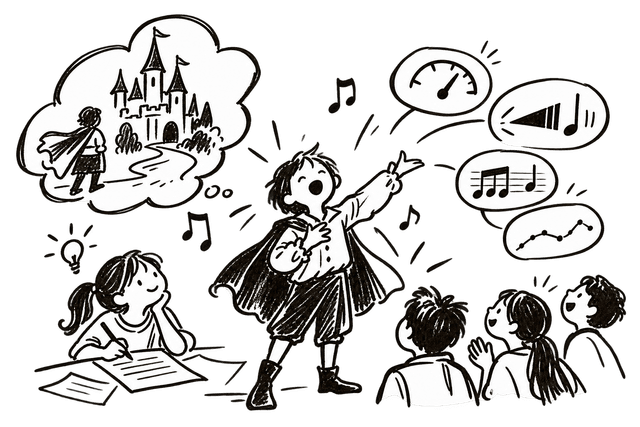
Students select a defining moment from a familiar story and explore weather that moment might be expressed through song rather than spoken dialogue. They identify the character’s dramatic purpose, create short lyrics, and make musical decisions about tempo, dynamics, register, rhythm, or texture. Students then perform or present a short musical number and explain how their musical choices support the story.
Procedures
- 1
Choose a defining moment from a familiar story in which a character experiences an important emotion, conflict, realization, or decision.
- 2
Discuss why this moment should become a song rather than remain spoken dialogue. Decide whether the song should reveal inner feelings, develop conflict, move the story forward, or communicate an important decision.
- 3
Identify who would sing in this moment and decide what the character most wants to express.
- 4
Write one central lyric that captures the character’s main thought or feeling, then expand it into approximately four to eight lines of lyrics.
- 5
Choose at least three musical features for the song, such as tempo, dynamics, register, rhythm, or texture, and explain why each choice fits the dramatic situation.
- 6
Turn the lyrics into a short musical number. Students may sing an original melody, improvise vocally, or use rhythmic speech with intentional musical expression.
- 7
Perform or present the musical number, then explain one musical choice and how it supports the character or dramatic moment.
- 8
Audience members identify one musical feature they heard and describe what it communicated about the character or story.
Variations
1. Choose a conflict between two characters and create a duet in which each character expresses a different perspective.
2. Create two different musical versions of the same scene and compare how the musical choices change the audience’s interpretation.
Activity Preparation
1. A story, novel excerpt, play, historical narrative, or other text familiar to students
2. Paper and pencil or digital writing tools
3. Optional keyboard, piano, guitar, or other instruments
4. Students should already understand the basic characters and plot of the selected story
5. For the advanced version, students should have prior experience with basic musical elements such as tempo, dynamics, register, rhythm, and texture
Activity Sources
- Source Type:
- Website / Online resource
- Source:
- Adapted from The Kennedy Center classroom resource Adapting a Musical, Grades 9–12.
- Adaptation Notes:
- The original lesson asks students to adapt a larger literary work into a musical. This activity isolates the “defining moment” and songwriting components and reorganizes them as a shorter, stand-alone classroom activity. Additional prompts were added to strengthen the connection between dramatic purpose and specific musical choices.
MAPS teaching activities may come from a variety of sources, including original contributions by the MAPS team, online resources, published materials, activities learned from teachers, activities shared by colleagues, traditional teaching practices, and other sources. When a source can be reasonably identified, we make every effort to acknowledge it on the relevant activity page or in the accompanying reference information.
Some content may be organized, translated, structured, or adapted by the MAPS team for specific teaching contexts. Such editorial or instructional adaptation does not mean that MAPS claims ownership of the underlying third-party material. Rights to third-party content remain with the original authors, publishers, or other lawful rights holders.
If you are an author, copyright holder, or authorized representative and have questions or concerns regarding the source, attribution, or use of any content, please contact us:
Email: musicactivityps@gmail.com
Adapting a Musical
Summary
Students select a defining moment from a familiar story and explore weather that moment might be expressed through song rather than spoken dialogue. They identify the character’s dramatic purpose, create short lyrics, and make musical decisions about tempo, dynamics, register, rhythm, or texture. Students then perform or present a short musical number and explain how their musical choices support the story.
Procedures
- 1
Choose a defining moment from a familiar story in which a character experiences an important emotion, conflict, realization, or decision.
- 2
Discuss why this moment should become a song rather than remain spoken dialogue. Decide whether the song should reveal inner feelings, develop conflict, move the story forward, or communicate an important decision.
- 3
Identify who would sing in this moment and decide what the character most wants to express.
- 4
Write one central lyric that captures the character’s main thought or feeling, then expand it into approximately four to eight lines of lyrics.
- 5
Choose at least three musical features for the song, such as tempo, dynamics, register, rhythm, or texture, and explain why each choice fits the dramatic situation.
- 6
Turn the lyrics into a short musical number. Students may sing an original melody, improvise vocally, or use rhythmic speech with intentional musical expression.
- 7
Perform or present the musical number, then explain one musical choice and how it supports the character or dramatic moment.
- 8
Audience members identify one musical feature they heard and describe what it communicated about the character or story.
Variations
1. Choose a conflict between two characters and create a duet in which each character expresses a different perspective.
2. Create two different musical versions of the same scene and compare how the musical choices change the audience’s interpretation.
Activity Preparation
1. A story, novel excerpt, play, historical narrative, or other text familiar to students
2. Paper and pencil or digital writing tools
3. Optional keyboard, piano, guitar, or other instruments
4. Students should already understand the basic characters and plot of the selected story
5. For the advanced version, students should have prior experience with basic musical elements such as tempo, dynamics, register, rhythm, and texture
Activity Sources
- Source Type:
- Website / Online resource
- Source:
- Adapted from The Kennedy Center classroom resource Adapting a Musical, Grades 9–12.
- Adaptation Notes:
- The original lesson asks students to adapt a larger literary work into a musical. This activity isolates the “defining moment” and songwriting components and reorganizes them as a shorter, stand-alone classroom activity. Additional prompts were added to strengthen the connection between dramatic purpose and specific musical choices.
MAPS teaching activities may come from a variety of sources, including original contributions by the MAPS team, online resources, published materials, activities learned from teachers, activities shared by colleagues, traditional teaching practices, and other sources. When a source can be reasonably identified, we make every effort to acknowledge it on the relevant activity page or in the accompanying reference information.
Some content may be organized, translated, structured, or adapted by the MAPS team for specific teaching contexts. Such editorial or instructional adaptation does not mean that MAPS claims ownership of the underlying third-party material. Rights to third-party content remain with the original authors, publishers, or other lawful rights holders.
If you are an author, copyright holder, or authorized representative and have questions or concerns regarding the source, attribution, or use of any content, please contact us:
Email: musicactivityps@gmail.com