 MAPS
Align with the Body, Not the Keys
Summary
Students learn to distinguish alignment from twisting, then apply the concept while blocking groups of two and three black keys. As they move across registers, they coordinate the hand, forearm, and torso to maintain alignment and avoid sideways bending at the wrist. The central cue is: “Align with the body, not the keys.”
Procedures
- 1
Learn alignment and twisting.
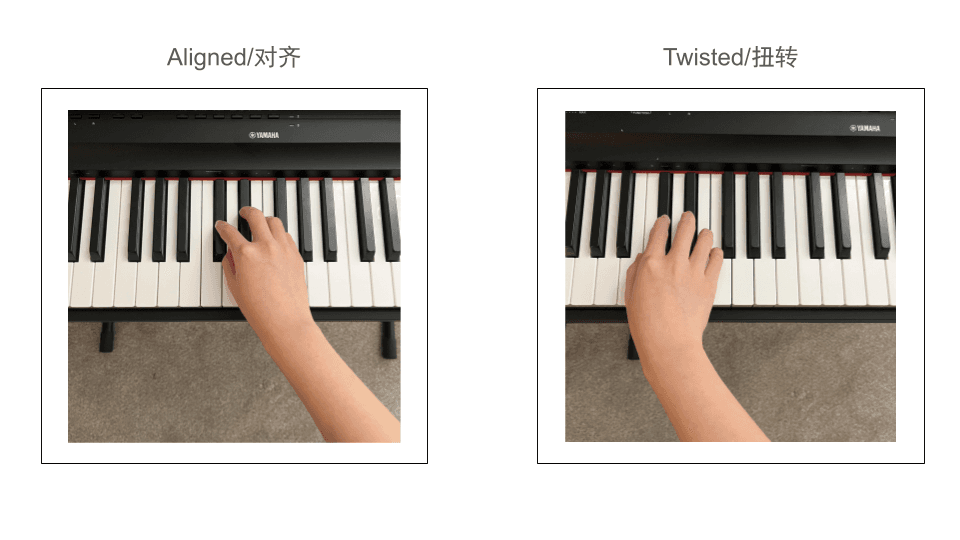
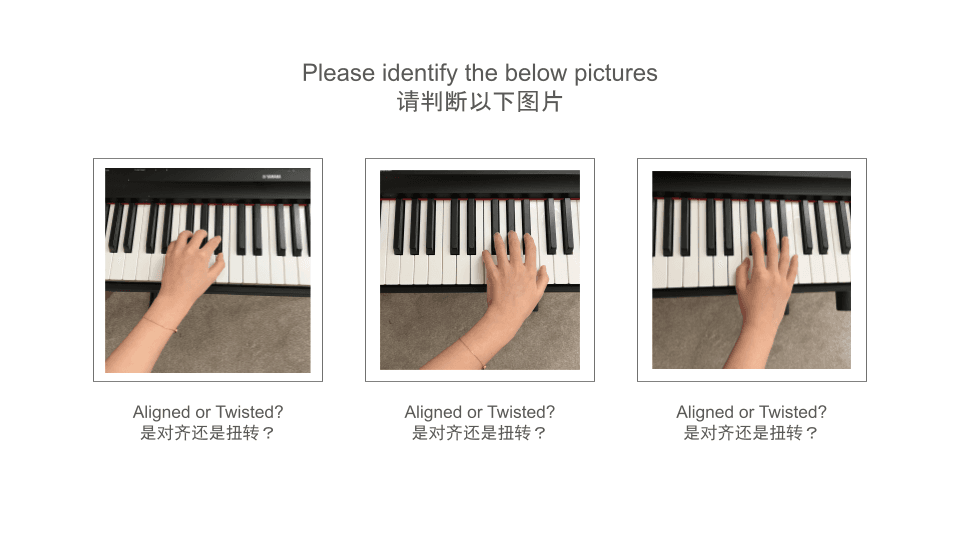
Introduce the difference between an aligned and a twisted position. In an aligned position, the hand and forearm remain naturally connected without a noticeable sideways bend at the wrist. In a twisted position, the hand bends sideways away from the forearm at the wrist.
- 2
Identify aligned or twisted.
Show several photos or demonstrations of different hand–forearm positions. Ask students to decide whether each example is aligned or twisted. Include examples in which the arm approaches the keyboard at an angle but the hand and forearm remain aligned.
- 3
Block the black-key groups.
Hands separately, have students block groups of two black keys and three black keys while moving through different registers of the keyboard. As the playing area changes, encourage students to shift the torso and arm with the hand so that alignment is maintained, rather than keeping the body fixed and bending the wrist sideways. Remind students: “Align with the body, not the keys.”
Activity Preparation
1. Piano or keyboard
2. Illustrations of alignment and twisting, or a live demonstration by the teacher.
Activity Sources
- Source Type:
- MAPS Original
MAPS teaching activities may come from a variety of sources, including original contributions by the MAPS team, online resources, published materials, activities learned from teachers, activities shared by colleagues, traditional teaching practices, and other sources. When a source can be reasonably identified, we make every effort to acknowledge it on the relevant activity page or in the accompanying reference information.
Some content may be organized, translated, structured, or adapted by the MAPS team for specific teaching contexts. Such editorial or instructional adaptation does not mean that MAPS claims ownership of the underlying third-party material. Rights to third-party content remain with the original authors, publishers, or other lawful rights holders.
If you are an author, copyright holder, or authorized representative and have questions or concerns regarding the source, attribution, or use of any content, please contact us:
Email: musicactivityps@gmail.com
Align with the Body, Not the Keys
Summary
Students learn to distinguish alignment from twisting, then apply the concept while blocking groups of two and three black keys. As they move across registers, they coordinate the hand, forearm, and torso to maintain alignment and avoid sideways bending at the wrist. The central cue is: “Align with the body, not the keys.”
Procedures
- 1
Learn alignment and twisting.
Introduce the difference between an aligned and a twisted position. In an aligned position, the hand and forearm remain naturally connected without a noticeable sideways bend at the wrist. In a twisted position, the hand bends sideways away from the forearm at the wrist.
- 2
Identify aligned or twisted.
Show several photos or demonstrations of different hand–forearm positions. Ask students to decide whether each example is aligned or twisted. Include examples in which the arm approaches the keyboard at an angle but the hand and forearm remain aligned.
- 3
Block the black-key groups.
Hands separately, have students block groups of two black keys and three black keys while moving through different registers of the keyboard. As the playing area changes, encourage students to shift the torso and arm with the hand so that alignment is maintained, rather than keeping the body fixed and bending the wrist sideways. Remind students: “Align with the body, not the keys.”
Activity Preparation
1. Piano or keyboard
2. Illustrations of alignment and twisting, or a live demonstration by the teacher.
Activity Sources
- Source Type:
- MAPS Original
MAPS teaching activities may come from a variety of sources, including original contributions by the MAPS team, online resources, published materials, activities learned from teachers, activities shared by colleagues, traditional teaching practices, and other sources. When a source can be reasonably identified, we make every effort to acknowledge it on the relevant activity page or in the accompanying reference information.
Some content may be organized, translated, structured, or adapted by the MAPS team for specific teaching contexts. Such editorial or instructional adaptation does not mean that MAPS claims ownership of the underlying third-party material. Rights to third-party content remain with the original authors, publishers, or other lawful rights holders.
If you are an author, copyright holder, or authorized representative and have questions or concerns regarding the source, attribution, or use of any content, please contact us:
Email: musicactivityps@gmail.com