 MAPS
Body Solfège Ladder
Summary
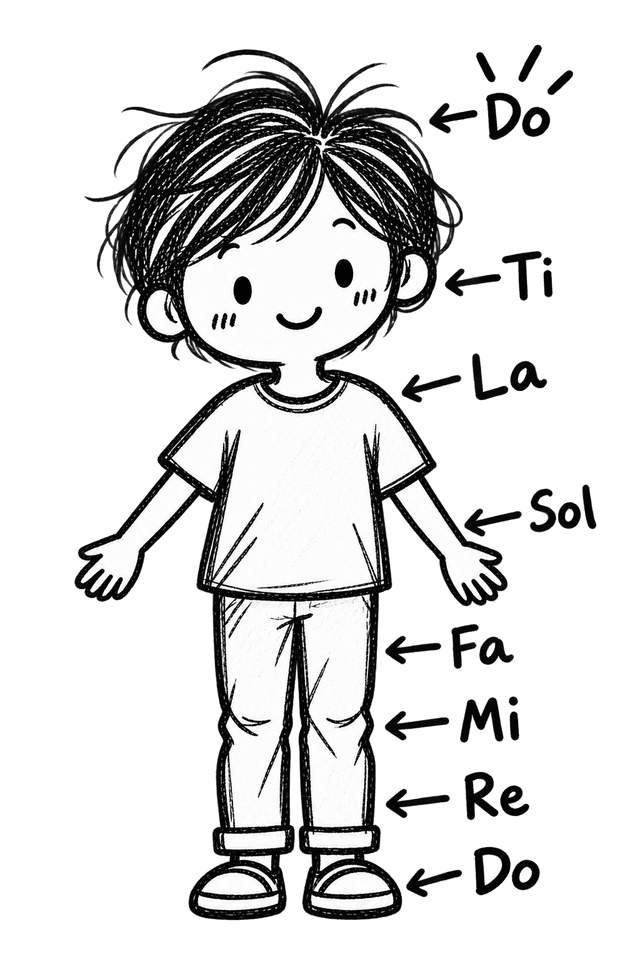
An embodied music activity that connects solfège, pitch, and body position while developing students’ pitch-matching accuracy. Students map Do–Re–Mi–Fa–Sol–La–Ti–Do onto a sequence of body positions from the feet to the top of the head. Through activities such as echoing the teacher while pointing to the corresponding body positions, and singing solfège in response to the teacher’s body-position cues, students reinforce solfège sequence, melodic direction, and pitch accuracy.
Procedures
- 1
Build the Body-Solfège Map: Introduce the body positions from low to high: Do—feet; Re—mid-calf; Mi—knees; Fa—mid-thigh; Sol—waist; La—shoulders; Ti—ear; high Do—top of the head. Sing each syllable while touching the corresponding position, and have students imitate.
- 2
Sing and Move Together: Lead the class through Do–Re–Mi–Fa–Sol–La–Ti–Do and back down again. Students sing while touching each body position in sequence, connecting higher pitch with higher body placement and lower pitch with lower body placement.
- 3
Teacher Sings, Students Echo and Point: Sing short solfège patterns such as Do–Mi–Sol, Sol–Fa–Mi–Re, or Do–Re–Mi–Fa. Students listen first, then echo the pattern while touching the matching body positions. Encourage them to match the teacher’s pitch as accurately as possible.
- 4
Teacher Points, Students Sing: Without singing, point to a sequence of body positions. Students interpret the visual cues and sing the corresponding solfège syllables and pitches. Begin with stepwise patterns, then introduce skips and changes of direction.
- 5
Refine Pitch Matching: Alternate between sung cues and silent pointing cues. Repeat patterns when needed and ask students to adjust until their sung pitches more closely match the teacher’s model. Gradually use longer or less predictable patterns as accuracy improves.
Variations
1. Five-Note Version: Begin with Do–Re–Mi–Fa–Sol only, then add La, Ti, and high Do as students become secure.
2. Student Leader: Invite a student to sing or point to a short pattern for the class to echo.
3. Longer Pattern Memory: Increase the number of notes in each pattern to add an aural-memory challenge while keeping the body mapping unchanged.
Activity Preparation
1.Provide enough open space for students to stand and touch the indicated body positions comfortably.
2.The teacher should choose a comfortable tonic and maintain a consistent tonal center while modeling the patterns.
3. Prior familiarity with basic solfège is helpful but not required.
Activity Sources
- Source Type:
- Learned from a teacher
- Source:
- Learned in Dr. Diana Dumlavwalla's Piano Pedagogy course
MAPS teaching activities may come from a variety of sources, including original contributions by the MAPS team, online resources, published materials, activities learned from teachers, activities shared by colleagues, traditional teaching practices, and other sources. When a source can be reasonably identified, we make every effort to acknowledge it on the relevant activity page or in the accompanying reference information.
Some content may be organized, translated, structured, or adapted by the MAPS team for specific teaching contexts. Such editorial or instructional adaptation does not mean that MAPS claims ownership of the underlying third-party material. Rights to third-party content remain with the original authors, publishers, or other lawful rights holders.
If you are an author, copyright holder, or authorized representative and have questions or concerns regarding the source, attribution, or use of any content, please contact us:
Email: musicactivityps@gmail.com
Body Solfège Ladder
Summary
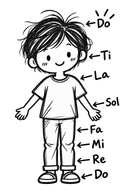
An embodied music activity that connects solfège, pitch, and body position while developing students’ pitch-matching accuracy. Students map Do–Re–Mi–Fa–Sol–La–Ti–Do onto a sequence of body positions from the feet to the top of the head. Through activities such as echoing the teacher while pointing to the corresponding body positions, and singing solfège in response to the teacher’s body-position cues, students reinforce solfège sequence, melodic direction, and pitch accuracy.
Procedures
- 1
Build the Body-Solfège Map: Introduce the body positions from low to high: Do—feet; Re—mid-calf; Mi—knees; Fa—mid-thigh; Sol—waist; La—shoulders; Ti—ear; high Do—top of the head. Sing each syllable while touching the corresponding position, and have students imitate.
- 2
Sing and Move Together: Lead the class through Do–Re–Mi–Fa–Sol–La–Ti–Do and back down again. Students sing while touching each body position in sequence, connecting higher pitch with higher body placement and lower pitch with lower body placement.
- 3
Teacher Sings, Students Echo and Point: Sing short solfège patterns such as Do–Mi–Sol, Sol–Fa–Mi–Re, or Do–Re–Mi–Fa. Students listen first, then echo the pattern while touching the matching body positions. Encourage them to match the teacher’s pitch as accurately as possible.
- 4
Teacher Points, Students Sing: Without singing, point to a sequence of body positions. Students interpret the visual cues and sing the corresponding solfège syllables and pitches. Begin with stepwise patterns, then introduce skips and changes of direction.
- 5
Refine Pitch Matching: Alternate between sung cues and silent pointing cues. Repeat patterns when needed and ask students to adjust until their sung pitches more closely match the teacher’s model. Gradually use longer or less predictable patterns as accuracy improves.
Variations
1. Five-Note Version: Begin with Do–Re–Mi–Fa–Sol only, then add La, Ti, and high Do as students become secure.
2. Student Leader: Invite a student to sing or point to a short pattern for the class to echo.
3. Longer Pattern Memory: Increase the number of notes in each pattern to add an aural-memory challenge while keeping the body mapping unchanged.
Activity Preparation
1.Provide enough open space for students to stand and touch the indicated body positions comfortably.
2.The teacher should choose a comfortable tonic and maintain a consistent tonal center while modeling the patterns.
3. Prior familiarity with basic solfège is helpful but not required.
Activity Sources
- Source Type:
- Learned from a teacher
- Source:
- Learned in Dr. Diana Dumlavwalla's Piano Pedagogy course
MAPS teaching activities may come from a variety of sources, including original contributions by the MAPS team, online resources, published materials, activities learned from teachers, activities shared by colleagues, traditional teaching practices, and other sources. When a source can be reasonably identified, we make every effort to acknowledge it on the relevant activity page or in the accompanying reference information.
Some content may be organized, translated, structured, or adapted by the MAPS team for specific teaching contexts. Such editorial or instructional adaptation does not mean that MAPS claims ownership of the underlying third-party material. Rights to third-party content remain with the original authors, publishers, or other lawful rights holders.
If you are an author, copyright holder, or authorized representative and have questions or concerns regarding the source, attribution, or use of any content, please contact us:
Email: musicactivityps@gmail.com