MAPS
Build a Dotted Note
Summary
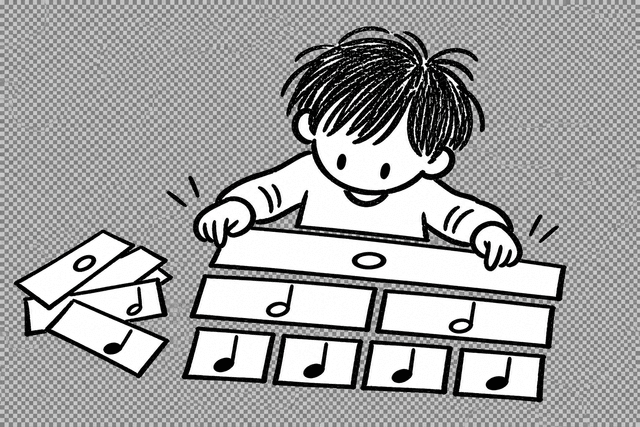
Students use proportionally sized duration strips to see how a dotted note is built from an original note value plus half of that value. They construct and deconstruct dotted quarter and dotted half notes, then connect the visual length to counting and physical holding so that dotted duration is understood as both notation and sound.
Procedures
- 1
Compare the duration strips. Show whole-, half-, quarter-, and eighth-note strips whose physical lengths are proportional to their note values. Ask students to compare the strips and notice, for example, that a half-note strip is twice as long as a quarter-note strip and a quarter-note strip is twice as long as an eighth-note strip.
- 2
Find half of the original value. Place a quarter-note strip on the table and ask, “What is half of a quarter note?” Students select the eighth-note strip and place it next to the quarter-note strip.
- 3
Build the dotted quarter note. Show the dotted-quarter-note symbol and explain that the dot adds half of the original note value. Align a dotted-quarter strip with the combined quarter + eighth strips so students can see that the total lengths match.
- 4
Repeat the same process with a half note. Students identify a quarter note as half of a half note, combine half + quarter, and match the result to a dotted-half-note strip.
- 5
Reverse the task. Give students a combined pair of strips, such as quarter + eighth or half + quarter, and ask them to identify the matching dotted note. Then give a dotted-note strip and ask students to separate it into the original value and half of that value.
- 6
Feel the full duration through counting and holding. For a dotted quarter note, students say “one and two and,” press or clap on “one,” keep the hand held through “one-and-two,” and release exactly on the “and” after beat 2, showing a duration of one and a half beats. For a dotted half note in 4/4, students count “1-2-3-4,” press or clap on beat 1, hold through beats 1-2-3, and release immediately as beat 4 begins.
- 7
Mix the representations. Randomly show a duration strip, a dotted-note symbol, or a counting pattern. Students identify the matching representations and explain how the original value and its half combine to create the dotted note.
Variations
1. Missing Piece: Show an incomplete relationship such as quarter + ? = dotted quarter or half + ? = dotted half. Students choose the missing duration strip and explain why it represents half of the original value.
2. Human Duration Bars: Give students note-value cards and have them stand in a line to represent the components of a dotted note. For example, one student holds a quarter-note card and another an eighth-note card; a third student holds the dotted-quarter card and checks that the two-part combination represents the same total duration.
3. Which One Is Wrong?: Present a correct and an incorrect combination, such as half + quarter = dotted half and half + eighth = dotted half. Students identify the incorrect example and explain the error using the “original value + half” rule.
4. Dot Builder Challenge: In pairs or small groups, give students a target dotted note. They must find the original-note strip, the strip that represents half of it, and the matching dotted-note strip, then perform the duration with counting and holding before the answer is accepted.
5. Extension for More Advanced Students: Add dotted eighth and dotted whole notes using the same process. Keep the strip lengths proportional so students can generalize the rule rather than memorize separate beat values.
Activity Preparation
1. Materials
a. A set of proportionally sized duration strips or rhythm bars for whole, half, quarter, and eighth notes. The physical length of each strip must accurately represent its relative duration; for example, a half-note strip should be twice the length of a quarter-note strip, and a quarter-note strip twice the length of an eighth-note strip.
b. Matching dotted-note strips, especially dotted quarter and dotted half, made to the same scale so they can be aligned directly with the combined component strips.
c. Separate printed note-symbol cards for whole, half, quarter, eighth, dotted quarter, and dotted half notes.
d. A flat table, floor space, magnetic board, or other surface where strips can be placed side by side and aligned clearly.
e. Optional: piano/keyboard or another instrument for transferring the duration into performance.
2. Prior Knowledge
a. Students should know the basic values of whole, half, quarter, and eighth notes in a familiar meter.
b. Students should understand that a larger note value can be divided into two equal smaller values, such as half note = two quarter notes and quarter note = two eighth notes.
c. Students should be able to maintain a simple steady count; for dotted-quarter practice, subdivision with “one and two and” should be familiar or briefly introduced.
3. Teacher Setup
a. Prepare enough duration strips for students to manipulate independently or in pairs.
b. Check the strip proportions before class. The activity depends on the visual lengths being accurate; equal-sized flashcards should not be used in place of proportional strips.
c. Begin with dotted quarter and dotted half notes. Introduce dotted eighth or dotted whole notes only as an extension after the core relationship is secure.
d. Arrange the strips so that students can physically place “original value + half of the original value” next to the matching dotted-note strip.
Activity Sources
- Source Type:
- MAPS Original
- Adaptation Notes:
- Developed as a hands-on activity using proportional duration strips and physical holding to make the mathematical and temporal relationship of dotted notes visible and performable.
MAPS teaching activities may come from a variety of sources, including original contributions by the MAPS team, online resources, published materials, activities learned from teachers, activities shared by colleagues, traditional teaching practices, and other sources. When a source can be reasonably identified, we make every effort to acknowledge it on the relevant activity page or in the accompanying reference information.
Some content may be organized, translated, structured, or adapted by the MAPS team for specific teaching contexts. Such editorial or instructional adaptation does not mean that MAPS claims ownership of the underlying third-party material. Rights to third-party content remain with the original authors, publishers, or other lawful rights holders.
If you are an author, copyright holder, or authorized representative and have questions or concerns regarding the source, attribution, or use of any content, please contact us:
Email: musicactivityps@gmail.com
Build a Dotted Note
Summary
Students use proportionally sized duration strips to see how a dotted note is built from an original note value plus half of that value. They construct and deconstruct dotted quarter and dotted half notes, then connect the visual length to counting and physical holding so that dotted duration is understood as both notation and sound.
Procedures
- 1
Compare the duration strips. Show whole-, half-, quarter-, and eighth-note strips whose physical lengths are proportional to their note values. Ask students to compare the strips and notice, for example, that a half-note strip is twice as long as a quarter-note strip and a quarter-note strip is twice as long as an eighth-note strip.
- 2
Find half of the original value. Place a quarter-note strip on the table and ask, “What is half of a quarter note?” Students select the eighth-note strip and place it next to the quarter-note strip.
- 3
Build the dotted quarter note. Show the dotted-quarter-note symbol and explain that the dot adds half of the original note value. Align a dotted-quarter strip with the combined quarter + eighth strips so students can see that the total lengths match.
- 4
Repeat the same process with a half note. Students identify a quarter note as half of a half note, combine half + quarter, and match the result to a dotted-half-note strip.
- 5
Reverse the task. Give students a combined pair of strips, such as quarter + eighth or half + quarter, and ask them to identify the matching dotted note. Then give a dotted-note strip and ask students to separate it into the original value and half of that value.
- 6
Feel the full duration through counting and holding. For a dotted quarter note, students say “one and two and,” press or clap on “one,” keep the hand held through “one-and-two,” and release exactly on the “and” after beat 2, showing a duration of one and a half beats. For a dotted half note in 4/4, students count “1-2-3-4,” press or clap on beat 1, hold through beats 1-2-3, and release immediately as beat 4 begins.
- 7
Mix the representations. Randomly show a duration strip, a dotted-note symbol, or a counting pattern. Students identify the matching representations and explain how the original value and its half combine to create the dotted note.
Variations
1. Missing Piece: Show an incomplete relationship such as quarter + ? = dotted quarter or half + ? = dotted half. Students choose the missing duration strip and explain why it represents half of the original value.
2. Human Duration Bars: Give students note-value cards and have them stand in a line to represent the components of a dotted note. For example, one student holds a quarter-note card and another an eighth-note card; a third student holds the dotted-quarter card and checks that the two-part combination represents the same total duration.
3. Which One Is Wrong?: Present a correct and an incorrect combination, such as half + quarter = dotted half and half + eighth = dotted half. Students identify the incorrect example and explain the error using the “original value + half” rule.
4. Dot Builder Challenge: In pairs or small groups, give students a target dotted note. They must find the original-note strip, the strip that represents half of it, and the matching dotted-note strip, then perform the duration with counting and holding before the answer is accepted.
5. Extension for More Advanced Students: Add dotted eighth and dotted whole notes using the same process. Keep the strip lengths proportional so students can generalize the rule rather than memorize separate beat values.
Activity Preparation
1. Materials
a. A set of proportionally sized duration strips or rhythm bars for whole, half, quarter, and eighth notes. The physical length of each strip must accurately represent its relative duration; for example, a half-note strip should be twice the length of a quarter-note strip, and a quarter-note strip twice the length of an eighth-note strip.
b. Matching dotted-note strips, especially dotted quarter and dotted half, made to the same scale so they can be aligned directly with the combined component strips.
c. Separate printed note-symbol cards for whole, half, quarter, eighth, dotted quarter, and dotted half notes.
d. A flat table, floor space, magnetic board, or other surface where strips can be placed side by side and aligned clearly.
e. Optional: piano/keyboard or another instrument for transferring the duration into performance.
2. Prior Knowledge
a. Students should know the basic values of whole, half, quarter, and eighth notes in a familiar meter.
b. Students should understand that a larger note value can be divided into two equal smaller values, such as half note = two quarter notes and quarter note = two eighth notes.
c. Students should be able to maintain a simple steady count; for dotted-quarter practice, subdivision with “one and two and” should be familiar or briefly introduced.
3. Teacher Setup
a. Prepare enough duration strips for students to manipulate independently or in pairs.
b. Check the strip proportions before class. The activity depends on the visual lengths being accurate; equal-sized flashcards should not be used in place of proportional strips.
c. Begin with dotted quarter and dotted half notes. Introduce dotted eighth or dotted whole notes only as an extension after the core relationship is secure.
d. Arrange the strips so that students can physically place “original value + half of the original value” next to the matching dotted-note strip.
Activity Sources
- Source Type:
- MAPS Original
- Adaptation Notes:
- Developed as a hands-on activity using proportional duration strips and physical holding to make the mathematical and temporal relationship of dotted notes visible and performable.
MAPS teaching activities may come from a variety of sources, including original contributions by the MAPS team, online resources, published materials, activities learned from teachers, activities shared by colleagues, traditional teaching practices, and other sources. When a source can be reasonably identified, we make every effort to acknowledge it on the relevant activity page or in the accompanying reference information.
Some content may be organized, translated, structured, or adapted by the MAPS team for specific teaching contexts. Such editorial or instructional adaptation does not mean that MAPS claims ownership of the underlying third-party material. Rights to third-party content remain with the original authors, publishers, or other lawful rights holders.
If you are an author, copyright holder, or authorized representative and have questions or concerns regarding the source, attribution, or use of any content, please contact us:
Email: musicactivityps@gmail.com