MAPS
Build-a-Trombone: Exploring Pitch
Summary
Students build and operate a simple homemade “trombone” to change the length of the air column and listen for changes in pitch. Before conducting the experiment, students develop a hypothesis and make predictions about the relationship between air-column length and pitch. Working in groups of four, they test the instrument, record data, and compare their results. Through this hands-on investigation, students develop an understanding of how air-column length affects pitch in brass instruments while also practicing basic scientific inquiry skills.
Procedures
- 1
Review Key Vocabulary
The teacher begins by reviewing air column and mouthpiece, making sure students understand that both concepts are related to sound production in brass instruments.
- 2
Pose the Question and Make a Prediction
The teacher asks: “What happens to the pitch when the air column becomes longer or shorter?” Each student first writes an individual hypothesis and completes the prediction sentence: “If our hypothesis is correct, then the pitch should be higher/lower when the air column is longer/shorter.”
- 3
Form Groups of Four and Assign Roles
Students work in groups of four, with each student taking one role: recorder, group leader, adjuster, or tester. Group members share their hypotheses and select one hypothesis and one prediction to test as a group.
- 4
Build and Prepare the Simple Trombone Model
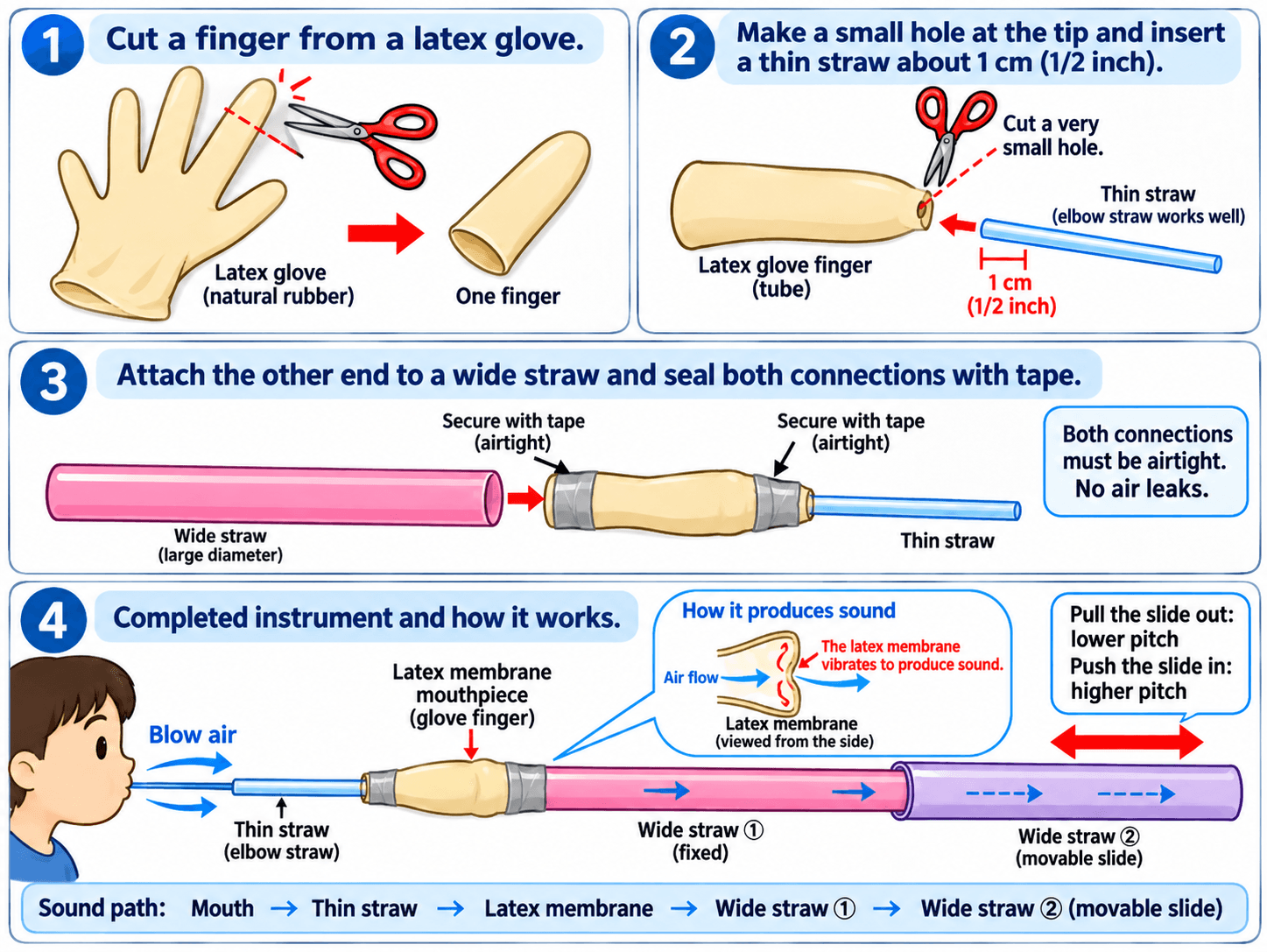
a. Prepare two straws of different diameters that can fit inside one another, with the wider straw serving as the movable outer tube. Cut a slit lengthwise along the wider straw so that it can fit around the narrower straw. b. Place the wider straw around the sound-producing tube and secure it along the lengthwise opening with tape so that it keeps its tube shape without becoming too tight. c. Check that the outer tube can slide smoothly back and forth over the inner tube. Pulling it outward lengthens the air passage, while pushing it inward shortens it. Check the connections and minimize air leakage, since leaks may affect sound production. d. Students blow into the device while slowly pulling the outer tube outward or pushing it inward, listening for changes in pitch as the air-column length changes.
- 5
Change the Air-Column Length and Conduct the Test
The tester blows into the instrument while the adjuster changes the length of the air column. Students compare the sounds produced with longer and shorter air columns and determine whether the pitch changes.
- 6
Record the Experimental Data
The recorder documents the results of each test in a data table, and the group checks the entries together for accuracy.
- 7
Compare the Results with the Original Prediction
The group revisits its original hypothesis and prediction, discusses whether the experimental results support the initial idea, and summarizes the relationship between air-column length and pitch.
- 8
Share and Summarize as a Class
Each group shares its hypothesis, experimental results, and conclusion. The teacher guides students in comparing results across groups and helps them connect the experiment to pitch changes in real brass instruments.
Variations
For younger students, the activity can be simplified to an oral prediction such as whether the pitch will become higher or lower when the air column gets longer. Older students can test several different air-column lengths and record the results for comparison.
Activity Preparation
Students work in groups of four with assigned roles. Whenever possible, the same student should do the blowing throughout the experiment, so that the primary variable being changed is the length of the air column. If students share a mouthpiece, it should be cleaned and disinfected appropriately between users.
Activity Sources
- Source Type:
- Website / Online resource
- Source:
- Adapted from an online teaching resource from the Kennedy Center; the homemade trombone construction section was supplemented and organized with reference to an online activity resource from the Smithsonian Latino Center. https://www.kennedy-center.org/education/resources-for-educators/classroom-resources/lessons-and-activities/lessons/3-5/brass-instruments-and-pitch/
MAPS teaching activities may come from a variety of sources, including original contributions by the MAPS team, online resources, published materials, activities learned from teachers, activities shared by colleagues, traditional teaching practices, and other sources. When a source can be reasonably identified, we make every effort to acknowledge it on the relevant activity page or in the accompanying reference information.
Some content may be organized, translated, structured, or adapted by the MAPS team for specific teaching contexts. Such editorial or instructional adaptation does not mean that MAPS claims ownership of the underlying third-party material. Rights to third-party content remain with the original authors, publishers, or other lawful rights holders.
If you are an author, copyright holder, or authorized representative and have questions or concerns regarding the source, attribution, or use of any content, please contact us:
Email: musicactivityps@gmail.com
Build-a-Trombone: Exploring Pitch
Summary
Students build and operate a simple homemade “trombone” to change the length of the air column and listen for changes in pitch. Before conducting the experiment, students develop a hypothesis and make predictions about the relationship between air-column length and pitch. Working in groups of four, they test the instrument, record data, and compare their results. Through this hands-on investigation, students develop an understanding of how air-column length affects pitch in brass instruments while also practicing basic scientific inquiry skills.
Procedures
- 1
Review Key Vocabulary
The teacher begins by reviewing air column and mouthpiece, making sure students understand that both concepts are related to sound production in brass instruments.
- 2
Pose the Question and Make a Prediction
The teacher asks: “What happens to the pitch when the air column becomes longer or shorter?” Each student first writes an individual hypothesis and completes the prediction sentence: “If our hypothesis is correct, then the pitch should be higher/lower when the air column is longer/shorter.”
- 3
Form Groups of Four and Assign Roles
Students work in groups of four, with each student taking one role: recorder, group leader, adjuster, or tester. Group members share their hypotheses and select one hypothesis and one prediction to test as a group.
- 4
Build and Prepare the Simple Trombone Model
a. Prepare two straws of different diameters that can fit inside one another, with the wider straw serving as the movable outer tube. Cut a slit lengthwise along the wider straw so that it can fit around the narrower straw. b. Place the wider straw around the sound-producing tube and secure it along the lengthwise opening with tape so that it keeps its tube shape without becoming too tight. c. Check that the outer tube can slide smoothly back and forth over the inner tube. Pulling it outward lengthens the air passage, while pushing it inward shortens it. Check the connections and minimize air leakage, since leaks may affect sound production. d. Students blow into the device while slowly pulling the outer tube outward or pushing it inward, listening for changes in pitch as the air-column length changes.
- 5
Change the Air-Column Length and Conduct the Test
The tester blows into the instrument while the adjuster changes the length of the air column. Students compare the sounds produced with longer and shorter air columns and determine whether the pitch changes.
- 6
Record the Experimental Data
The recorder documents the results of each test in a data table, and the group checks the entries together for accuracy.
- 7
Compare the Results with the Original Prediction
The group revisits its original hypothesis and prediction, discusses whether the experimental results support the initial idea, and summarizes the relationship between air-column length and pitch.
- 8
Share and Summarize as a Class
Each group shares its hypothesis, experimental results, and conclusion. The teacher guides students in comparing results across groups and helps them connect the experiment to pitch changes in real brass instruments.
Variations
For younger students, the activity can be simplified to an oral prediction such as whether the pitch will become higher or lower when the air column gets longer. Older students can test several different air-column lengths and record the results for comparison.
Activity Preparation
Students work in groups of four with assigned roles. Whenever possible, the same student should do the blowing throughout the experiment, so that the primary variable being changed is the length of the air column. If students share a mouthpiece, it should be cleaned and disinfected appropriately between users.
Activity Sources
- Source Type:
- Website / Online resource
- Source:
- Adapted from an online teaching resource from the Kennedy Center; the homemade trombone construction section was supplemented and organized with reference to an online activity resource from the Smithsonian Latino Center. https://www.kennedy-center.org/education/resources-for-educators/classroom-resources/lessons-and-activities/lessons/3-5/brass-instruments-and-pitch/
MAPS teaching activities may come from a variety of sources, including original contributions by the MAPS team, online resources, published materials, activities learned from teachers, activities shared by colleagues, traditional teaching practices, and other sources. When a source can be reasonably identified, we make every effort to acknowledge it on the relevant activity page or in the accompanying reference information.
Some content may be organized, translated, structured, or adapted by the MAPS team for specific teaching contexts. Such editorial or instructional adaptation does not mean that MAPS claims ownership of the underlying third-party material. Rights to third-party content remain with the original authors, publishers, or other lawful rights holders.
If you are an author, copyright holder, or authorized representative and have questions or concerns regarding the source, attribution, or use of any content, please contact us:
Email: musicactivityps@gmail.com