 MAPS
Building Two-Part Harmony Through Canon — *Frère Jacques*
Summary
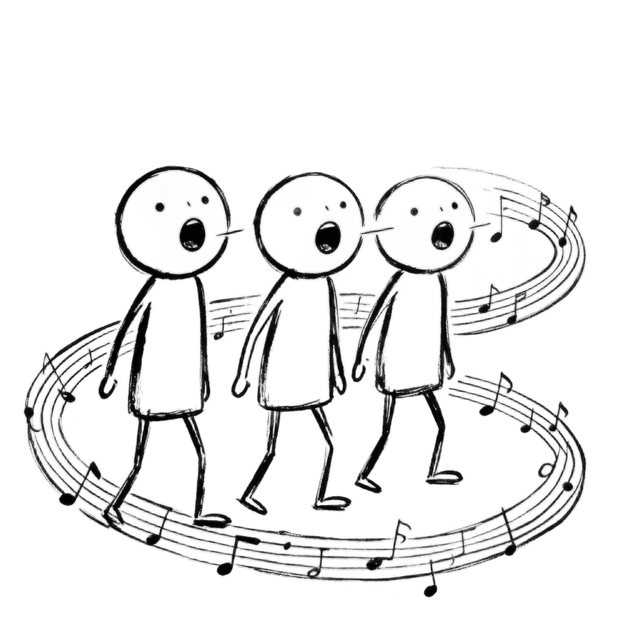
Students learn to sing *Frère Jacques* using solfège and Curwen hand signs. After preparing with a “switch-and-relay” singing activity, they move into a canon with staggered group entrances to experience two-part harmony. Students practice listening to the other part while maintaining their own, and eventually perform the canon in small groups and in pairs.
Procedures
- 1
Learn and sing the complete melody using solfège syllables and Curwen hand signs.
- 2
Sing while keeping a steady beat to establish a consistent tempo.
- 3
Switch-and-Relay Singing: Divide the class into two groups and have them alternate singing one phrase at a time, developing attentive listening between groups.
- 4
Divide the class into two concentric circles. The second group enters two measures later than the first.
- 5
Sing the two parts softly, maintaining accurate pitch and a steady tempo even while hearing the other part.
- 6
Switch parts, then sing with eyes closed and rely only on the teacher’s hand gesture for the entrance cue.
- 7
In groups of 4–6 students, choose an entrance point, practice the canon, and give one another feedback and corrections.
- 8
Perform in pairs and use intonation, tempo, and blend as criteria for peer feedback.
Variations
1. Classroom Management: Use a silent hand signal to quiet the class at any moment and floor dots to anchor standing positions.
2. Difficulty Adjustments: Easier—delay entry by four bars or hum the second voice on a neutral syllable; harder—add an upper-fifth voice to form a three-part canon.
3. Extensions: Add a sustained do–so drone under the round; transfer the canon process to other well-known rounds.
Activity Preparation
Melody chart, Curwen hand-sign poster, piano, floor-dot markers.
Activity Sources
- Source Type:
- Website / Online resource
- Source:
- (https://zy.gdedu.gov.cn/studio/index.php?r=studio/post/view&sid=945&id=13557) Referenced: hand-sign-supported part-singing drills, the "relay singing" introduction, and the "Two Tigers" two-group round design.
- Adaptation Notes:
- Activity is built on the public Kodály practice article; arrangement and grade level adapted for Chinese elementary classes.
MAPS teaching activities may come from a variety of sources, including original contributions by the MAPS team, online resources, published materials, activities learned from teachers, activities shared by colleagues, traditional teaching practices, and other sources. When a source can be reasonably identified, we make every effort to acknowledge it on the relevant activity page or in the accompanying reference information.
Some content may be organized, translated, structured, or adapted by the MAPS team for specific teaching contexts. Such editorial or instructional adaptation does not mean that MAPS claims ownership of the underlying third-party material. Rights to third-party content remain with the original authors, publishers, or other lawful rights holders.
If you are an author, copyright holder, or authorized representative and have questions or concerns regarding the source, attribution, or use of any content, please contact us:
Email: musicactivityps@gmail.com
Building Two-Part Harmony Through Canon — *Frère Jacques*
Summary
Students learn to sing *Frère Jacques* using solfège and Curwen hand signs. After preparing with a “switch-and-relay” singing activity, they move into a canon with staggered group entrances to experience two-part harmony. Students practice listening to the other part while maintaining their own, and eventually perform the canon in small groups and in pairs.
Procedures
- 1
Learn and sing the complete melody using solfège syllables and Curwen hand signs.
- 2
Sing while keeping a steady beat to establish a consistent tempo.
- 3
Switch-and-Relay Singing: Divide the class into two groups and have them alternate singing one phrase at a time, developing attentive listening between groups.
- 4
Divide the class into two concentric circles. The second group enters two measures later than the first.
- 5
Sing the two parts softly, maintaining accurate pitch and a steady tempo even while hearing the other part.
- 6
Switch parts, then sing with eyes closed and rely only on the teacher’s hand gesture for the entrance cue.
- 7
In groups of 4–6 students, choose an entrance point, practice the canon, and give one another feedback and corrections.
- 8
Perform in pairs and use intonation, tempo, and blend as criteria for peer feedback.
Variations
1. Classroom Management: Use a silent hand signal to quiet the class at any moment and floor dots to anchor standing positions.
2. Difficulty Adjustments: Easier—delay entry by four bars or hum the second voice on a neutral syllable; harder—add an upper-fifth voice to form a three-part canon.
3. Extensions: Add a sustained do–so drone under the round; transfer the canon process to other well-known rounds.
Activity Preparation
Melody chart, Curwen hand-sign poster, piano, floor-dot markers.
Activity Sources
- Source Type:
- Website / Online resource
- Source:
- (https://zy.gdedu.gov.cn/studio/index.php?r=studio/post/view&sid=945&id=13557) Referenced: hand-sign-supported part-singing drills, the "relay singing" introduction, and the "Two Tigers" two-group round design.
- Adaptation Notes:
- Activity is built on the public Kodály practice article; arrangement and grade level adapted for Chinese elementary classes.
MAPS teaching activities may come from a variety of sources, including original contributions by the MAPS team, online resources, published materials, activities learned from teachers, activities shared by colleagues, traditional teaching practices, and other sources. When a source can be reasonably identified, we make every effort to acknowledge it on the relevant activity page or in the accompanying reference information.
Some content may be organized, translated, structured, or adapted by the MAPS team for specific teaching contexts. Such editorial or instructional adaptation does not mean that MAPS claims ownership of the underlying third-party material. Rights to third-party content remain with the original authors, publishers, or other lawful rights holders.
If you are an author, copyright holder, or authorized representative and have questions or concerns regarding the source, attribution, or use of any content, please contact us:
Email: musicactivityps@gmail.com