MAPS
Clappers and Hand Signs: Four Ways to Level Up
Summary
Based on Akiko Yamamoto's workshop video: students learn song Tea-Picking (采茶歌), then play it four ways in rising difficulty — clapping hands to the beat, pair castanets with one plate each, group castanets following the teacher's hand signs, and passing a rhythm around the circle — finishing all four levels in one run.
Procedures
- 1
Learn the Tea-Picking Song (3 minutes): Listen to the song twice. During the second listening, have the whole class hum along softly. Introduce the goal: “We’re going to play with this song in four different ways. Each one is a new challenge, and Challenge 4 is the hardest.”
- 2
Challenge 1: Partner Clapping (4 minutes): Have the class sit in a circle. While singing, clap both hands together once on every beat. Practice first without the song using the cue: “One clap on every beat—where the hands land is where the sound happens.” Once the beat is steady, students face a partner across from them and use a classic partner-clapping pattern: clap their own hands once, then clap their partner’s hands once, continuing in alternation.
- 3
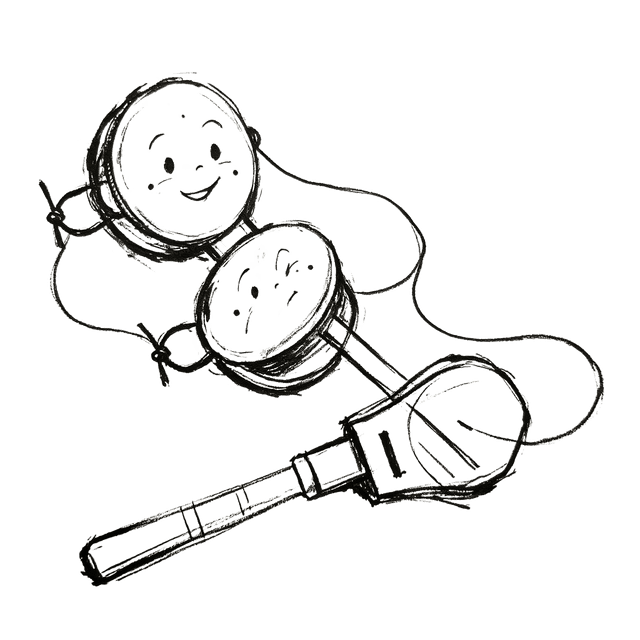
Challenge 2: Clappers in Pairs (5 minutes): Students work in pairs facing each other, with each student holding one clapper piece in one hand. While singing, they strike the two pieces together once on every beat—the earlier “hand-to-hand clap” now becomes “clapper-to-clapper.” Perform once at a slow tempo and once at the original tempo, then switch partners and repeat. If the pair loses the beat, they clap their hands together once to re-establish the pulse before continuing with the clappers.
- 4
Challenge 3: Clapper Groups and Hand Signals (5 minutes): Form groups of four to six students in small circles, with each student holding a pair of clappers. The teacher becomes the “tea-picking conductor.” Students play their clappers wherever the teacher’s hand signal indicates: hand low = play at knee level, as if picking low tea leaves; hand at mid-level = play in front of the chest; hand high = play above the head, as if picking high tea leaves. Students keep their eyes on the teacher’s hand and move their clappers up and down with the signals, imitating the motion of tea picking.
- 5
Challenge 4: Pass the Sound (5 minutes): The whole class first taps a steady beat softly on their knees. One student plays a two-measure rhythmic pattern. As soon as that student finishes, the next student immediately repeats the same two-measure pattern, passing the sound around the circle like a relay baton. The goal is for the sound to travel all the way around without stopping. If the chain breaks, simply restart from the point where it stopped.
- 6
Four-Challenge Run-Through (4 minutes): Perform all four challenges continuously from beginning to end without stopping—first partner clapping, then clappers in pairs, then responding to hand signals, and finally passing the sound. If the song keeps going and the steady beat remains intact throughout, the class has “completed all four challenges.”
Variations
Repeat the four challenges with another folk song, and compare the similarities and differences between the two songs.
Reference Video Link
Activity Sources
- Source Type:
- Website / Online resource
- Source:
- フラワービート(Flower Beat)
MAPS teaching activities may come from a variety of sources, including original contributions by the MAPS team, online resources, published materials, activities learned from teachers, activities shared by colleagues, traditional teaching practices, and other sources. When a source can be reasonably identified, we make every effort to acknowledge it on the relevant activity page or in the accompanying reference information.
Some content may be organized, translated, structured, or adapted by the MAPS team for specific teaching contexts. Such editorial or instructional adaptation does not mean that MAPS claims ownership of the underlying third-party material. Rights to third-party content remain with the original authors, publishers, or other lawful rights holders.
If you are an author, copyright holder, or authorized representative and have questions or concerns regarding the source, attribution, or use of any content, please contact us:
Email: musicactivityps@gmail.com
Clappers and Hand Signs: Four Ways to Level Up
Summary
Based on Akiko Yamamoto's workshop video: students learn song Tea-Picking (采茶歌), then play it four ways in rising difficulty — clapping hands to the beat, pair castanets with one plate each, group castanets following the teacher's hand signs, and passing a rhythm around the circle — finishing all four levels in one run.
Procedures
- 1
Learn the Tea-Picking Song (3 minutes): Listen to the song twice. During the second listening, have the whole class hum along softly. Introduce the goal: “We’re going to play with this song in four different ways. Each one is a new challenge, and Challenge 4 is the hardest.”
- 2
Challenge 1: Partner Clapping (4 minutes): Have the class sit in a circle. While singing, clap both hands together once on every beat. Practice first without the song using the cue: “One clap on every beat—where the hands land is where the sound happens.” Once the beat is steady, students face a partner across from them and use a classic partner-clapping pattern: clap their own hands once, then clap their partner’s hands once, continuing in alternation.
- 3
Challenge 2: Clappers in Pairs (5 minutes): Students work in pairs facing each other, with each student holding one clapper piece in one hand. While singing, they strike the two pieces together once on every beat—the earlier “hand-to-hand clap” now becomes “clapper-to-clapper.” Perform once at a slow tempo and once at the original tempo, then switch partners and repeat. If the pair loses the beat, they clap their hands together once to re-establish the pulse before continuing with the clappers.
- 4
Challenge 3: Clapper Groups and Hand Signals (5 minutes): Form groups of four to six students in small circles, with each student holding a pair of clappers. The teacher becomes the “tea-picking conductor.” Students play their clappers wherever the teacher’s hand signal indicates: hand low = play at knee level, as if picking low tea leaves; hand at mid-level = play in front of the chest; hand high = play above the head, as if picking high tea leaves. Students keep their eyes on the teacher’s hand and move their clappers up and down with the signals, imitating the motion of tea picking.
- 5
Challenge 4: Pass the Sound (5 minutes): The whole class first taps a steady beat softly on their knees. One student plays a two-measure rhythmic pattern. As soon as that student finishes, the next student immediately repeats the same two-measure pattern, passing the sound around the circle like a relay baton. The goal is for the sound to travel all the way around without stopping. If the chain breaks, simply restart from the point where it stopped.
- 6
Four-Challenge Run-Through (4 minutes): Perform all four challenges continuously from beginning to end without stopping—first partner clapping, then clappers in pairs, then responding to hand signals, and finally passing the sound. If the song keeps going and the steady beat remains intact throughout, the class has “completed all four challenges.”
Variations
Repeat the four challenges with another folk song, and compare the similarities and differences between the two songs.
Reference Video Link
Activity Sources
- Source Type:
- Website / Online resource
- Source:
- フラワービート(Flower Beat)
MAPS teaching activities may come from a variety of sources, including original contributions by the MAPS team, online resources, published materials, activities learned from teachers, activities shared by colleagues, traditional teaching practices, and other sources. When a source can be reasonably identified, we make every effort to acknowledge it on the relevant activity page or in the accompanying reference information.
Some content may be organized, translated, structured, or adapted by the MAPS team for specific teaching contexts. Such editorial or instructional adaptation does not mean that MAPS claims ownership of the underlying third-party material. Rights to third-party content remain with the original authors, publishers, or other lawful rights holders.
If you are an author, copyright holder, or authorized representative and have questions or concerns regarding the source, attribution, or use of any content, please contact us:
Email: musicactivityps@gmail.com