MAPS
Collaborative Soundscape
Summary
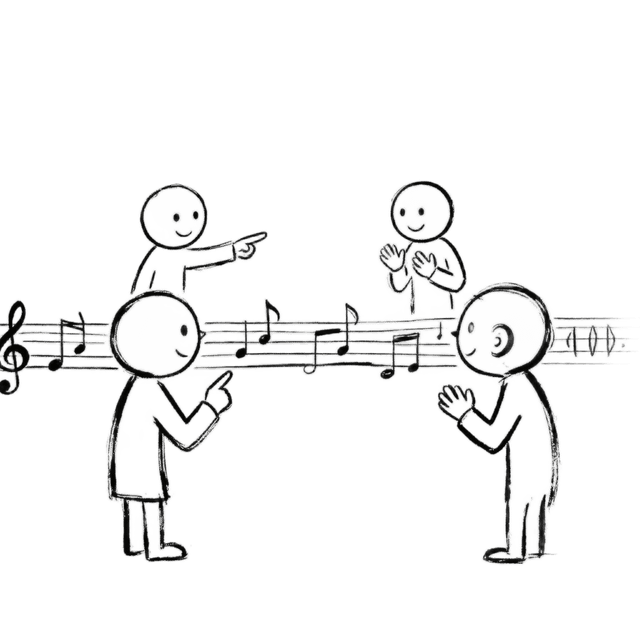
Students stand or sit in a circle, and each person chooses a sound that can be repeated continuously, such as a vocal sound, clapping, stomping, or another body-percussion sound. Under the teacher’s direction, students enter one at a time until the group has created a complete collaborative soundscape. The activity requires students to listen continuously to the sounds around them and decide when to enter, when to stop, and how to blend their sound with the overall texture. In a more advanced version, students can create a soundscape based on a specific location, while one student listens and tries to identify the setting.
Procedures
- 1
The teacher asks students to stand or sit in a circle and explains that the class will work together to create an original soundscape that has never existed before.
- 2
The teacher asks each student to think of a sound that can be repeated continuously, using the voice, clapping, stomping, or other body sounds.
- 3
If needed, the teacher first leads the class in trying several different sounds to help students become familiar with the types of sounds they can choose.
- 4
The teacher acts as the conductor and uses pointing, a light tap on the shoulder, hand gestures, or another clear cue to invite one student at random to begin repeating their sound.
- 5
The teacher continues adding students one by one, gradually layering the different sounds until the whole class is participating in the soundscape.
- 6
While all sounds are being performed together, the teacher uses conducting gestures to shape the overall texture, such as asking certain students to increase or decrease their volume.
- 7
The teacher cues students one by one to stop making sound, gradually thinning out the soundscape until only one sound remains.
- 8
The teacher signals the final student to stop, bringing the piece to an end.
Variations
1. Location Soundscape: The class first chooses a specific location, such as a library, park, beach, or movie theater. Each student imagines a sound that might be heard in that setting, and the class works together to build a soundscape.
2. Guess the Location: One student briefly leaves the room while the rest of the class creates a soundscape based on a chosen location. When the student returns, they listen and try to identify the location using only the sounds they hear.
3. Student Conductor: Once students are familiar with the basic activity, let them take turns acting as the conductor, using gestures to decide who starts, who stops, and how the dynamics change. The original webpage specifically suggests repeating the activity for multiple rounds and giving students opportunities to conduct.
4. Instrumental Soundscape: In addition to vocal sounds and body percussion, students can incorporate classroom percussion instruments or other sound-producing objects.
Activity Preparation
1. Students stand or sit in a circle.
2. When introducing the activity for the first time, the teacher may first have students explore a variety of sounds together, such as vocal sounds, clapping, and stomping.
3. The teacher establishes basic conducting gestures in advance for cues such as start, stop, get louder, and get softer.
4. If using an advanced version, the teacher may prepare several possible location themes in advance.
Activity Sources
- Source Type:
- Website / Online resource
- Source:
- GIVE Guide — Collaborative Soundscape Contributed by Julia Sirna-Frist and Rachael Schefrin https://teachwithgive.org/activities/collaborativesoundscape/
- Adaptation Notes:
- This documentation largely retains the core structure of the original activity’s Beginner Version. Some steps have been reorganized to follow a clearer sequence for implementation in the music classroom.
MAPS teaching activities may come from a variety of sources, including original contributions by the MAPS team, online resources, published materials, activities learned from teachers, activities shared by colleagues, traditional teaching practices, and other sources. When a source can be reasonably identified, we make every effort to acknowledge it on the relevant activity page or in the accompanying reference information.
Some content may be organized, translated, structured, or adapted by the MAPS team for specific teaching contexts. Such editorial or instructional adaptation does not mean that MAPS claims ownership of the underlying third-party material. Rights to third-party content remain with the original authors, publishers, or other lawful rights holders.
If you are an author, copyright holder, or authorized representative and have questions or concerns regarding the source, attribution, or use of any content, please contact us:
Email: musicactivityps@gmail.com
Collaborative Soundscape
Summary
Students stand or sit in a circle, and each person chooses a sound that can be repeated continuously, such as a vocal sound, clapping, stomping, or another body-percussion sound. Under the teacher’s direction, students enter one at a time until the group has created a complete collaborative soundscape. The activity requires students to listen continuously to the sounds around them and decide when to enter, when to stop, and how to blend their sound with the overall texture. In a more advanced version, students can create a soundscape based on a specific location, while one student listens and tries to identify the setting.
Procedures
- 1
The teacher asks students to stand or sit in a circle and explains that the class will work together to create an original soundscape that has never existed before.
- 2
The teacher asks each student to think of a sound that can be repeated continuously, using the voice, clapping, stomping, or other body sounds.
- 3
If needed, the teacher first leads the class in trying several different sounds to help students become familiar with the types of sounds they can choose.
- 4
The teacher acts as the conductor and uses pointing, a light tap on the shoulder, hand gestures, or another clear cue to invite one student at random to begin repeating their sound.
- 5
The teacher continues adding students one by one, gradually layering the different sounds until the whole class is participating in the soundscape.
- 6
While all sounds are being performed together, the teacher uses conducting gestures to shape the overall texture, such as asking certain students to increase or decrease their volume.
- 7
The teacher cues students one by one to stop making sound, gradually thinning out the soundscape until only one sound remains.
- 8
The teacher signals the final student to stop, bringing the piece to an end.
Variations
1. Location Soundscape: The class first chooses a specific location, such as a library, park, beach, or movie theater. Each student imagines a sound that might be heard in that setting, and the class works together to build a soundscape.
2. Guess the Location: One student briefly leaves the room while the rest of the class creates a soundscape based on a chosen location. When the student returns, they listen and try to identify the location using only the sounds they hear.
3. Student Conductor: Once students are familiar with the basic activity, let them take turns acting as the conductor, using gestures to decide who starts, who stops, and how the dynamics change. The original webpage specifically suggests repeating the activity for multiple rounds and giving students opportunities to conduct.
4. Instrumental Soundscape: In addition to vocal sounds and body percussion, students can incorporate classroom percussion instruments or other sound-producing objects.
Activity Preparation
1. Students stand or sit in a circle.
2. When introducing the activity for the first time, the teacher may first have students explore a variety of sounds together, such as vocal sounds, clapping, and stomping.
3. The teacher establishes basic conducting gestures in advance for cues such as start, stop, get louder, and get softer.
4. If using an advanced version, the teacher may prepare several possible location themes in advance.
Activity Sources
- Source Type:
- Website / Online resource
- Source:
- GIVE Guide — Collaborative Soundscape Contributed by Julia Sirna-Frist and Rachael Schefrin https://teachwithgive.org/activities/collaborativesoundscape/
- Adaptation Notes:
- This documentation largely retains the core structure of the original activity’s Beginner Version. Some steps have been reorganized to follow a clearer sequence for implementation in the music classroom.
MAPS teaching activities may come from a variety of sources, including original contributions by the MAPS team, online resources, published materials, activities learned from teachers, activities shared by colleagues, traditional teaching practices, and other sources. When a source can be reasonably identified, we make every effort to acknowledge it on the relevant activity page or in the accompanying reference information.
Some content may be organized, translated, structured, or adapted by the MAPS team for specific teaching contexts. Such editorial or instructional adaptation does not mean that MAPS claims ownership of the underlying third-party material. Rights to third-party content remain with the original authors, publishers, or other lawful rights holders.
If you are an author, copyright holder, or authorized representative and have questions or concerns regarding the source, attribution, or use of any content, please contact us:
Email: musicactivityps@gmail.com