MAPS
Doggie, Where is Your Bone?
Summary
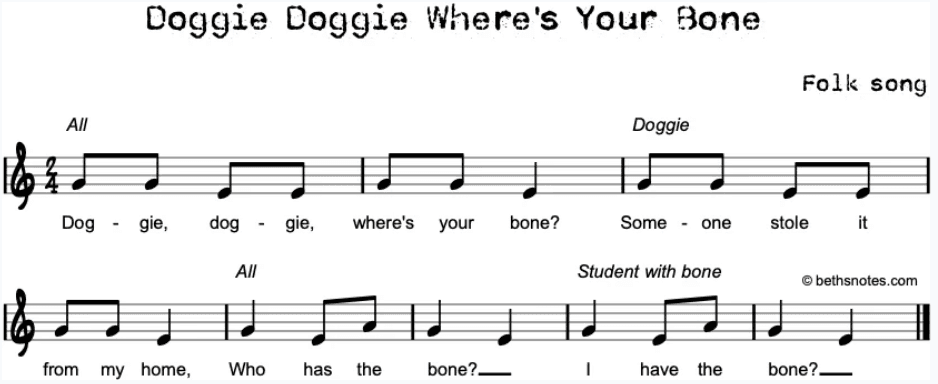
A singing and hidden-object guessing game in which students naturally experience and practice sol–la–mi pitch patterns through repeated singing. The game alternates between whole-class singing and individual responses, giving students opportunities to sing independently and make listening-based judgments. It can be used both for early aural experience and for later practice, reinforcement, and informal assessment.
Procedures
- 1
Prepare a small object that can be safely held in a student’s hand or hidden behind their back to serve as the bone. Have the class sit in a circle or in positions where students can see one another.
- 2
Choose one student to be the Doggie. The Doggie is the student who tries to find the “bone.” At the start of the game, the Doggie closes their eyes or sits facing away from the class so they cannot see who takes the bone.
- 3
The teacher chooses one student to be the bone stealer, or gives the bone to a student while the Doggie is unable to see. The student with the bone hides it, while the other students remain in place and avoid giving away the answer through gestures or facial expressions.
- 4
The whole class sings three times: “Doggie, Doggie, where’s your bone?”
- 5
After the class finishes singing, the Doggie sings independently: “Who stole my bone?”
- 6
The Doggie turns to face the class and guesses the name of one student.
- 7
If the Doggie guesses correctly, the student holding the bone reveals it and sings independently: “I stole your bone!”
- 8
If the guess is incorrect, the Doggie may continue guessing, with a maximum of three guesses. If the Doggie does not guess correctly after three attempts, the student holding the bone reveals it and sings: “I stole your bone!”
- 9
At the end of the round, choose a new Doggie and a new bone stealer, and begin another round. The teacher can repeat the game several times so that more students have opportunities to sing independently and take turns participating.
Reference Video Link
Activity Preparation
Activity Sources
- Source Type:
- Website / Online resource
- Source:
- Active Music, “Doggie Doggie” (YouTube instructional video)
MAPS teaching activities may come from a variety of sources, including original contributions by the MAPS team, online resources, published materials, activities learned from teachers, activities shared by colleagues, traditional teaching practices, and other sources. When a source can be reasonably identified, we make every effort to acknowledge it on the relevant activity page or in the accompanying reference information.
Some content may be organized, translated, structured, or adapted by the MAPS team for specific teaching contexts. Such editorial or instructional adaptation does not mean that MAPS claims ownership of the underlying third-party material. Rights to third-party content remain with the original authors, publishers, or other lawful rights holders.
If you are an author, copyright holder, or authorized representative and have questions or concerns regarding the source, attribution, or use of any content, please contact us:
Email: musicactivityps@gmail.com
Doggie, Where is Your Bone?
Summary
A singing and hidden-object guessing game in which students naturally experience and practice sol–la–mi pitch patterns through repeated singing. The game alternates between whole-class singing and individual responses, giving students opportunities to sing independently and make listening-based judgments. It can be used both for early aural experience and for later practice, reinforcement, and informal assessment.
Procedures
- 1
Prepare a small object that can be safely held in a student’s hand or hidden behind their back to serve as the bone. Have the class sit in a circle or in positions where students can see one another.
- 2
Choose one student to be the Doggie. The Doggie is the student who tries to find the “bone.” At the start of the game, the Doggie closes their eyes or sits facing away from the class so they cannot see who takes the bone.
- 3
The teacher chooses one student to be the bone stealer, or gives the bone to a student while the Doggie is unable to see. The student with the bone hides it, while the other students remain in place and avoid giving away the answer through gestures or facial expressions.
- 4
The whole class sings three times: “Doggie, Doggie, where’s your bone?”
- 5
After the class finishes singing, the Doggie sings independently: “Who stole my bone?”
- 6
The Doggie turns to face the class and guesses the name of one student.
- 7
If the Doggie guesses correctly, the student holding the bone reveals it and sings independently: “I stole your bone!”
- 8
If the guess is incorrect, the Doggie may continue guessing, with a maximum of three guesses. If the Doggie does not guess correctly after three attempts, the student holding the bone reveals it and sings: “I stole your bone!”
- 9
At the end of the round, choose a new Doggie and a new bone stealer, and begin another round. The teacher can repeat the game several times so that more students have opportunities to sing independently and take turns participating.
Reference Video Link
Activity Preparation
Activity Sources
- Source Type:
- Website / Online resource
- Source:
- Active Music, “Doggie Doggie” (YouTube instructional video)
MAPS teaching activities may come from a variety of sources, including original contributions by the MAPS team, online resources, published materials, activities learned from teachers, activities shared by colleagues, traditional teaching practices, and other sources. When a source can be reasonably identified, we make every effort to acknowledge it on the relevant activity page or in the accompanying reference information.
Some content may be organized, translated, structured, or adapted by the MAPS team for specific teaching contexts. Such editorial or instructional adaptation does not mean that MAPS claims ownership of the underlying third-party material. Rights to third-party content remain with the original authors, publishers, or other lawful rights holders.
If you are an author, copyright holder, or authorized representative and have questions or concerns regarding the source, attribution, or use of any content, please contact us:
Email: musicactivityps@gmail.com