MAPS
Exploring Rhythmic Groupings
Summary
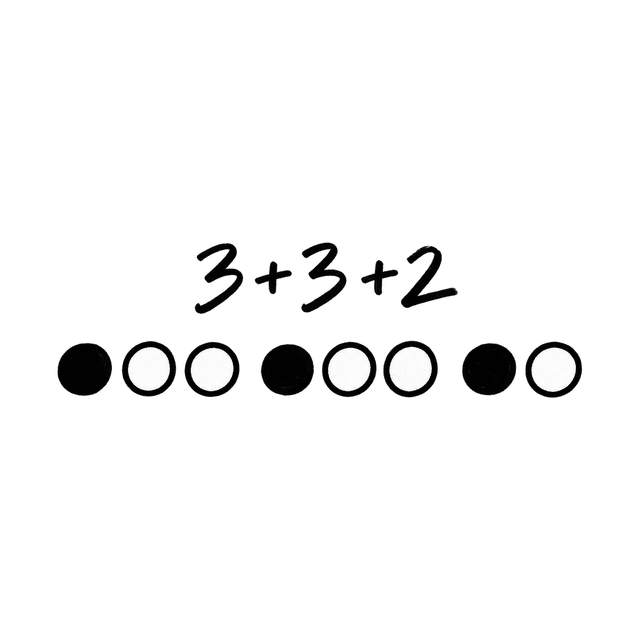
This activity introduces rhythmic groupings through listening, clapping, and movement. Students first explore 3+3+2 and 2+2+3 patterns using visual cues and accented claps, then experiment with variations such as 3+2+3 and 2+3+3. Suggested musical examples encourage students to independently recognize and explore rhythmic groupings, developing rhythmic awareness, listening skills, and physical coordination.
Procedures
- 1
Listen and Imitate: The teacher invites students to listen to eight evenly spaced beats. On the second repetition, students clap along with the steady beat.
- 2
Feel Different Accent Patterns: The teacher adds accents to different beats and asks students to imitate the patterns. Guiding questions include: “Did the tempo change?” “Did the total number of beats change?” “What sounded different?” “Can you use strong and weak beats to demonstrate these groupings?” Guide students to discover that even with the same number of beats, different groupings can create different rhythmic feelings.
- 3
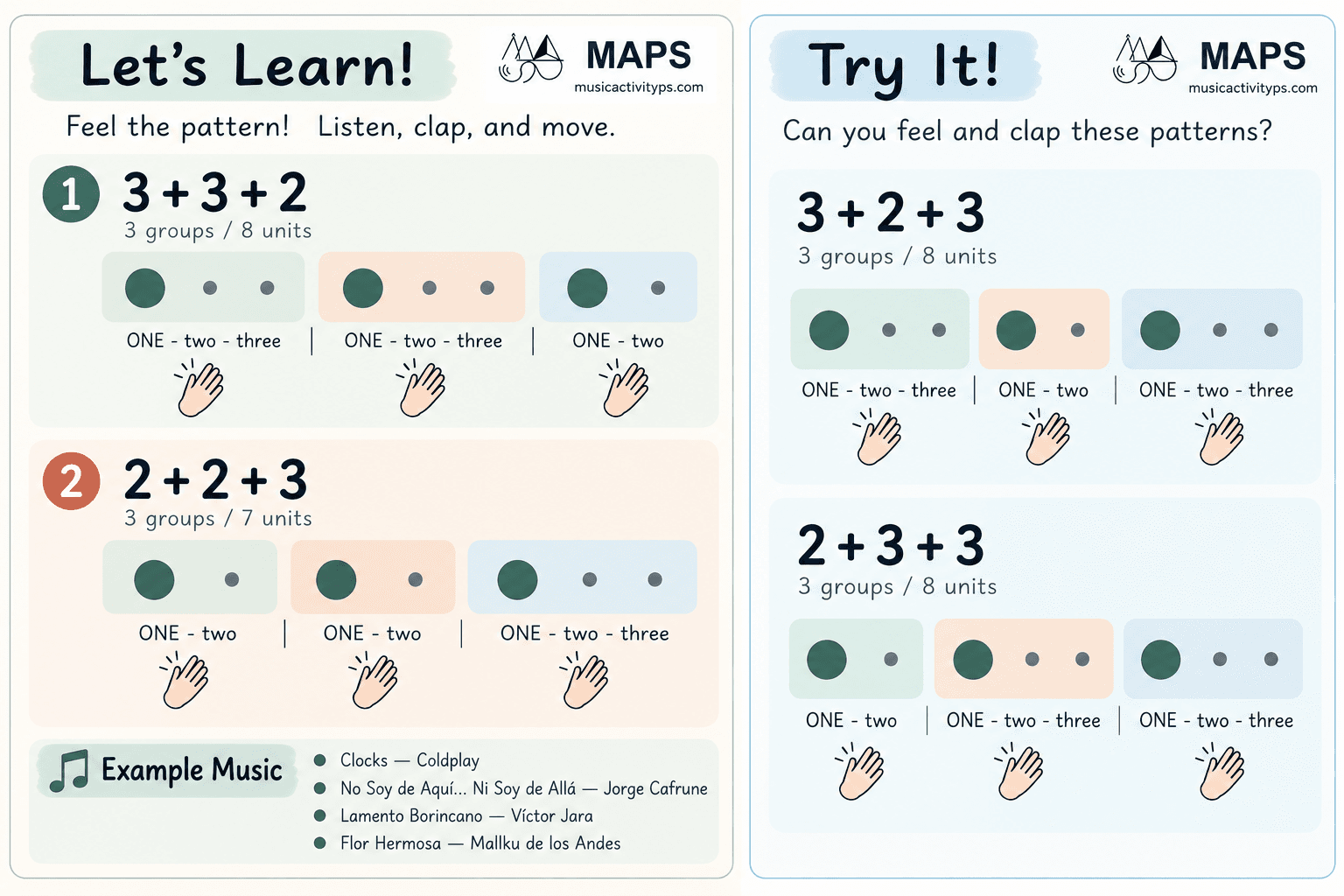
Explore Rhythmic Groupings: The teacher introduces the activity cards and guides students in practicing the 3+3+2 and 2+2+3 rhythmic groupings. Students can also incorporate stomping, grooving, or other body movements to help internalize the rhythms.
- 4
Listen and Apply: Once students can confidently perform both rhythmic groupings, the teacher plays the suggested musical examples and encourages students to naturally feel and identify the rhythmic groupings through clapping or body movement.
Variations
Advanced Challenge: The teacher introduces additional rhythmic groupings, such as 3+2+3 and 2+3+3
Activity Preparation
Prepare the music features 3+3+2 and 2+2+3 rhythmic groupings
Activity Sources
- Source Type:
- MAPS Original
MAPS teaching activities may come from a variety of sources, including original contributions by the MAPS team, online resources, published materials, activities learned from teachers, activities shared by colleagues, traditional teaching practices, and other sources. When a source can be reasonably identified, we make every effort to acknowledge it on the relevant activity page or in the accompanying reference information.
Some content may be organized, translated, structured, or adapted by the MAPS team for specific teaching contexts. Such editorial or instructional adaptation does not mean that MAPS claims ownership of the underlying third-party material. Rights to third-party content remain with the original authors, publishers, or other lawful rights holders.
If you are an author, copyright holder, or authorized representative and have questions or concerns regarding the source, attribution, or use of any content, please contact us:
Email: musicactivityps@gmail.com
Exploring Rhythmic Groupings
Summary
This activity introduces rhythmic groupings through listening, clapping, and movement. Students first explore 3+3+2 and 2+2+3 patterns using visual cues and accented claps, then experiment with variations such as 3+2+3 and 2+3+3. Suggested musical examples encourage students to independently recognize and explore rhythmic groupings, developing rhythmic awareness, listening skills, and physical coordination.
Procedures
- 1
Listen and Imitate: The teacher invites students to listen to eight evenly spaced beats. On the second repetition, students clap along with the steady beat.
- 2
Feel Different Accent Patterns: The teacher adds accents to different beats and asks students to imitate the patterns. Guiding questions include: “Did the tempo change?” “Did the total number of beats change?” “What sounded different?” “Can you use strong and weak beats to demonstrate these groupings?” Guide students to discover that even with the same number of beats, different groupings can create different rhythmic feelings.
- 3
Explore Rhythmic Groupings: The teacher introduces the activity cards and guides students in practicing the 3+3+2 and 2+2+3 rhythmic groupings. Students can also incorporate stomping, grooving, or other body movements to help internalize the rhythms.
- 4
Listen and Apply: Once students can confidently perform both rhythmic groupings, the teacher plays the suggested musical examples and encourages students to naturally feel and identify the rhythmic groupings through clapping or body movement.
Variations
Advanced Challenge: The teacher introduces additional rhythmic groupings, such as 3+2+3 and 2+3+3
Activity Preparation
Prepare the music features 3+3+2 and 2+2+3 rhythmic groupings
Activity Sources
- Source Type:
- MAPS Original
MAPS teaching activities may come from a variety of sources, including original contributions by the MAPS team, online resources, published materials, activities learned from teachers, activities shared by colleagues, traditional teaching practices, and other sources. When a source can be reasonably identified, we make every effort to acknowledge it on the relevant activity page or in the accompanying reference information.
Some content may be organized, translated, structured, or adapted by the MAPS team for specific teaching contexts. Such editorial or instructional adaptation does not mean that MAPS claims ownership of the underlying third-party material. Rights to third-party content remain with the original authors, publishers, or other lawful rights holders.
If you are an author, copyright holder, or authorized representative and have questions or concerns regarding the source, attribution, or use of any content, please contact us:
Email: musicactivityps@gmail.com