 MAPS
Find the C Minor Blues Scale
Summary
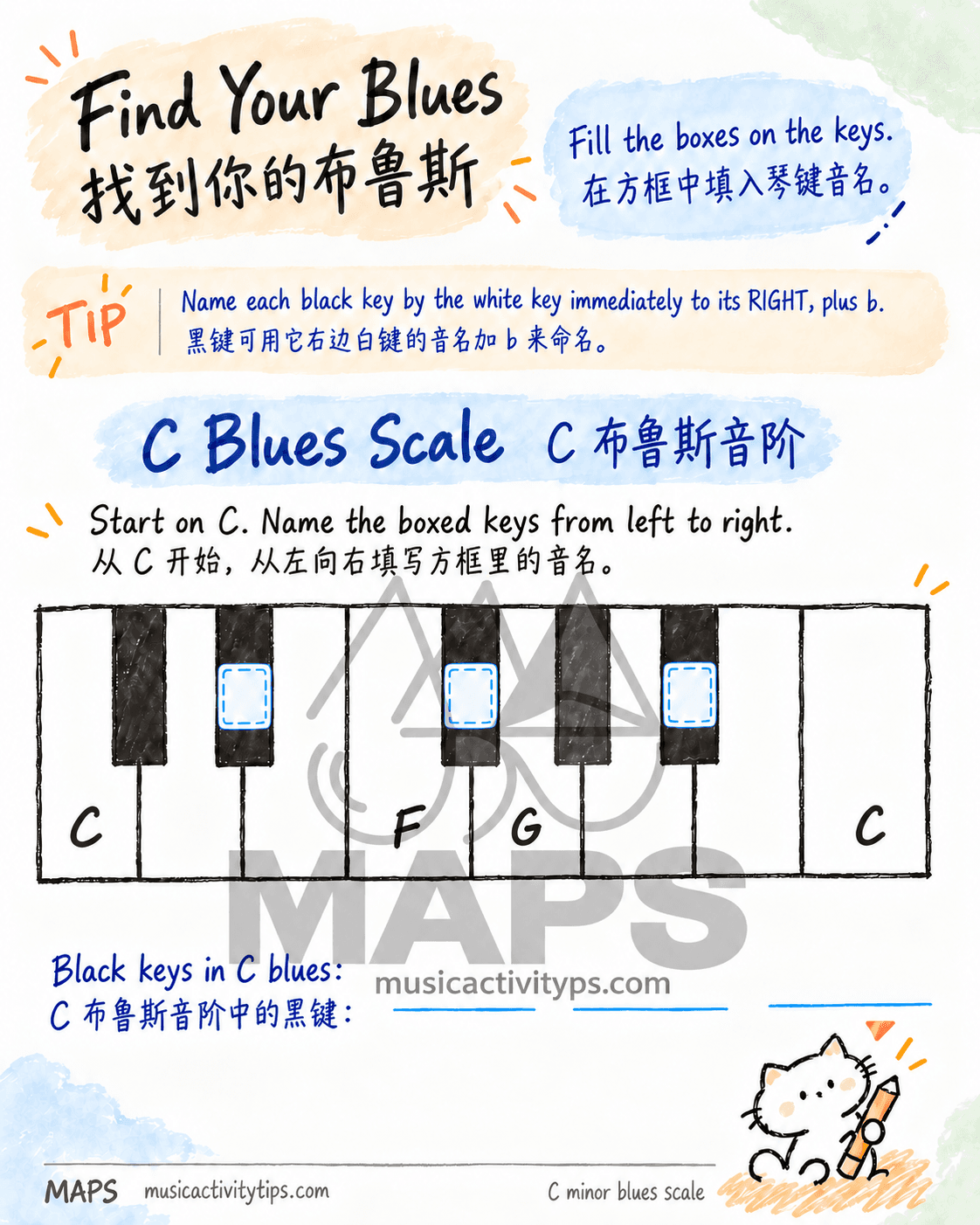
Students explore the C minor blues scale by identifying three missing black-key notes on a piano keyboard diagram. Using the neighboring white keys as clues, students complete the scale and then try playing it on the piano. This activity prepares students for blues improvisation.
Procedures
- 1
Distribute the worksheet. Ask students to locate the given notes (C, F, G, and C) on the keyboard diagram.
- 2
Students identify the three missing black-key notes. Encourage them to use the white key immediately to the right of each black key as a clue, adding a flat (♭) to name the note.
- 3
Students fill in the boxes and write the three black-key note names in order below the keyboard. Review the completed C minor blues scale together: C–E♭–F–G♭–G–B♭–C.
- 4
Invite students to play the completed scale on the piano, listening to its distinctive sound.
Variations
Listen and Echo: The teacher plays a short three-note pattern (F–G♭–G). Students echo the pattern and then create a short variation using the same notes. This can lead into the Play Your Blues! activity.
Activity Preparation
1. Printable student worksheet.
2. Pencil or writing utensil.
3. Optional: piano or keyboard for checking selected interval answers.
Activity Sources
- Source Type:
- MAPS Original
MAPS teaching activities may come from a variety of sources, including original contributions by the MAPS team, online resources, published materials, activities learned from teachers, activities shared by colleagues, traditional teaching practices, and other sources. When a source can be reasonably identified, we make every effort to acknowledge it on the relevant activity page or in the accompanying reference information.
Some content may be organized, translated, structured, or adapted by the MAPS team for specific teaching contexts. Such editorial or instructional adaptation does not mean that MAPS claims ownership of the underlying third-party material. Rights to third-party content remain with the original authors, publishers, or other lawful rights holders.
If you are an author, copyright holder, or authorized representative and have questions or concerns regarding the source, attribution, or use of any content, please contact us:
Email: musicactivityps@gmail.com
Find the C Minor Blues Scale
Summary
Students explore the C minor blues scale by identifying three missing black-key notes on a piano keyboard diagram. Using the neighboring white keys as clues, students complete the scale and then try playing it on the piano. This activity prepares students for blues improvisation.
Procedures
- 1
Distribute the worksheet. Ask students to locate the given notes (C, F, G, and C) on the keyboard diagram.
- 2
Students identify the three missing black-key notes. Encourage them to use the white key immediately to the right of each black key as a clue, adding a flat (♭) to name the note.
- 3
Students fill in the boxes and write the three black-key note names in order below the keyboard. Review the completed C minor blues scale together: C–E♭–F–G♭–G–B♭–C.
- 4
Invite students to play the completed scale on the piano, listening to its distinctive sound.
Variations
Listen and Echo: The teacher plays a short three-note pattern (F–G♭–G). Students echo the pattern and then create a short variation using the same notes. This can lead into the Play Your Blues! activity.
Activity Preparation
1. Printable student worksheet.
2. Pencil or writing utensil.
3. Optional: piano or keyboard for checking selected interval answers.
Activity Sources
- Source Type:
- MAPS Original
MAPS teaching activities may come from a variety of sources, including original contributions by the MAPS team, online resources, published materials, activities learned from teachers, activities shared by colleagues, traditional teaching practices, and other sources. When a source can be reasonably identified, we make every effort to acknowledge it on the relevant activity page or in the accompanying reference information.
Some content may be organized, translated, structured, or adapted by the MAPS team for specific teaching contexts. Such editorial or instructional adaptation does not mean that MAPS claims ownership of the underlying third-party material. Rights to third-party content remain with the original authors, publishers, or other lawful rights holders.
If you are an author, copyright holder, or authorized representative and have questions or concerns regarding the source, attribution, or use of any content, please contact us:
Email: musicactivityps@gmail.com