MAPS
Five-Beat Hopscotch: Experiencing Quintuple Meter
Summary
Through a hopscotch-style hula-hoop activity, students physically experience quintuple meter and its 3+2 grouping. Quintuple meter is an asymmetrical meter commonly grouped as 3+2 or 2+3. Whole-body movement helps students experience these groupings kinesthetically.
Procedures
- 1
Identify quintuple meter.
Before listening, the teacher reviews duple, triple, and quadruple meter with the students, then plays Axi Tiaoyue and asks, “How many beats are there in each measure?” Students gently tap a steady beat along with the music. They may notice that “it sounds like three beats, then two,” or that “the first group is longer than the second.” The teacher then asks, “How many beats do we get when we count these two groups together?” By counting “1 2 3 4 5,” students discover that each measure contains five beats.
- 2
Find the group accents.
The teacher plays the same excerpt again and asks, “On which beats can you hear the two group accents?” Guide students to identify beats 1 and 4. First count “1 2 3 4 5,” then change to “1 2 3 | 1 2” to help students feel the 3+2 grouping. If needed, the teacher can pat their thighs at the beginning of each group to support listening.
- 3
Practice hopscotch without music.
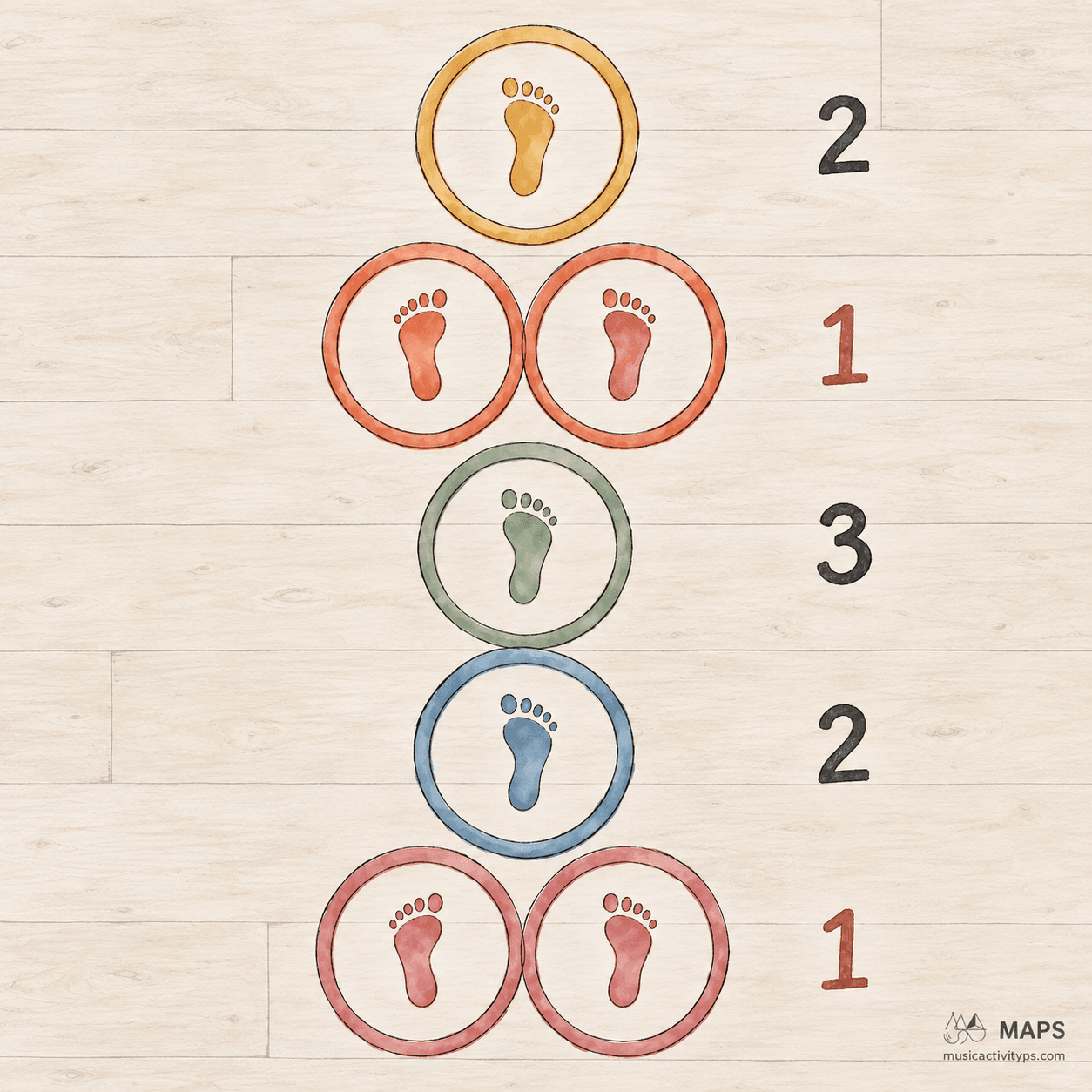
The teacher arranges hula hoops into a five-beat hopscotch course and demonstrates: land on both feet on beats 1 and 4 to represent the strong and secondary strong beats, and land on one foot on the remaining beats to represent the weak beats. Students first jump while following the teacher’s counting of “1 2 3 | 1 2,” then practice counting and jumping independently, keeping each beat equal in duration.
- 4
Add music and practice in place.
The teacher plays Axi Tiaoyue. Students first count along and locate beat 1 of each measure, then practice the five-beat movement pattern in place: land on both feet on beats 1 and 4 and on one foot on the remaining beats. The teacher checks that students land on the correct beats and maintain all five beats with the correct grouping. If students lose their place, they pause, count along with the teacher, and rejoin on beat 1 of the next measure.
- 5
Take turns on the hopscotch course.
Students line up to use the same five-beat hula-hoop course. Initially, one student completes five beats, followed by a full five-beat measure for that student to exit. The next student enters on beat 1 of the following measure. Once students are comfortable, try a continuous relay: as one student completes five beats and exits, the next student enters on beat 1 of the next measure. While waiting, students continue counting softly, “1 2 3 | 1 2,” to prepare for their entrance.
- 6
Review how to listen for quintuple meter.
The teacher asks, “When we hear a new piece, how can we tell whether it is in quintuple meter?” First, tap a steady beat and try counting the beats in each measure. Then listen for recurring accents, accompaniment patterns, or rhythmic figures to locate beat 1 and determine whether the five beats are grouped as 3+2 or 2+3. Remind students that the groups differ in length, but each beat remains equal in duration.
- 7
Apply the strategies to another piece.
The teacher plays Take Five. Students use the same strategies to identify quintuple meter, locate beat 1 of each measure, and recognize the grouping. They then perform the corresponding five-beat movement pattern in place with the music.
Variations
1. Other pieces in quintuple meter include Take Five and the Mission: Impossible theme. Because the original recordings are quite fast, use the slower versions provided with this lesson plan.
2. Assign the second movement of Tchaikovsky’s Symphony No. 6 “Pathétique” as a listening activity. Guide students to identify the quintuple meter through focused listening and body movement, and encourage them to find and maintain a steady five-beat pulse.
Reference Video Link
- 1. 阿细跳月/Axi Tiaoyue: https://youtu.be/BjeHbRsZESo?si=RUywARQZWxESK3Xi
- 2. 五拍/Take Five: https://youtu.be/5HYd32BC0zI?si=zgWupaL3Lb9x0N28
- 3. 不可能的任务/Mission: Impossible: https://youtu.be/rE7HD7Nita8?si=SVJ98-UvVVC4mc2j
- 4. 柴可夫斯基《第六交响曲“悲怆”》第二乐章/Tchaikovsky’s Symphony No. 6 “Pathétique” mvt. 2: https://youtu.be/dLlo3i7qZME?si=I_fP8vsEiVfh3Eq5
Activity Preparation
1. The teacher arranges the hula hoops on the classroom floor in the pattern shown below.
2.
Activity Sources
- Source Type:
- Learned from a teacher
- Source:
- This activity adapts the hula-hoop movement format used in an undergraduate course, Introduction to School Music Education and Teaching Materials and Methods II, taught by Xiuxiu Luo at Zhejiang Conservatory of Music in 2018.
- Adaptation Notes:
- This version adds the use of Axi Tiaoyue, a progressive listening-and-movement sequence, and observable assessment criteria.
MAPS teaching activities may come from a variety of sources, including original contributions by the MAPS team, online resources, published materials, activities learned from teachers, activities shared by colleagues, traditional teaching practices, and other sources. When a source can be reasonably identified, we make every effort to acknowledge it on the relevant activity page or in the accompanying reference information.
Some content may be organized, translated, structured, or adapted by the MAPS team for specific teaching contexts. Such editorial or instructional adaptation does not mean that MAPS claims ownership of the underlying third-party material. Rights to third-party content remain with the original authors, publishers, or other lawful rights holders.
If you are an author, copyright holder, or authorized representative and have questions or concerns regarding the source, attribution, or use of any content, please contact us:
Email: musicactivityps@gmail.com
Five-Beat Hopscotch: Experiencing Quintuple Meter
Summary
Through a hopscotch-style hula-hoop activity, students physically experience quintuple meter and its 3+2 grouping. Quintuple meter is an asymmetrical meter commonly grouped as 3+2 or 2+3. Whole-body movement helps students experience these groupings kinesthetically.
Procedures
- 1
Identify quintuple meter.
Before listening, the teacher reviews duple, triple, and quadruple meter with the students, then plays Axi Tiaoyue and asks, “How many beats are there in each measure?” Students gently tap a steady beat along with the music. They may notice that “it sounds like three beats, then two,” or that “the first group is longer than the second.” The teacher then asks, “How many beats do we get when we count these two groups together?” By counting “1 2 3 4 5,” students discover that each measure contains five beats.
- 2
Find the group accents.
The teacher plays the same excerpt again and asks, “On which beats can you hear the two group accents?” Guide students to identify beats 1 and 4. First count “1 2 3 4 5,” then change to “1 2 3 | 1 2” to help students feel the 3+2 grouping. If needed, the teacher can pat their thighs at the beginning of each group to support listening.
- 3
Practice hopscotch without music.
The teacher arranges hula hoops into a five-beat hopscotch course and demonstrates: land on both feet on beats 1 and 4 to represent the strong and secondary strong beats, and land on one foot on the remaining beats to represent the weak beats. Students first jump while following the teacher’s counting of “1 2 3 | 1 2,” then practice counting and jumping independently, keeping each beat equal in duration.
- 4
Add music and practice in place.
The teacher plays Axi Tiaoyue. Students first count along and locate beat 1 of each measure, then practice the five-beat movement pattern in place: land on both feet on beats 1 and 4 and on one foot on the remaining beats. The teacher checks that students land on the correct beats and maintain all five beats with the correct grouping. If students lose their place, they pause, count along with the teacher, and rejoin on beat 1 of the next measure.
- 5
Take turns on the hopscotch course.
Students line up to use the same five-beat hula-hoop course. Initially, one student completes five beats, followed by a full five-beat measure for that student to exit. The next student enters on beat 1 of the following measure. Once students are comfortable, try a continuous relay: as one student completes five beats and exits, the next student enters on beat 1 of the next measure. While waiting, students continue counting softly, “1 2 3 | 1 2,” to prepare for their entrance.
- 6
Review how to listen for quintuple meter.
The teacher asks, “When we hear a new piece, how can we tell whether it is in quintuple meter?” First, tap a steady beat and try counting the beats in each measure. Then listen for recurring accents, accompaniment patterns, or rhythmic figures to locate beat 1 and determine whether the five beats are grouped as 3+2 or 2+3. Remind students that the groups differ in length, but each beat remains equal in duration.
- 7
Apply the strategies to another piece.
The teacher plays Take Five. Students use the same strategies to identify quintuple meter, locate beat 1 of each measure, and recognize the grouping. They then perform the corresponding five-beat movement pattern in place with the music.
Variations
1. Other pieces in quintuple meter include Take Five and the Mission: Impossible theme. Because the original recordings are quite fast, use the slower versions provided with this lesson plan.
2. Assign the second movement of Tchaikovsky’s Symphony No. 6 “Pathétique” as a listening activity. Guide students to identify the quintuple meter through focused listening and body movement, and encourage them to find and maintain a steady five-beat pulse.
Reference Video Link
- 1. 阿细跳月/Axi Tiaoyue: https://youtu.be/BjeHbRsZESo?si=RUywARQZWxESK3Xi
- 2. 五拍/Take Five: https://youtu.be/5HYd32BC0zI?si=zgWupaL3Lb9x0N28
- 3. 不可能的任务/Mission: Impossible: https://youtu.be/rE7HD7Nita8?si=SVJ98-UvVVC4mc2j
- 4. 柴可夫斯基《第六交响曲“悲怆”》第二乐章/Tchaikovsky’s Symphony No. 6 “Pathétique” mvt. 2: https://youtu.be/dLlo3i7qZME?si=I_fP8vsEiVfh3Eq5
Activity Preparation
1. The teacher arranges the hula hoops on the classroom floor in the pattern shown below.
2.
Activity Sources
- Source Type:
- Learned from a teacher
- Source:
- This activity adapts the hula-hoop movement format used in an undergraduate course, Introduction to School Music Education and Teaching Materials and Methods II, taught by Xiuxiu Luo at Zhejiang Conservatory of Music in 2018.
- Adaptation Notes:
- This version adds the use of Axi Tiaoyue, a progressive listening-and-movement sequence, and observable assessment criteria.
MAPS teaching activities may come from a variety of sources, including original contributions by the MAPS team, online resources, published materials, activities learned from teachers, activities shared by colleagues, traditional teaching practices, and other sources. When a source can be reasonably identified, we make every effort to acknowledge it on the relevant activity page or in the accompanying reference information.
Some content may be organized, translated, structured, or adapted by the MAPS team for specific teaching contexts. Such editorial or instructional adaptation does not mean that MAPS claims ownership of the underlying third-party material. Rights to third-party content remain with the original authors, publishers, or other lawful rights holders.
If you are an author, copyright holder, or authorized representative and have questions or concerns regarding the source, attribution, or use of any content, please contact us:
Email: musicactivityps@gmail.com