 MAPS
Haunting Music: Listen, Imagine, and Create a Story
Summary
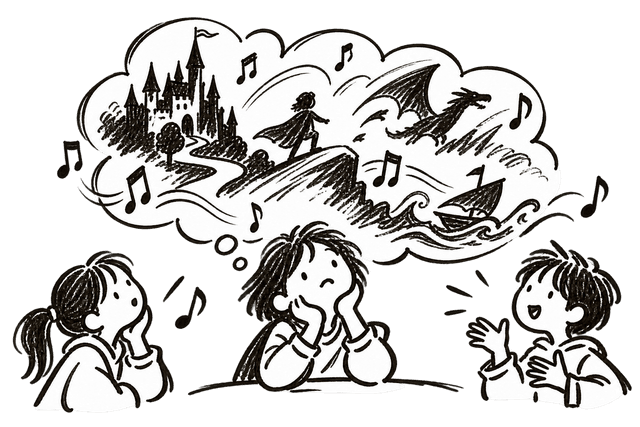
Students listen to an expressive orchestral excerpt and imagine characters, settings, and events suggested by the music. Through repeated listening, they identify changes in dynamics, tempo, timbre, pitch/register, and other musical features, then use those changes as evidence for developing a short story. Students share their stories and explain how specific sounds influenced their musical imagery.
Procedures
- 1
Play the selected musical excerpt once without revealing its title or originalstory/backgroud, and ask students to listen without writing.
- 2
After listening, ask students to describe several images, emotions, characters, places, or actions that came to mind.
- 3
Play the music again. This time, students listen for specific musical changes, such as changes in dynamics, tempo, timbre, pitch/register, or instrumentation.
- 4
For each important musical change, students record what they heard and what they imagined.
- 5
Choose three or four important moments from the music and arrange the imagined events into a simple sequence with a beginning, change or conflict, and ending.
- 6
Write or orally create a short story in which at least two important events clearly correspond to musical changes.
- 7
Play the music again while selected students read or tell their stories, matching major story events with the corresponding musical moments.
- 8
After each presentation, listeners identify one musical feature that helped communicate the story.
Variations
1. Instead of writing a story, students draw three images representing the beginning, an important musical change, and the ending.
2. Create an individual or collaborative illustration or mural based on the musical story.
Activity Preparation
1. One expressive orchestral or programmatic music excerpt
2. Audio playback equipment
3. Paper and pencils or another way to record ideas
4. Optional drawing materials
5. No prior knowledge of the original story behind the music is required
6. If musical terminology is part of the learning goal, students should have basic familiarity with concepts such as dynamics, tempo, timbre, and pitch
Activity Sources
- Source Type:
- Website / Online resource
- Source:
- Adapted from The Kennedy Center classroom resource Haunting Music, Grades 3–5. https://www.kennedy-center.org/education/resources-for-educators/classroom-resources/lessons-and-activities/lessons/3-5/haunting-music/
- Adaptation Notes:
- The original lesson combines listening to expressive orchestral music with musical vocabulary, imaginative writing, and visual art. This version isolates the listening-to-story component as a stand-alone activity and strengthens the requirement that students connect imagined events to observable musical evidence.
MAPS teaching activities may come from a variety of sources, including original contributions by the MAPS team, online resources, published materials, activities learned from teachers, activities shared by colleagues, traditional teaching practices, and other sources. When a source can be reasonably identified, we make every effort to acknowledge it on the relevant activity page or in the accompanying reference information.
Some content may be organized, translated, structured, or adapted by the MAPS team for specific teaching contexts. Such editorial or instructional adaptation does not mean that MAPS claims ownership of the underlying third-party material. Rights to third-party content remain with the original authors, publishers, or other lawful rights holders.
If you are an author, copyright holder, or authorized representative and have questions or concerns regarding the source, attribution, or use of any content, please contact us:
Email: musicactivityps@gmail.com
Haunting Music: Listen, Imagine, and Create a Story
Summary
Students listen to an expressive orchestral excerpt and imagine characters, settings, and events suggested by the music. Through repeated listening, they identify changes in dynamics, tempo, timbre, pitch/register, and other musical features, then use those changes as evidence for developing a short story. Students share their stories and explain how specific sounds influenced their musical imagery.
Procedures
- 1
Play the selected musical excerpt once without revealing its title or originalstory/backgroud, and ask students to listen without writing.
- 2
After listening, ask students to describe several images, emotions, characters, places, or actions that came to mind.
- 3
Play the music again. This time, students listen for specific musical changes, such as changes in dynamics, tempo, timbre, pitch/register, or instrumentation.
- 4
For each important musical change, students record what they heard and what they imagined.
- 5
Choose three or four important moments from the music and arrange the imagined events into a simple sequence with a beginning, change or conflict, and ending.
- 6
Write or orally create a short story in which at least two important events clearly correspond to musical changes.
- 7
Play the music again while selected students read or tell their stories, matching major story events with the corresponding musical moments.
- 8
After each presentation, listeners identify one musical feature that helped communicate the story.
Variations
1. Instead of writing a story, students draw three images representing the beginning, an important musical change, and the ending.
2. Create an individual or collaborative illustration or mural based on the musical story.
Activity Preparation
1. One expressive orchestral or programmatic music excerpt
2. Audio playback equipment
3. Paper and pencils or another way to record ideas
4. Optional drawing materials
5. No prior knowledge of the original story behind the music is required
6. If musical terminology is part of the learning goal, students should have basic familiarity with concepts such as dynamics, tempo, timbre, and pitch
Activity Sources
- Source Type:
- Website / Online resource
- Source:
- Adapted from The Kennedy Center classroom resource Haunting Music, Grades 3–5. https://www.kennedy-center.org/education/resources-for-educators/classroom-resources/lessons-and-activities/lessons/3-5/haunting-music/
- Adaptation Notes:
- The original lesson combines listening to expressive orchestral music with musical vocabulary, imaginative writing, and visual art. This version isolates the listening-to-story component as a stand-alone activity and strengthens the requirement that students connect imagined events to observable musical evidence.
MAPS teaching activities may come from a variety of sources, including original contributions by the MAPS team, online resources, published materials, activities learned from teachers, activities shared by colleagues, traditional teaching practices, and other sources. When a source can be reasonably identified, we make every effort to acknowledge it on the relevant activity page or in the accompanying reference information.
Some content may be organized, translated, structured, or adapted by the MAPS team for specific teaching contexts. Such editorial or instructional adaptation does not mean that MAPS claims ownership of the underlying third-party material. Rights to third-party content remain with the original authors, publishers, or other lawful rights holders.
If you are an author, copyright holder, or authorized representative and have questions or concerns regarding the source, attribution, or use of any content, please contact us:
Email: musicactivityps@gmail.com