MAPS
Improvising with Brazilian Samba
Summary
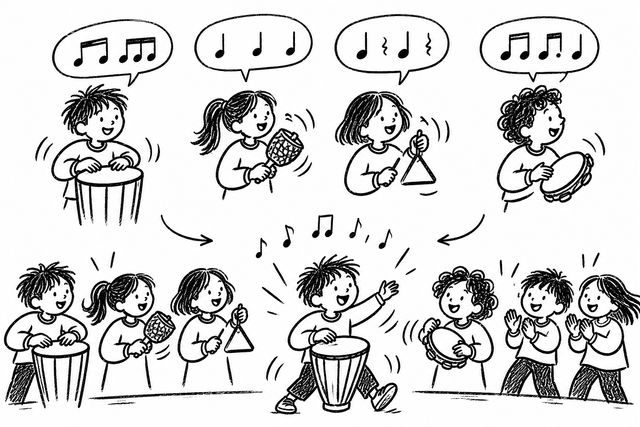
Students learn four Brazilian-inspired samba rhythms through call and response, rehearse them independently in four percussion groups, and layer the parts into a class groove. They then alternate the recurring rhythm section with student solo improvisations to create an ABA or ABACA rondo-form performance.
Procedures
- 1
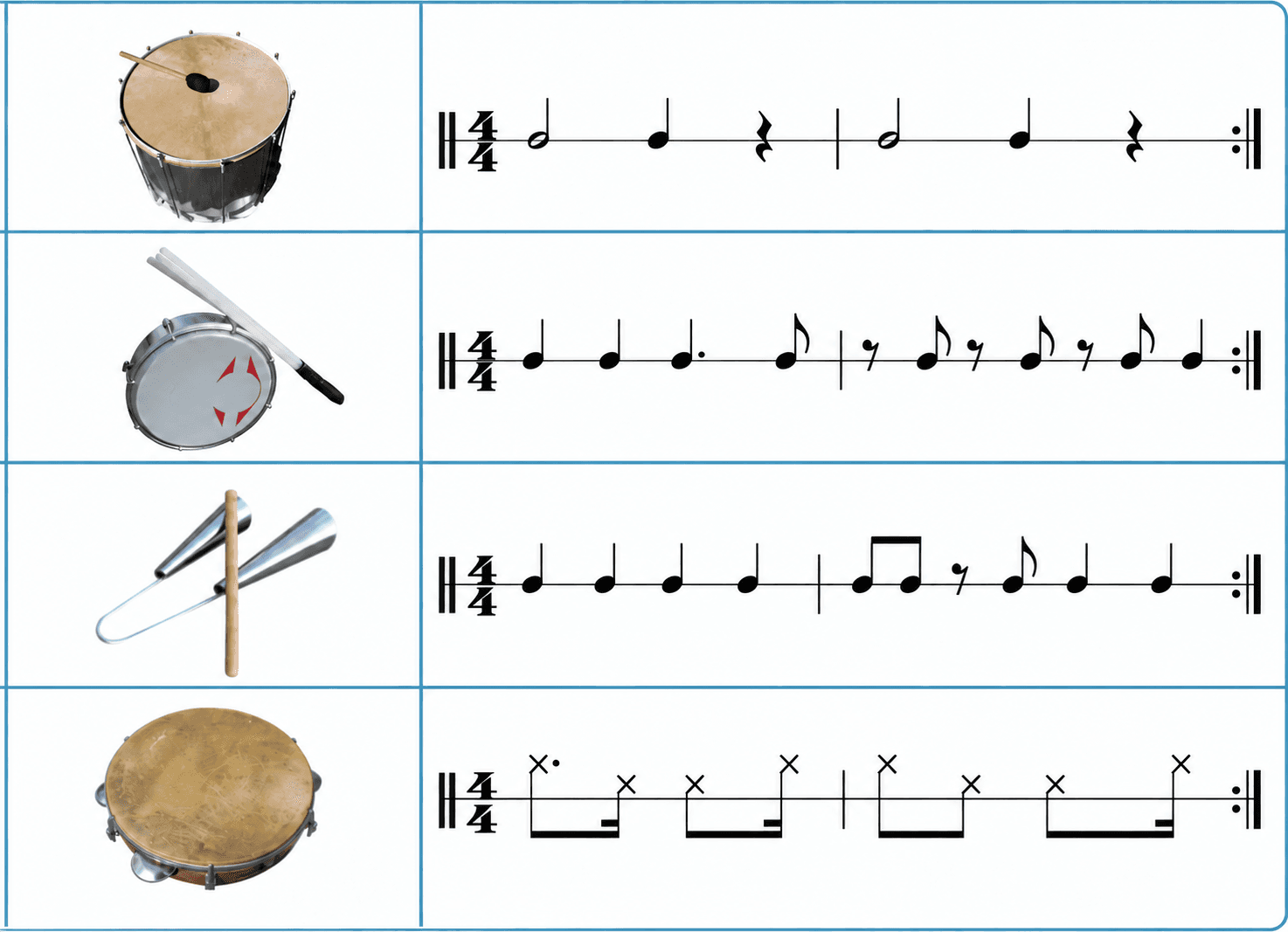
Teach four different Brazilian-inspired samba rhythms through call and response, one pattern at a time.
- 2
Invite student volunteers to take turns leading one of the learned rhythms, and encourage students to try establishing similar grooves.
- 3
Rehearse until students can perform the four rhythms independently with a steady pulse.
- 4
Divide the class into four groups and assign one rhythm to each group.
- 5
Choose student volunteers to lead the four sections using surdo, tamborim, agogô, or classroom percussion instruments with similar sound qualities.
- 6
Rehearse each group independently, then combine the four parts so the class can maintain the layered rhythm section together.
- 7
Establish the complete samba rhythm section as the recurring A section.
- 8
Invite one student soloist to improvise a contrasting rhythmic passage.
- 9
Alternate the recurring samba section with student solo improvisations to create an ABA or ABACA rondo pattern.
- 10
Repeat with different soloists and, when students are ready, with student-generated grooves.
Variations
1. Simplify: Use only two of the four rhythms and combine two groups before adding the remaining parts.
2. Increase challenge: Ask each group to maintain its ostinato without a teacher cue while another group or soloist performs a contrasting rhythm.
3. Student-created groove: Have students design a rhythm that resembles the learned samba-inspired patterns and teach it to their section through call and response.
4. Form extension: Begin with ABA, then expand to ABACA and ask students to identify each return of the A section.
5. Cultural listening extension: Listen to samba excerpts and discuss the instruments heard, the character of the music, and questions students have about Brazil and its music.
Reference Video Link
Activity Preparation
Worksheet (can be downloaded from website)
Activity Sources
- Source Type:
- Website / Online resource
- Source:
- Carnegie Hall, Music Educators Toolbox — Grade 5: “Improvising with Brazilian Samba.”https://www.carnegiehall.org/Education/Programs/Music-Educators-Toolbox/5-Improvising-with-Brazilian-Samba
MAPS teaching activities may come from a variety of sources, including original contributions by the MAPS team, online resources, published materials, activities learned from teachers, activities shared by colleagues, traditional teaching practices, and other sources. When a source can be reasonably identified, we make every effort to acknowledge it on the relevant activity page or in the accompanying reference information.
Some content may be organized, translated, structured, or adapted by the MAPS team for specific teaching contexts. Such editorial or instructional adaptation does not mean that MAPS claims ownership of the underlying third-party material. Rights to third-party content remain with the original authors, publishers, or other lawful rights holders.
If you are an author, copyright holder, or authorized representative and have questions or concerns regarding the source, attribution, or use of any content, please contact us:
Email: musicactivityps@gmail.com
Improvising with Brazilian Samba
Summary
Students learn four Brazilian-inspired samba rhythms through call and response, rehearse them independently in four percussion groups, and layer the parts into a class groove. They then alternate the recurring rhythm section with student solo improvisations to create an ABA or ABACA rondo-form performance.
Procedures
- 1
Teach four different Brazilian-inspired samba rhythms through call and response, one pattern at a time.
- 2
Invite student volunteers to take turns leading one of the learned rhythms, and encourage students to try establishing similar grooves.
- 3
Rehearse until students can perform the four rhythms independently with a steady pulse.
- 4
Divide the class into four groups and assign one rhythm to each group.
- 5
Choose student volunteers to lead the four sections using surdo, tamborim, agogô, or classroom percussion instruments with similar sound qualities.
- 6
Rehearse each group independently, then combine the four parts so the class can maintain the layered rhythm section together.
- 7
Establish the complete samba rhythm section as the recurring A section.
- 8
Invite one student soloist to improvise a contrasting rhythmic passage.
- 9
Alternate the recurring samba section with student solo improvisations to create an ABA or ABACA rondo pattern.
- 10
Repeat with different soloists and, when students are ready, with student-generated grooves.
Variations
1. Simplify: Use only two of the four rhythms and combine two groups before adding the remaining parts.
2. Increase challenge: Ask each group to maintain its ostinato without a teacher cue while another group or soloist performs a contrasting rhythm.
3. Student-created groove: Have students design a rhythm that resembles the learned samba-inspired patterns and teach it to their section through call and response.
4. Form extension: Begin with ABA, then expand to ABACA and ask students to identify each return of the A section.
5. Cultural listening extension: Listen to samba excerpts and discuss the instruments heard, the character of the music, and questions students have about Brazil and its music.
Reference Video Link
Activity Preparation
Worksheet (can be downloaded from website)
Activity Sources
- Source Type:
- Website / Online resource
- Source:
- Carnegie Hall, Music Educators Toolbox — Grade 5: “Improvising with Brazilian Samba.”https://www.carnegiehall.org/Education/Programs/Music-Educators-Toolbox/5-Improvising-with-Brazilian-Samba
MAPS teaching activities may come from a variety of sources, including original contributions by the MAPS team, online resources, published materials, activities learned from teachers, activities shared by colleagues, traditional teaching practices, and other sources. When a source can be reasonably identified, we make every effort to acknowledge it on the relevant activity page or in the accompanying reference information.
Some content may be organized, translated, structured, or adapted by the MAPS team for specific teaching contexts. Such editorial or instructional adaptation does not mean that MAPS claims ownership of the underlying third-party material. Rights to third-party content remain with the original authors, publishers, or other lawful rights holders.
If you are an author, copyright holder, or authorized representative and have questions or concerns regarding the source, attribution, or use of any content, please contact us:
Email: musicactivityps@gmail.com