 MAPS
Land on the Last Beat
Summary
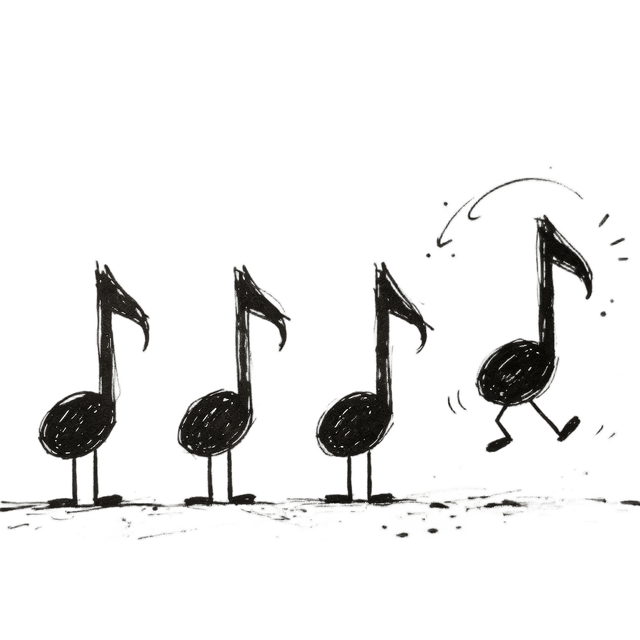
The teacher prepares musical material made up of several four-note groups. Students jump when they hear the fourth note of each group and land exactly on the beat. The key is that students cannot wait until the fourth note sounds before beginning the jump. Instead, they must establish a steady internal beat from the first three notes and anticipate when the fourth note will occur in order to land on time. Students without prior training often begin jumping only after hearing the fourth note, and this delayed response is especially noticeable in slower groups. Through the repeated cycle of listening to the first three notes—anticipating the fourth note—landing on the beat, the game strengthens students’ sense of steady beat and their ability to adjust immediately to changes in tempo.
Procedures
 1
The teacher prepares musical material made up of four-note groups, with a steady tempo within each group and randomly varied tempos from one group to the next. Begin with one slow four-note group so students can become familiar with the “four notes per group” structure.
- 2
The teacher explains the rule: “Each group has four notes. When you hear the fourth note, jump and land on the floor together.” The teacher may demonstrate one group first so students can identify where the fourth note occurs.
- 3
Before adding the jump, the teacher plays one four-note group and asks students to count the four notes using their fingers or by nodding, making sure everyone can accurately identify the fourth note.
- 4
Begin the game: the teacher continuously plays multiple four-note groups at different tempos. Students jump so that their movement and landing align with the fourth note of each group.
- 5
The teacher observes whether students are already physically prepared before the fourth note and can land on time, or whether they wait until they hear the fourth note and then jump too late. Slow-tempo groups are especially useful for revealing this difference and helping the teacher identify students who have not yet developed a stable internal beat.
Variations
1. The teacher prepares musical material made up of four-note groups, with a steady tempo within each group and randomly varied tempos from one group to the next. Begin with one slow four-note group so students can become familiar with the “four notes per group” structure.
2. The teacher explains the rule: “Each group has four notes. When you hear the fourth note, jump and land on the floor together.” The teacher may demonstrate one group first so students can identify where the fourth note occurs.
3. Before adding the jump, the teacher plays one four-note group and asks students to count the four notes using their fingers or by nodding, making sure everyone can accurately identify the fourth note.
4. Begin the game: the teacher continuously plays multiple four-note groups at different tempos. Students jump so that their movement and landing align with the fourth note of each group.
5. The teacher observes whether students are already physically prepared before the fourth note and can land on time, or whether they wait until they hear the fourth note and then jump too late. Slow-tempo groups are especially useful for revealing this difference and helping the teacher identify students who have not yet developed a stable internal beat.
Reference Video Link
Activity Preparation
1. Prepare musical material consisting of multiple four-note groups played in sequence, with the tempo varying randomly from group to group. The material can be created using percussion instruments, a metronome, or audio-editing software. About 6–10 groups are recommended.
2. Prepare a playback device or piano/percussion instruments. Make sure there is enough open space in the classroom, with students standing at least an arm’s length apart from one another.
Activity Sources
- Source Type:
- Shared by colleague
MAPS teaching activities may come from a variety of sources, including original contributions by the MAPS team, online resources, published materials, activities learned from teachers, activities shared by colleagues, traditional teaching practices, and other sources. When a source can be reasonably identified, we make every effort to acknowledge it on the relevant activity page or in the accompanying reference information.
Some content may be organized, translated, structured, or adapted by the MAPS team for specific teaching contexts. Such editorial or instructional adaptation does not mean that MAPS claims ownership of the underlying third-party material. Rights to third-party content remain with the original authors, publishers, or other lawful rights holders.
If you are an author, copyright holder, or authorized representative and have questions or concerns regarding the source, attribution, or use of any content, please contact us:
Email: musicactivityps@gmail.com
Land on the Last Beat
Summary
The teacher prepares musical material made up of several four-note groups. Students jump when they hear the fourth note of each group and land exactly on the beat. The key is that students cannot wait until the fourth note sounds before beginning the jump. Instead, they must establish a steady internal beat from the first three notes and anticipate when the fourth note will occur in order to land on time. Students without prior training often begin jumping only after hearing the fourth note, and this delayed response is especially noticeable in slower groups. Through the repeated cycle of listening to the first three notes—anticipating the fourth note—landing on the beat, the game strengthens students’ sense of steady beat and their ability to adjust immediately to changes in tempo.
Procedures
- 1
The teacher prepares musical material made up of four-note groups, with a steady tempo within each group and randomly varied tempos from one group to the next. Begin with one slow four-note group so students can become familiar with the “four notes per group” structure.
- 2
The teacher explains the rule: “Each group has four notes. When you hear the fourth note, jump and land on the floor together.” The teacher may demonstrate one group first so students can identify where the fourth note occurs.
- 3
Before adding the jump, the teacher plays one four-note group and asks students to count the four notes using their fingers or by nodding, making sure everyone can accurately identify the fourth note.
- 4
Begin the game: the teacher continuously plays multiple four-note groups at different tempos. Students jump so that their movement and landing align with the fourth note of each group.
- 5
The teacher observes whether students are already physically prepared before the fourth note and can land on time, or whether they wait until they hear the fourth note and then jump too late. Slow-tempo groups are especially useful for revealing this difference and helping the teacher identify students who have not yet developed a stable internal beat.
Variations
1. The teacher prepares musical material made up of four-note groups, with a steady tempo within each group and randomly varied tempos from one group to the next. Begin with one slow four-note group so students can become familiar with the “four notes per group” structure.
2. The teacher explains the rule: “Each group has four notes. When you hear the fourth note, jump and land on the floor together.” The teacher may demonstrate one group first so students can identify where the fourth note occurs.
3. Before adding the jump, the teacher plays one four-note group and asks students to count the four notes using their fingers or by nodding, making sure everyone can accurately identify the fourth note.
4. Begin the game: the teacher continuously plays multiple four-note groups at different tempos. Students jump so that their movement and landing align with the fourth note of each group.
5. The teacher observes whether students are already physically prepared before the fourth note and can land on time, or whether they wait until they hear the fourth note and then jump too late. Slow-tempo groups are especially useful for revealing this difference and helping the teacher identify students who have not yet developed a stable internal beat.
Reference Video Link
Activity Preparation
1. Prepare musical material consisting of multiple four-note groups played in sequence, with the tempo varying randomly from group to group. The material can be created using percussion instruments, a metronome, or audio-editing software. About 6–10 groups are recommended.
2. Prepare a playback device or piano/percussion instruments. Make sure there is enough open space in the classroom, with students standing at least an arm’s length apart from one another.
Activity Sources
- Source Type:
- Shared by colleague
MAPS teaching activities may come from a variety of sources, including original contributions by the MAPS team, online resources, published materials, activities learned from teachers, activities shared by colleagues, traditional teaching practices, and other sources. When a source can be reasonably identified, we make every effort to acknowledge it on the relevant activity page or in the accompanying reference information.
Some content may be organized, translated, structured, or adapted by the MAPS team for specific teaching contexts. Such editorial or instructional adaptation does not mean that MAPS claims ownership of the underlying third-party material. Rights to third-party content remain with the original authors, publishers, or other lawful rights holders.
If you are an author, copyright holder, or authorized representative and have questions or concerns regarding the source, attribution, or use of any content, please contact us:
Email: musicactivityps@gmail.com