MAPS
Landmark Note Jump
Summary
Students use the piano grand staff to build a visual map of seven landmark notes: Middle C, Treble G, Bass F, High C, Low C, Flying F, and Ground G. They first recognize the landmarks as paired positions around Middle C, then use the nearest landmark as a reference point to identify nearby notes by step or skip. The activity helps students move away from counting every line and space and toward faster, relationship-based note reading.
Procedures
 1
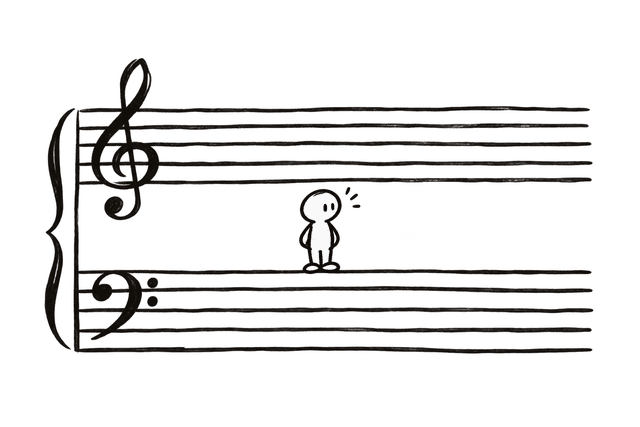
Show a piano grand staff with the treble staff above and the bass staff below. Confirm that students already understand the two clefs, then introduce Middle C as the central reference point between the staves. Have students locate and play Middle C on the piano.
- 2
Introduce the first landmark pair: Treble G and Bass F. Place both notes on the grand staff and ask students to compare their positions around Middle C. Have students point to each note on the staff and then play Bass F–Middle C–Treble G on the piano.
- 3
Add High C and Low C. Ask students what stays the same and what changes. Emphasize that both are C in different registers, and have students play Low C–Middle C–High C to connect the visual spacing on the grand staff with the keyboard.
- 4
Add the outer pair, Flying F and Ground G. Use the names as memory cues: Flying F is high on the top line of the treble staff, while Ground G is low on the bottom line of the bass staff. Have students identify and play both notes.
- 5
Display all seven landmarks from top to bottom: Flying F, High C, Treble G, Middle C, Bass F, Low C, Ground G. Point to landmarks in random order and ask students to name them, find them on the piano, or identify their paired landmark across Middle C.
- 6
Begin the Landmark Jump. Place an unfamiliar note one step or one skip away from a landmark. Ask students to start from the landmark, identify the direction and distance, and determine the new note. For example: one step above Treble G = A; one skip below Bass F = D.
- 7
Apply the strategy to short excerpts. Before reading, ask students to locate any landmark notes first, then use the nearest landmark to work out nearby notes. Gradually reduce verbal prompts so that students begin using landmarks independently during reading.
Variations
1. Mirror Partner Match: Call or show one landmark and ask students to find its paired landmark across Middle C: Treble G–Bass F, High C–Low C, or Flying F–Ground G. Students can then play the pair with Middle C in between to reinforce the spatial relationship.
2. Jump Challenge: Start from a named landmark and give a sequence such as “step up, skip down, step down.” Students move a note token on the staff or follow the sequence at the keyboard. Keep early jumps within steps and skips before adding larger intervals.
3. Landmarks in Repertoire: Use a short excerpt from the student's current piece or a sight-reading example. Have the student lightly circle or point out landmark notes first, then read the surrounding notes from those anchors. Remove the markings once the student can use the strategy independently.
4. Quick-Draw Grand Staff: Give students a blank grand staff and ask them to place as many of the seven landmarks as they can from memory. After checking the map, they correct any misplaced notes and explain the visual relationship that helps them remember each pair.
Activity Preparation
1.Materials
a. A printed, projected, or whiteboard piano grand staff with the treble staff above and bass staff below.
b. Seven landmark-note cards or movable note markers: Middle C, Treble G, Bass F, High C, Low C, Flying F, and Ground G.
c. A piano or keyboard for connecting notation to physical key locations.
2.Prior Knowledge
a. Students should already understand the basic meaning of the treble and bass clefs; this activity does not teach clef symbols from the beginning.
b. Students should understand that notes are placed on lines and spaces and know the musical alphabet A–G.
c. Students should be able to recognize simple step and skip relationships, or the teacher can briefly review these before the Landmark Jump portion.
Activity Sources
- Source Type:
- Textbook / Book
- Source:
- Open Music Theory, Version 2. Online open textbook, Pressbooks.
- Adaptation Notes:
- Organizes landmark-note reading around the spatial structure of the piano grand staff and extends memorized landmarks into nearby-note reading by step and skip.
MAPS teaching activities may come from a variety of sources, including original contributions by the MAPS team, online resources, published materials, activities learned from teachers, activities shared by colleagues, traditional teaching practices, and other sources. When a source can be reasonably identified, we make every effort to acknowledge it on the relevant activity page or in the accompanying reference information.
Some content may be organized, translated, structured, or adapted by the MAPS team for specific teaching contexts. Such editorial or instructional adaptation does not mean that MAPS claims ownership of the underlying third-party material. Rights to third-party content remain with the original authors, publishers, or other lawful rights holders.
If you are an author, copyright holder, or authorized representative and have questions or concerns regarding the source, attribution, or use of any content, please contact us:
Email: musicactivityps@gmail.com
Landmark Note Jump
Summary
Students use the piano grand staff to build a visual map of seven landmark notes: Middle C, Treble G, Bass F, High C, Low C, Flying F, and Ground G. They first recognize the landmarks as paired positions around Middle C, then use the nearest landmark as a reference point to identify nearby notes by step or skip. The activity helps students move away from counting every line and space and toward faster, relationship-based note reading.
Procedures
- 1
Show a piano grand staff with the treble staff above and the bass staff below. Confirm that students already understand the two clefs, then introduce Middle C as the central reference point between the staves. Have students locate and play Middle C on the piano.
- 2
Introduce the first landmark pair: Treble G and Bass F. Place both notes on the grand staff and ask students to compare their positions around Middle C. Have students point to each note on the staff and then play Bass F–Middle C–Treble G on the piano.
- 3
Add High C and Low C. Ask students what stays the same and what changes. Emphasize that both are C in different registers, and have students play Low C–Middle C–High C to connect the visual spacing on the grand staff with the keyboard.
- 4
Add the outer pair, Flying F and Ground G. Use the names as memory cues: Flying F is high on the top line of the treble staff, while Ground G is low on the bottom line of the bass staff. Have students identify and play both notes.
- 5
Display all seven landmarks from top to bottom: Flying F, High C, Treble G, Middle C, Bass F, Low C, Ground G. Point to landmarks in random order and ask students to name them, find them on the piano, or identify their paired landmark across Middle C.
- 6
Begin the Landmark Jump. Place an unfamiliar note one step or one skip away from a landmark. Ask students to start from the landmark, identify the direction and distance, and determine the new note. For example: one step above Treble G = A; one skip below Bass F = D.
- 7
Apply the strategy to short excerpts. Before reading, ask students to locate any landmark notes first, then use the nearest landmark to work out nearby notes. Gradually reduce verbal prompts so that students begin using landmarks independently during reading.
Variations
1. Mirror Partner Match: Call or show one landmark and ask students to find its paired landmark across Middle C: Treble G–Bass F, High C–Low C, or Flying F–Ground G. Students can then play the pair with Middle C in between to reinforce the spatial relationship.
2. Jump Challenge: Start from a named landmark and give a sequence such as “step up, skip down, step down.” Students move a note token on the staff or follow the sequence at the keyboard. Keep early jumps within steps and skips before adding larger intervals.
3. Landmarks in Repertoire: Use a short excerpt from the student's current piece or a sight-reading example. Have the student lightly circle or point out landmark notes first, then read the surrounding notes from those anchors. Remove the markings once the student can use the strategy independently.
4. Quick-Draw Grand Staff: Give students a blank grand staff and ask them to place as many of the seven landmarks as they can from memory. After checking the map, they correct any misplaced notes and explain the visual relationship that helps them remember each pair.
Activity Preparation
1.Materials
a. A printed, projected, or whiteboard piano grand staff with the treble staff above and bass staff below.
b. Seven landmark-note cards or movable note markers: Middle C, Treble G, Bass F, High C, Low C, Flying F, and Ground G.
c. A piano or keyboard for connecting notation to physical key locations.
2.Prior Knowledge
a. Students should already understand the basic meaning of the treble and bass clefs; this activity does not teach clef symbols from the beginning.
b. Students should understand that notes are placed on lines and spaces and know the musical alphabet A–G.
c. Students should be able to recognize simple step and skip relationships, or the teacher can briefly review these before the Landmark Jump portion.
Activity Sources
- Source Type:
- Textbook / Book
- Source:
- Open Music Theory, Version 2. Online open textbook, Pressbooks.
- Adaptation Notes:
- Organizes landmark-note reading around the spatial structure of the piano grand staff and extends memorized landmarks into nearby-note reading by step and skip.
MAPS teaching activities may come from a variety of sources, including original contributions by the MAPS team, online resources, published materials, activities learned from teachers, activities shared by colleagues, traditional teaching practices, and other sources. When a source can be reasonably identified, we make every effort to acknowledge it on the relevant activity page or in the accompanying reference information.
Some content may be organized, translated, structured, or adapted by the MAPS team for specific teaching contexts. Such editorial or instructional adaptation does not mean that MAPS claims ownership of the underlying third-party material. Rights to third-party content remain with the original authors, publishers, or other lawful rights holders.
If you are an author, copyright holder, or authorized representative and have questions or concerns regarding the source, attribution, or use of any content, please contact us:
Email: musicactivityps@gmail.com