MAPS
Legato or Staccato?
Summary
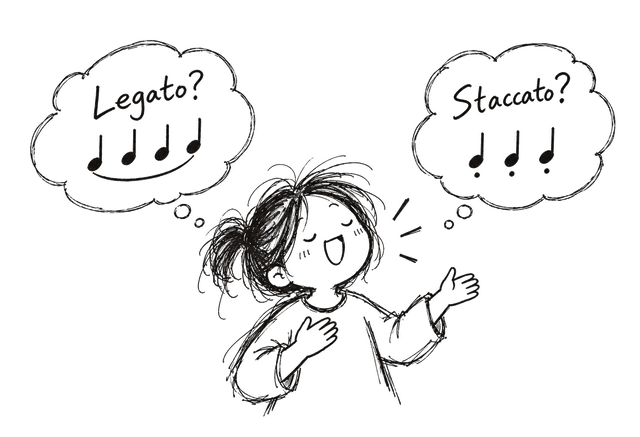
A concept-building and exploratory activity in which students sing a familiar song in both legato and staccato styles to experience and compare the two articulations. Students learn that legato sounds smooth and connected, while staccato sounds short and detached.
Procedures
- 1
Sing Normally: The teacher leads students in singing Happy Birthday to You once in their usual way to establish a familiar musical starting point.
- 2
Sing Staccato: The teacher introduces staccato as short and detached sounds, demonstrates it, and then leads students in singing Happy Birthday to You in staccato.
- 3
Sing Legato: The teacher introduces legato as smooth and connected sounds, demonstrates it, and then leads students in singing the song in legato.
- 4
Gesture-Cue Switching Game: The teacher establishes two visual cues: point to the leg → Legato; point upward → Staccato. Students continue singing Happy Birthday to You while watching the teacher. The teacher changes the gesture at different points in the song, and students immediately switch between legato and staccato singing accordingly.
Variations
1. Classroom management: Make sure all students can clearly see the visual cues. Begin with slower changes between legato and staccato, then increase the switching frequency as students become more confident.
2. Easier: Sing the entire song in one articulation before switching.
3. More challenging: Switch randomly and more frequently between legato and staccato during the song.
4. Extensions: Perform the same melody on piano or another instrument using both articulations; or let students take turns as the “conductor,” using gestures to cue the class to switch between legato and staccato.
Reference Video Link
Activity Sources
- Source Type:
- Website / Online resource
- Source:
- Adapted from a Legato and Staccato teaching activity in a Myleene’s Music Klass video. The original video includes singing, kitchen instruments, and instrumental playing; this version retains and adapts only the singing portion.
- Adaptation Notes:
- Organized and adapted from publicly available video content for teaching use.
MAPS teaching activities may come from a variety of sources, including original contributions by the MAPS team, online resources, published materials, activities learned from teachers, activities shared by colleagues, traditional teaching practices, and other sources. When a source can be reasonably identified, we make every effort to acknowledge it on the relevant activity page or in the accompanying reference information.
Some content may be organized, translated, structured, or adapted by the MAPS team for specific teaching contexts. Such editorial or instructional adaptation does not mean that MAPS claims ownership of the underlying third-party material. Rights to third-party content remain with the original authors, publishers, or other lawful rights holders.
If you are an author, copyright holder, or authorized representative and have questions or concerns regarding the source, attribution, or use of any content, please contact us:
Email: musicactivityps@gmail.com
Legato or Staccato?
Summary
A concept-building and exploratory activity in which students sing a familiar song in both legato and staccato styles to experience and compare the two articulations. Students learn that legato sounds smooth and connected, while staccato sounds short and detached.
Procedures
- 1
Sing Normally: The teacher leads students in singing Happy Birthday to You once in their usual way to establish a familiar musical starting point.
- 2
Sing Staccato: The teacher introduces staccato as short and detached sounds, demonstrates it, and then leads students in singing Happy Birthday to You in staccato.
- 3
Sing Legato: The teacher introduces legato as smooth and connected sounds, demonstrates it, and then leads students in singing the song in legato.
- 4
Gesture-Cue Switching Game: The teacher establishes two visual cues: point to the leg → Legato; point upward → Staccato. Students continue singing Happy Birthday to You while watching the teacher. The teacher changes the gesture at different points in the song, and students immediately switch between legato and staccato singing accordingly.
Variations
1. Classroom management: Make sure all students can clearly see the visual cues. Begin with slower changes between legato and staccato, then increase the switching frequency as students become more confident.
2. Easier: Sing the entire song in one articulation before switching.
3. More challenging: Switch randomly and more frequently between legato and staccato during the song.
4. Extensions: Perform the same melody on piano or another instrument using both articulations; or let students take turns as the “conductor,” using gestures to cue the class to switch between legato and staccato.
Reference Video Link
Activity Sources
- Source Type:
- Website / Online resource
- Source:
- Adapted from a Legato and Staccato teaching activity in a Myleene’s Music Klass video. The original video includes singing, kitchen instruments, and instrumental playing; this version retains and adapts only the singing portion.
- Adaptation Notes:
- Organized and adapted from publicly available video content for teaching use.
MAPS teaching activities may come from a variety of sources, including original contributions by the MAPS team, online resources, published materials, activities learned from teachers, activities shared by colleagues, traditional teaching practices, and other sources. When a source can be reasonably identified, we make every effort to acknowledge it on the relevant activity page or in the accompanying reference information.
Some content may be organized, translated, structured, or adapted by the MAPS team for specific teaching contexts. Such editorial or instructional adaptation does not mean that MAPS claims ownership of the underlying third-party material. Rights to third-party content remain with the original authors, publishers, or other lawful rights holders.
If you are an author, copyright holder, or authorized representative and have questions or concerns regarding the source, attribution, or use of any content, please contact us:
Email: musicactivityps@gmail.com