 MAPS
Listening for Contrasts in Genre
Summary
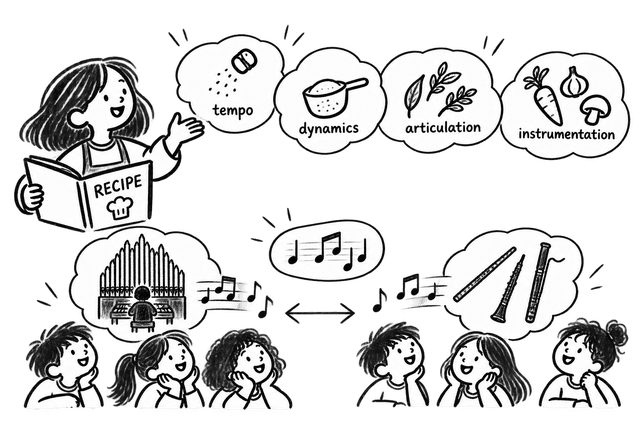
Students explore how musical elements such as tempo, dynamics, articulation, and instrumentation shape the sound of a performance. After reviewing these elements through a familiar recipe analogy, students listen to two recordings of “Little Fugue” performed by Organ and woodwind quartet. Guided by the teacher, they identify what remains the same and compare differences in timbre, instrumentation, and expressive character.
Procedures
- 1
Begin by discussing how ingredients give recipes their distinctive qualities. Ask students how changing the ingredients of a chocolate sundae would alter the result.
- 2
Connect recipe ingredients to musical elements. Invite students to name ways musicians can shape a piece, including tempo, dynamics, articulation, and instrumentation.
- 3
Briefly review the meanings of these musical elements, emphasizing that the same composition can sound different in different performances.
- 4
Play the recording of “Little Fugue” performed by organ. Ask students to listen for the performing voices, timbre, and overall musical character.
- 5
Play the recording of “Little Fugue” performed by woodwind quartet. Ask students to notice the instrumentation, timbre, and expressive character of this version.
- 6
Guide a class comparison: What is the same in the two performances? What sounds different? Which musical elements—especially instrumentation and timbre—help explain those differences? Replay short excerpts as needed so students can support their observations with audible examples.
Activity Preparation
Review the terminology for tempo, dynamics, articulation, instrumentation, and timbre; prepare a few listening questions to guide discussion.
Activity Sources
- Source Type:
- Website / Online resource
MAPS teaching activities may come from a variety of sources, including original contributions by the MAPS team, online resources, published materials, activities learned from teachers, activities shared by colleagues, traditional teaching practices, and other sources. When a source can be reasonably identified, we make every effort to acknowledge it on the relevant activity page or in the accompanying reference information.
Some content may be organized, translated, structured, or adapted by the MAPS team for specific teaching contexts. Such editorial or instructional adaptation does not mean that MAPS claims ownership of the underlying third-party material. Rights to third-party content remain with the original authors, publishers, or other lawful rights holders.
If you are an author, copyright holder, or authorized representative and have questions or concerns regarding the source, attribution, or use of any content, please contact us:
Email: musicactivityps@gmail.com
Listening for Contrasts in Genre
Summary
Students explore how musical elements such as tempo, dynamics, articulation, and instrumentation shape the sound of a performance. After reviewing these elements through a familiar recipe analogy, students listen to two recordings of “Little Fugue” performed by Organ and woodwind quartet. Guided by the teacher, they identify what remains the same and compare differences in timbre, instrumentation, and expressive character.
Procedures
- 1
Begin by discussing how ingredients give recipes their distinctive qualities. Ask students how changing the ingredients of a chocolate sundae would alter the result.
- 2
Connect recipe ingredients to musical elements. Invite students to name ways musicians can shape a piece, including tempo, dynamics, articulation, and instrumentation.
- 3
Briefly review the meanings of these musical elements, emphasizing that the same composition can sound different in different performances.
- 4
Play the recording of “Little Fugue” performed by organ. Ask students to listen for the performing voices, timbre, and overall musical character.
- 5
Play the recording of “Little Fugue” performed by woodwind quartet. Ask students to notice the instrumentation, timbre, and expressive character of this version.
- 6
Guide a class comparison: What is the same in the two performances? What sounds different? Which musical elements—especially instrumentation and timbre—help explain those differences? Replay short excerpts as needed so students can support their observations with audible examples.
Activity Preparation
Review the terminology for tempo, dynamics, articulation, instrumentation, and timbre; prepare a few listening questions to guide discussion.
Activity Sources
- Source Type:
- Website / Online resource
MAPS teaching activities may come from a variety of sources, including original contributions by the MAPS team, online resources, published materials, activities learned from teachers, activities shared by colleagues, traditional teaching practices, and other sources. When a source can be reasonably identified, we make every effort to acknowledge it on the relevant activity page or in the accompanying reference information.
Some content may be organized, translated, structured, or adapted by the MAPS team for specific teaching contexts. Such editorial or instructional adaptation does not mean that MAPS claims ownership of the underlying third-party material. Rights to third-party content remain with the original authors, publishers, or other lawful rights holders.
If you are an author, copyright holder, or authorized representative and have questions or concerns regarding the source, attribution, or use of any content, please contact us:
Email: musicactivityps@gmail.com