MAPS
Mini Percussion Quartet
Summary
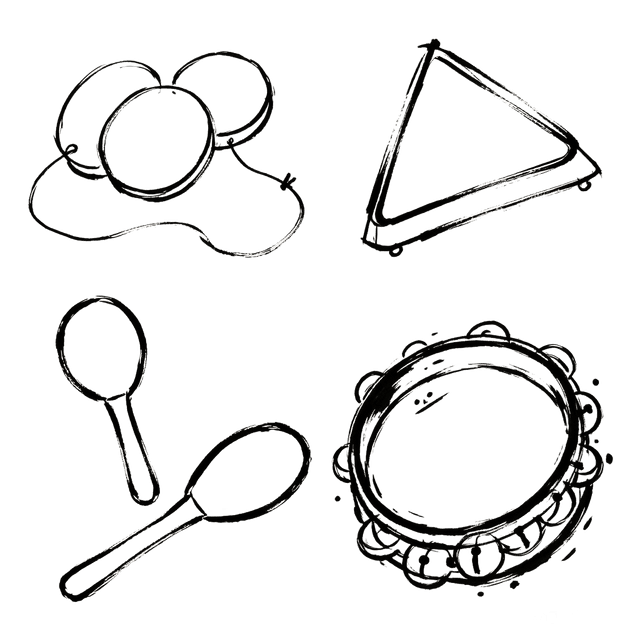
Modeled on Akiko Yamamoto's demonstration video, students watch a quartet of wood block, hand bell, tambourine and triangle perform the Lupin Ⅲ Theme (by Yuji Ohno), and follow five chalkboard hints — sounds layering, repetition, rhythms layering, call and answer, and unison — then try each one with claps, body percussion and instruments.
Procedures
- 1
Introduce the Instruments and the “Mystery Melody” (3 minutes): The teacher introduces four small percussion instruments one at a time—a woodblock, handbell, tambourine, and triangle—and plays each instrument once. Students identify which instrument they hear. The teacher, or a recording, then plays the main theme from Lupin the Third Theme ’78, composed by Yuji Ohno, so that students become familiar with the melody before beginning the listening activity.
- 2
First Complete Viewing (4 minutes): The class watches the quartet performance, either on video or demonstrated live by the teacher and three students. Students are given one listening task: each time a new instrument enters, they raise one finger and keep it raised. At the end, they count how many layers of sound are sounding at the same time.
- 3
Clue 1: Layering of Sound — Instruments Enter One by One (3 minutes): Write “Layering of Sound (Instrument Entries)” on the board. Listen to the opening again and notice that the instruments enter one at a time, with each instrument continuing to play after it enters. Students stack their hands in the air, adding one hand layer for each new instrument, to physically represent the texture becoming thicker.
- 4
Clue 2: Repetition (2 minutes): Write “Repetition” on the board. Students notice that each performer repeatedly plays the same short rhythmic pattern. Choose one instrument—for example, the woodblock—and have students clap its rhythmic pattern along with the video.
- 5
Clue 3: Layering of Rhythms (4 minutes): Write “Layering of Rhythms” on the board. Divide the class into two groups: one half claps the woodblock pattern while the other half claps the tambourine pattern. Practice each pattern separately first, then perform them simultaneously so students can hear and experience two different rhythmic patterns layered together, just as they are in the video.
- 6
Clue 4: Call and Response (4 minutes): Write “Call and Response” on the board. The teacher plays a short “call” on a drum, and the class answers by clapping a “response.” Then divide the class into two groups: one group performs the theme rhythm as the call, and the other responds. Point out that in the video, the tambourine gives the call and the other instruments respond.
- 7
Clue 5: Playing the Same Rhythm Together — Unison (3 minutes): Write “Same Rhythm (Unison)” on the board. Watch the ending and notice how all four performers shift to the same rhythm before finishing together on a strong accented note. The class then performs the ending phrase in unison—first by clapping and, if instruments are available, by playing—to experience the effect of everyone joining together as one ensemble.
- 8
Musical-Elements Map and Second Viewing (3 minutes): The board now displays all five clues: Layering of Sound / Repetition / Layering of Rhythms / Call and Response / Unison. Watch the complete performance again. Students silently indicate which clue they hear using gestures: stacking hands = layering of sound; alternating fists = repetition; hands separated = layering of rhythms; passing an imaginary ball = call and response; one raised fist = unison. Conclude by explaining that these five musical ideas function like building blocks that shape the music.
Variations
1. Classroom Management: Agree on the five silent signals before watching; watching rounds are completely silent and instruments stay under chairs until the performing rounds; the teacher's raised hand freezes all sound at once.
2. Difficulty Adjustments: Easier—work with only two hints (layering and unison) and let the teacher chant every rhythm pattern first; harder—each group invents its own short pattern for the theme, then arranges the five hints in their own order (layering → call and response → unison) and performs it.
3. Extensions: re-arrange another familiar cartoon or song theme as a mini percussion quartet using the same five hints; or listen to a pop song and hunt for where each of the five hints appears.
Reference Video Link
Activity Preparation
1. wood block, hand bell, tambourine and triangle — if instruments are hard to get, use body-percussion substitutes (desk tap, knee clap, finger snap, tongue click);
2. Recording of the Lupin Ⅲ Theme or the teacher playing the riff on piano;
3. Five hint words presented.
Activity Sources
- Source Type:
- Website / Online resource
- Source:
- フラワービート(Flower Beat)
MAPS teaching activities may come from a variety of sources, including original contributions by the MAPS team, online resources, published materials, activities learned from teachers, activities shared by colleagues, traditional teaching practices, and other sources. When a source can be reasonably identified, we make every effort to acknowledge it on the relevant activity page or in the accompanying reference information.
Some content may be organized, translated, structured, or adapted by the MAPS team for specific teaching contexts. Such editorial or instructional adaptation does not mean that MAPS claims ownership of the underlying third-party material. Rights to third-party content remain with the original authors, publishers, or other lawful rights holders.
If you are an author, copyright holder, or authorized representative and have questions or concerns regarding the source, attribution, or use of any content, please contact us:
Email: musicactivityps@gmail.com
Mini Percussion Quartet
Summary
Modeled on Akiko Yamamoto's demonstration video, students watch a quartet of wood block, hand bell, tambourine and triangle perform the Lupin Ⅲ Theme (by Yuji Ohno), and follow five chalkboard hints — sounds layering, repetition, rhythms layering, call and answer, and unison — then try each one with claps, body percussion and instruments.
Procedures
- 1
Introduce the Instruments and the “Mystery Melody” (3 minutes): The teacher introduces four small percussion instruments one at a time—a woodblock, handbell, tambourine, and triangle—and plays each instrument once. Students identify which instrument they hear. The teacher, or a recording, then plays the main theme from Lupin the Third Theme ’78, composed by Yuji Ohno, so that students become familiar with the melody before beginning the listening activity.
- 2
First Complete Viewing (4 minutes): The class watches the quartet performance, either on video or demonstrated live by the teacher and three students. Students are given one listening task: each time a new instrument enters, they raise one finger and keep it raised. At the end, they count how many layers of sound are sounding at the same time.
- 3
Clue 1: Layering of Sound — Instruments Enter One by One (3 minutes): Write “Layering of Sound (Instrument Entries)” on the board. Listen to the opening again and notice that the instruments enter one at a time, with each instrument continuing to play after it enters. Students stack their hands in the air, adding one hand layer for each new instrument, to physically represent the texture becoming thicker.
- 4
Clue 2: Repetition (2 minutes): Write “Repetition” on the board. Students notice that each performer repeatedly plays the same short rhythmic pattern. Choose one instrument—for example, the woodblock—and have students clap its rhythmic pattern along with the video.
- 5
Clue 3: Layering of Rhythms (4 minutes): Write “Layering of Rhythms” on the board. Divide the class into two groups: one half claps the woodblock pattern while the other half claps the tambourine pattern. Practice each pattern separately first, then perform them simultaneously so students can hear and experience two different rhythmic patterns layered together, just as they are in the video.
- 6
Clue 4: Call and Response (4 minutes): Write “Call and Response” on the board. The teacher plays a short “call” on a drum, and the class answers by clapping a “response.” Then divide the class into two groups: one group performs the theme rhythm as the call, and the other responds. Point out that in the video, the tambourine gives the call and the other instruments respond.
- 7
Clue 5: Playing the Same Rhythm Together — Unison (3 minutes): Write “Same Rhythm (Unison)” on the board. Watch the ending and notice how all four performers shift to the same rhythm before finishing together on a strong accented note. The class then performs the ending phrase in unison—first by clapping and, if instruments are available, by playing—to experience the effect of everyone joining together as one ensemble.
- 8
Musical-Elements Map and Second Viewing (3 minutes): The board now displays all five clues: Layering of Sound / Repetition / Layering of Rhythms / Call and Response / Unison. Watch the complete performance again. Students silently indicate which clue they hear using gestures: stacking hands = layering of sound; alternating fists = repetition; hands separated = layering of rhythms; passing an imaginary ball = call and response; one raised fist = unison. Conclude by explaining that these five musical ideas function like building blocks that shape the music.
Variations
1. Classroom Management: Agree on the five silent signals before watching; watching rounds are completely silent and instruments stay under chairs until the performing rounds; the teacher's raised hand freezes all sound at once.
2. Difficulty Adjustments: Easier—work with only two hints (layering and unison) and let the teacher chant every rhythm pattern first; harder—each group invents its own short pattern for the theme, then arranges the five hints in their own order (layering → call and response → unison) and performs it.
3. Extensions: re-arrange another familiar cartoon or song theme as a mini percussion quartet using the same five hints; or listen to a pop song and hunt for where each of the five hints appears.
Reference Video Link
Activity Preparation
1. wood block, hand bell, tambourine and triangle — if instruments are hard to get, use body-percussion substitutes (desk tap, knee clap, finger snap, tongue click);
2. Recording of the Lupin Ⅲ Theme or the teacher playing the riff on piano;
3. Five hint words presented.
Activity Sources
- Source Type:
- Website / Online resource
- Source:
- フラワービート(Flower Beat)
MAPS teaching activities may come from a variety of sources, including original contributions by the MAPS team, online resources, published materials, activities learned from teachers, activities shared by colleagues, traditional teaching practices, and other sources. When a source can be reasonably identified, we make every effort to acknowledge it on the relevant activity page or in the accompanying reference information.
Some content may be organized, translated, structured, or adapted by the MAPS team for specific teaching contexts. Such editorial or instructional adaptation does not mean that MAPS claims ownership of the underlying third-party material. Rights to third-party content remain with the original authors, publishers, or other lawful rights holders.
If you are an author, copyright holder, or authorized representative and have questions or concerns regarding the source, attribution, or use of any content, please contact us:
Email: musicactivityps@gmail.com