 MAPS
Music Sculptor
Summary
Students "sculpt" their bodies into visible shapes that represent the musical elements they hear — reaching high for high pitches, crouching low for low pitches, expanding for loud dynamics, contracting for soft dynamics. As difficulty increases, students combine multiple elements simultaneously, sculpting body postures that reflect pitch, dynamics, and tempo all at once. This activity is ideal for experiential learning and exploration of musical concepts, especially for kinesthetic learners.
Procedures
- 1
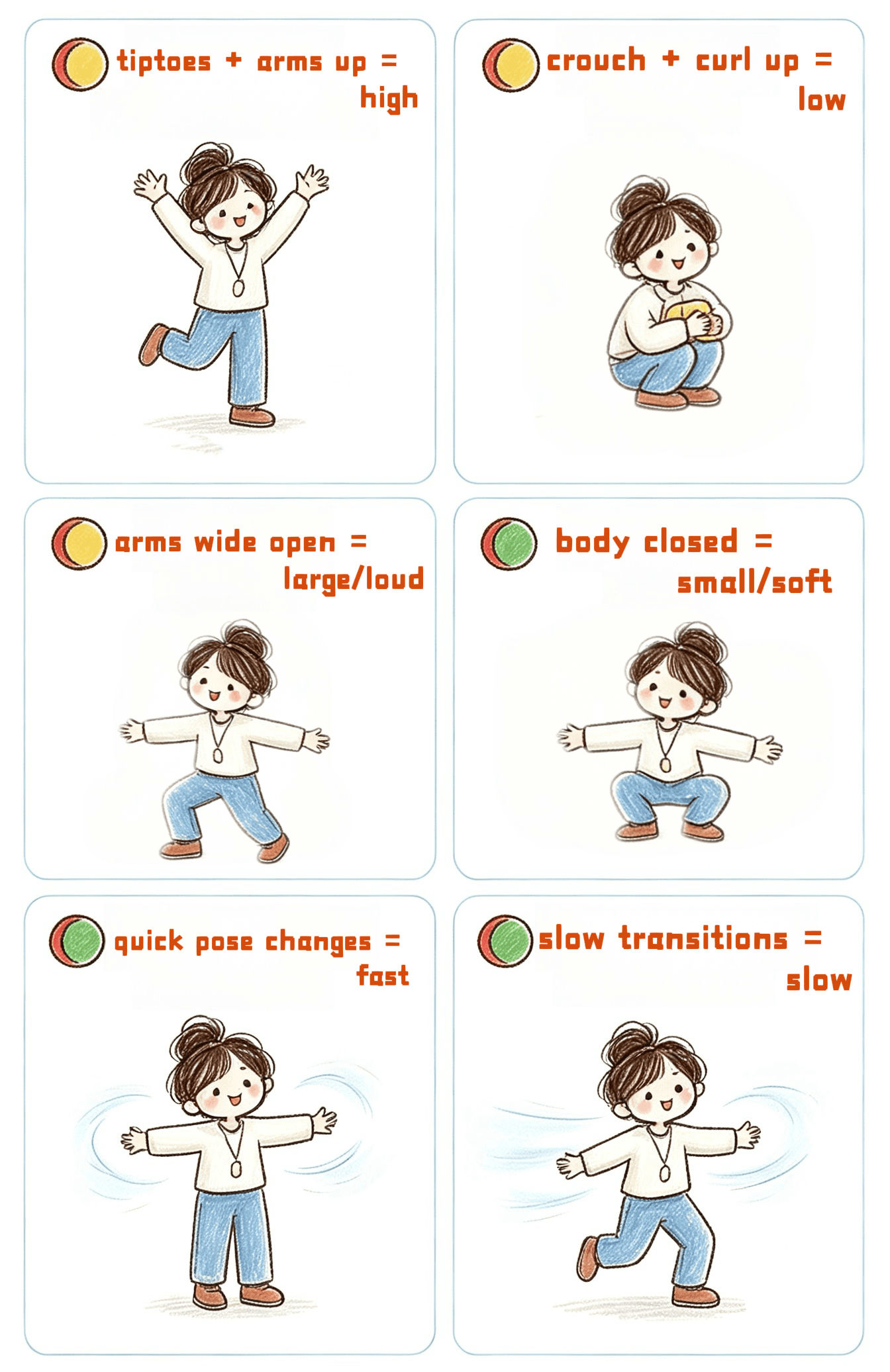
Without music, the teacher guides students in exploring three "sculpture dimensions": height (tiptoes + arms up = high, crouch + curl up = low), size (arms wide open = large/loud, body closed = small/soft), and speed (quick pose changes = fast, slow transitions = slow).
- 2
The teacher plays a passage with obvious pitch changes (e.g., ascending/descending piano scales). Students grow taller as the pitch rises (from crouch to standing to raising arms) and shrink as the pitch falls.
- 3
The teacher switches to a passage with clear dynamic changes (piano to forte). Students grow larger as the sound gets louder (arms from closed to wide open) and smaller as it gets softer.
- 4
The teacher plays a passage with tempo changes. Students transition from one sculpted pose to the next quickly or slowly, matching the music's speed.
- 5
The teacher combines two musical elements (e.g., high pitch + loud dynamics). Students must simultaneously "grow tall" and "grow large." The teacher presents all combinations: high+loud, high+soft, low+loud, low+soft.
- 6
The teacher combines three elements (e.g., high pitch + soft + fast). Students must synthesize and rapidly sculpt the corresponding full-body response.
- 7
Advanced play: The teacher no longer plays music live but verbally describes a musical scenario (e.g., "strong wind on a high mountain — loud and slow"). Students create sculptures from the description and freeze for 5 seconds while others guess the elements.
- 8
Close by inviting several students to present their "sculptures" at the front as the class observes and discusses the relationship between body posture and musical elements.
Variations
1. Classroom Management: Emphasize controlled movements and maintaining personal space to avoid collisions. During each "freeze," students must remain completely silent. For overexcited students, remind them: "Sculptures are quiet."
2. Difficulty Adjustments: To lower difficulty, process only one element at a time (pitch only or dynamics only); allow students to close their eyes and feel the music before moving. To increase difficulty, process four elements simultaneously (high/low + loud/soft + fast/slow + legato/staccato) and require creative, aesthetically pleasing poses.
3. Extensions: Introduce "partner sculptures" — two students collaborate on one sculpture, dividing the elements between them (one does pitch, the other does dynamics). Or create a "sculpture gallery" — students walk through the "gallery" of frozen sculptures, observing and commenting on each other's work.
Activity Preparation
Students standing with arm's-length spacing; piano or audio device with recordings of obvious pitch, dynamics, and tempo changes (or prepared for live improvisation); open classroom space with obstacles removed.
Activity Sources
- Source Type:
- MAPS Original
MAPS teaching activities may come from a variety of sources, including original contributions by the MAPS team, online resources, published materials, activities learned from teachers, activities shared by colleagues, traditional teaching practices, and other sources. When a source can be reasonably identified, we make every effort to acknowledge it on the relevant activity page or in the accompanying reference information.
Some content may be organized, translated, structured, or adapted by the MAPS team for specific teaching contexts. Such editorial or instructional adaptation does not mean that MAPS claims ownership of the underlying third-party material. Rights to third-party content remain with the original authors, publishers, or other lawful rights holders.
If you are an author, copyright holder, or authorized representative and have questions or concerns regarding the source, attribution, or use of any content, please contact us:
Email: musicactivityps@gmail.com
Music Sculptor
Summary
Students "sculpt" their bodies into visible shapes that represent the musical elements they hear — reaching high for high pitches, crouching low for low pitches, expanding for loud dynamics, contracting for soft dynamics. As difficulty increases, students combine multiple elements simultaneously, sculpting body postures that reflect pitch, dynamics, and tempo all at once. This activity is ideal for experiential learning and exploration of musical concepts, especially for kinesthetic learners.
Procedures
- 1
Without music, the teacher guides students in exploring three "sculpture dimensions": height (tiptoes + arms up = high, crouch + curl up = low), size (arms wide open = large/loud, body closed = small/soft), and speed (quick pose changes = fast, slow transitions = slow).
- 2
The teacher plays a passage with obvious pitch changes (e.g., ascending/descending piano scales). Students grow taller as the pitch rises (from crouch to standing to raising arms) and shrink as the pitch falls.
- 3
The teacher switches to a passage with clear dynamic changes (piano to forte). Students grow larger as the sound gets louder (arms from closed to wide open) and smaller as it gets softer.
- 4
The teacher plays a passage with tempo changes. Students transition from one sculpted pose to the next quickly or slowly, matching the music's speed.
- 5
The teacher combines two musical elements (e.g., high pitch + loud dynamics). Students must simultaneously "grow tall" and "grow large." The teacher presents all combinations: high+loud, high+soft, low+loud, low+soft.
- 6
The teacher combines three elements (e.g., high pitch + soft + fast). Students must synthesize and rapidly sculpt the corresponding full-body response.
- 7
Advanced play: The teacher no longer plays music live but verbally describes a musical scenario (e.g., "strong wind on a high mountain — loud and slow"). Students create sculptures from the description and freeze for 5 seconds while others guess the elements.
- 8
Close by inviting several students to present their "sculptures" at the front as the class observes and discusses the relationship between body posture and musical elements.
Variations
1. Classroom Management: Emphasize controlled movements and maintaining personal space to avoid collisions. During each "freeze," students must remain completely silent. For overexcited students, remind them: "Sculptures are quiet."
2. Difficulty Adjustments: To lower difficulty, process only one element at a time (pitch only or dynamics only); allow students to close their eyes and feel the music before moving. To increase difficulty, process four elements simultaneously (high/low + loud/soft + fast/slow + legato/staccato) and require creative, aesthetically pleasing poses.
3. Extensions: Introduce "partner sculptures" — two students collaborate on one sculpture, dividing the elements between them (one does pitch, the other does dynamics). Or create a "sculpture gallery" — students walk through the "gallery" of frozen sculptures, observing and commenting on each other's work.
Activity Preparation
Students standing with arm's-length spacing; piano or audio device with recordings of obvious pitch, dynamics, and tempo changes (or prepared for live improvisation); open classroom space with obstacles removed.
Activity Sources
- Source Type:
- MAPS Original
MAPS teaching activities may come from a variety of sources, including original contributions by the MAPS team, online resources, published materials, activities learned from teachers, activities shared by colleagues, traditional teaching practices, and other sources. When a source can be reasonably identified, we make every effort to acknowledge it on the relevant activity page or in the accompanying reference information.
Some content may be organized, translated, structured, or adapted by the MAPS team for specific teaching contexts. Such editorial or instructional adaptation does not mean that MAPS claims ownership of the underlying third-party material. Rights to third-party content remain with the original authors, publishers, or other lawful rights holders.
If you are an author, copyright holder, or authorized representative and have questions or concerns regarding the source, attribution, or use of any content, please contact us:
Email: musicactivityps@gmail.com