MAPS
Name Introduction

Summary
Students take turns introducing themselves by saying their names in time with a continuous steady beat. This activity can be used at the beginning of the semester to help students get to know one another while developing their awareness of a steady beat.
Procedures
- 1
Form a circle and establish the beat. The teacher invites students to stand in a circle and says, “Today we will introduce ourselves and get to know one another.” The class gently pats their thighs once per quarter-note beat.
- 2
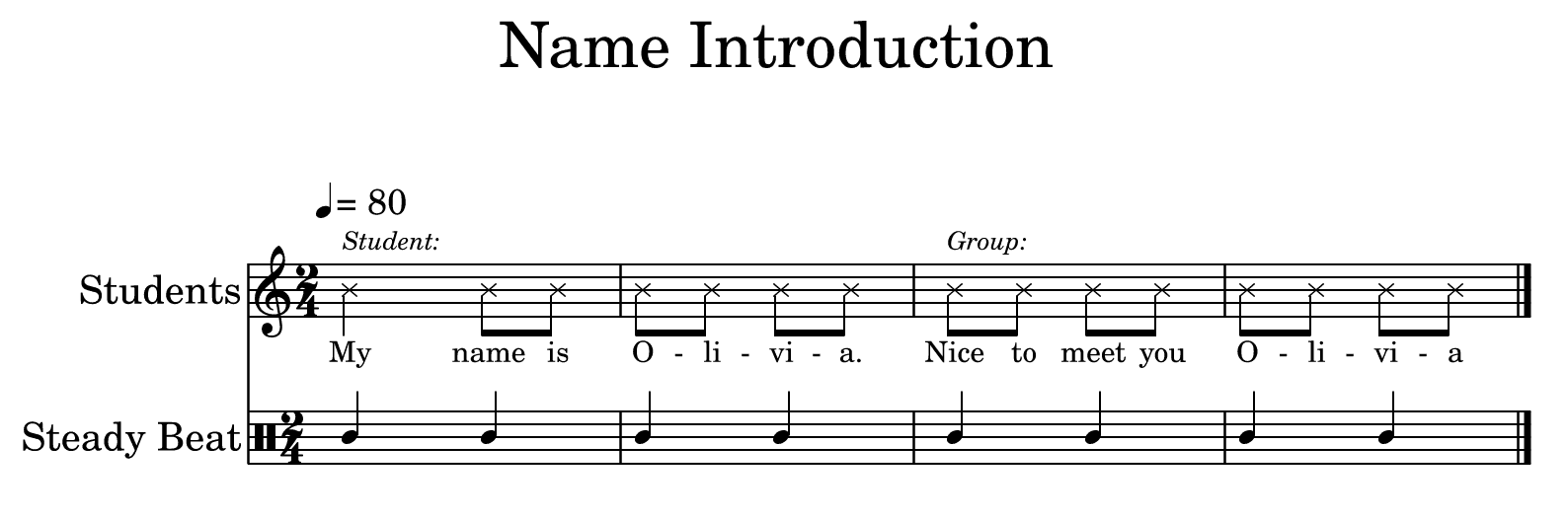
Model the introduction and response. While the class keeps the beat, the teacher models “My name is Ms. Lee” and “Nice to meet you, Ms. Lee,” then leads students in responding. Each introduction and response lasts four beats: the opening words take two beats and the name takes two beats.
- 3
Explore different name rhythms together. The teacher asks, “How can we fit names with two, three, or four syllables into two beats?” The class tries An-na (two quarter notes), Jes-si-ca (two eighth notes followed by a quarter note), and O-li-vi-a (four eighth notes). Students practice each name in both the introduction and response, then apply a suitable rhythm to their own names.
- 4
Introduce everyone in turn. Continuing the quarter-note beat, students go around the circle. Each student introduces themselves for four beats; the others respond for four beats with “Nice to meet you” and the same name rhythm. The next student enters immediately after the response. The teacher cues entries and leads a shared ending after everyone has participated.
Variations
1. Increase the tempo gradually once students can complete a round fluently, keeping the quarter-note pulse and clear, coordinated speech.
2. Replace thigh patting with stepping in place, taking one step per quarter-note beat. Once students are comfortable, combine stepping with a gradual tempo increase.
The English version uses “Nice to meet you” regardless of the time of day.
Activity Preparation
Leave enough space for the class to stand in a circle. Display the English score as needed; no instrument is required.
Activity Sources
- Source Type:
- Learned from a teacher
- Source:
- Teaching practicum in children’s piano pedagogy at Florida State University.
MAPS teaching activities may come from a variety of sources, including original contributions by the MAPS team, online resources, published materials, activities learned from teachers, activities shared by colleagues, traditional teaching practices, and other sources. When a source can be reasonably identified, we make every effort to acknowledge it on the relevant activity page or in the accompanying reference information.
Some content may be organized, translated, structured, or adapted by the MAPS team for specific teaching contexts. Such editorial or instructional adaptation does not mean that MAPS claims ownership of the underlying third-party material. Rights to third-party content remain with the original authors, publishers, or other lawful rights holders.
If you are an author, copyright holder, or authorized representative and have questions or concerns regarding the source, attribution, or use of any content, please contact us:
Email: musicactivityps@gmail.com
Name Introduction
Summary
Students take turns introducing themselves by saying their names in time with a continuous steady beat. This activity can be used at the beginning of the semester to help students get to know one another while developing their awareness of a steady beat.
Procedures
- 1
Form a circle and establish the beat. The teacher invites students to stand in a circle and says, “Today we will introduce ourselves and get to know one another.” The class gently pats their thighs once per quarter-note beat.
- 2
Model the introduction and response. While the class keeps the beat, the teacher models “My name is Ms. Lee” and “Nice to meet you, Ms. Lee,” then leads students in responding. Each introduction and response lasts four beats: the opening words take two beats and the name takes two beats.
- 3
Explore different name rhythms together. The teacher asks, “How can we fit names with two, three, or four syllables into two beats?” The class tries An-na (two quarter notes), Jes-si-ca (two eighth notes followed by a quarter note), and O-li-vi-a (four eighth notes). Students practice each name in both the introduction and response, then apply a suitable rhythm to their own names.
- 4
Introduce everyone in turn. Continuing the quarter-note beat, students go around the circle. Each student introduces themselves for four beats; the others respond for four beats with “Nice to meet you” and the same name rhythm. The next student enters immediately after the response. The teacher cues entries and leads a shared ending after everyone has participated.
Variations
1. Increase the tempo gradually once students can complete a round fluently, keeping the quarter-note pulse and clear, coordinated speech.
2. Replace thigh patting with stepping in place, taking one step per quarter-note beat. Once students are comfortable, combine stepping with a gradual tempo increase.
The English version uses “Nice to meet you” regardless of the time of day.
Activity Preparation
Leave enough space for the class to stand in a circle. Display the English score as needed; no instrument is required.
Activity Sources
- Source Type:
- Learned from a teacher
- Source:
- Teaching practicum in children’s piano pedagogy at Florida State University.
MAPS teaching activities may come from a variety of sources, including original contributions by the MAPS team, online resources, published materials, activities learned from teachers, activities shared by colleagues, traditional teaching practices, and other sources. When a source can be reasonably identified, we make every effort to acknowledge it on the relevant activity page or in the accompanying reference information.
Some content may be organized, translated, structured, or adapted by the MAPS team for specific teaching contexts. Such editorial or instructional adaptation does not mean that MAPS claims ownership of the underlying third-party material. Rights to third-party content remain with the original authors, publishers, or other lawful rights holders.
If you are an author, copyright holder, or authorized representative and have questions or concerns regarding the source, attribution, or use of any content, please contact us:
Email: musicactivityps@gmail.com