MAPS
Note Value Pizza
Summary
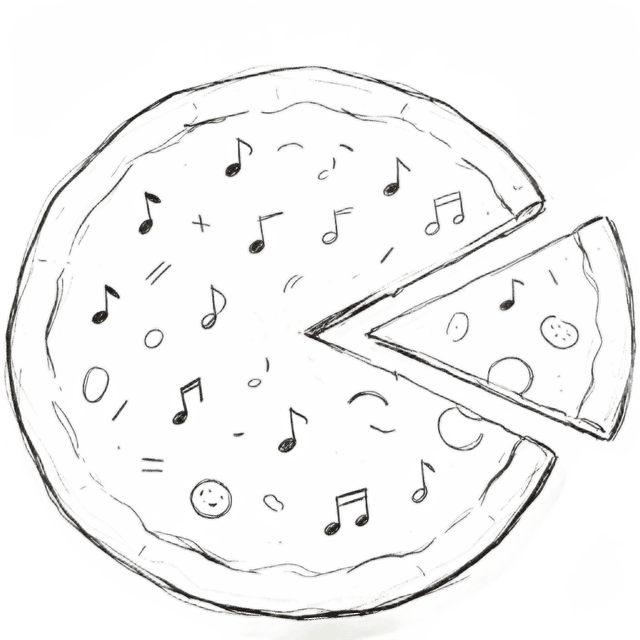
A concept-building activity that uses a whole pizza divided into halves, quarters, and eighths to help students visually understand the proportional relationships among whole notes, half notes, quarter notes, and eighth notes.
Procedures
- 1
Whole Pizza: The teacher shows a picture of a whole pizza and matches it with a whole note, explaining that the whole pizza represents one complete unit.
- 2
Divide into Halves: The teacher divides the pizza into two equal halves and matches each half with a half note. Students observe and identify that two half notes equal one whole note.
- 3
Continue Dividing: The teacher continues dividing the pizza equally: four pieces correspond to four quarter notes, and eight pieces correspond to eight eighth notes. Students compare the sizes of the pizza pieces with the corresponding note values.
- 4
Combine and Match: The teacher provides different pizza pieces or note cards for students to combine and match. For example, students join two quarter-pizza pieces to make half a pizza and connect this with two quarter notes equaling one half note.
- 5
Review the Relationships: The teacher guides students to review and state the proportional relationships among the note values: 1 whole note = 2 half notes = 4 quarter notes = 8 eighth notes.
Variations
Students can combine different pizza pieces to make a whole pizza, translate the combination into corresponding note values, and then clap or perform the resulting rhythm.
Activity Preparation
1. A whole pizza image or manipulable model divided into halves, quarters, and eighths
2. Note cards for whole notes, half notes, quarter notes, and eighth notes.
3. Pizza pieces and note cards that students can physically arrange and match
Activity Sources
- Source Type:
- Learned from a teacher
MAPS teaching activities may come from a variety of sources, including original contributions by the MAPS team, online resources, published materials, activities learned from teachers, activities shared by colleagues, traditional teaching practices, and other sources. When a source can be reasonably identified, we make every effort to acknowledge it on the relevant activity page or in the accompanying reference information.
Some content may be organized, translated, structured, or adapted by the MAPS team for specific teaching contexts. Such editorial or instructional adaptation does not mean that MAPS claims ownership of the underlying third-party material. Rights to third-party content remain with the original authors, publishers, or other lawful rights holders.
If you are an author, copyright holder, or authorized representative and have questions or concerns regarding the source, attribution, or use of any content, please contact us:
Email: musicactivityps@gmail.com
Note Value Pizza
Summary
A concept-building activity that uses a whole pizza divided into halves, quarters, and eighths to help students visually understand the proportional relationships among whole notes, half notes, quarter notes, and eighth notes.
Procedures
- 1
Whole Pizza: The teacher shows a picture of a whole pizza and matches it with a whole note, explaining that the whole pizza represents one complete unit.
- 2
Divide into Halves: The teacher divides the pizza into two equal halves and matches each half with a half note. Students observe and identify that two half notes equal one whole note.
- 3
Continue Dividing: The teacher continues dividing the pizza equally: four pieces correspond to four quarter notes, and eight pieces correspond to eight eighth notes. Students compare the sizes of the pizza pieces with the corresponding note values.
- 4
Combine and Match: The teacher provides different pizza pieces or note cards for students to combine and match. For example, students join two quarter-pizza pieces to make half a pizza and connect this with two quarter notes equaling one half note.
- 5
Review the Relationships: The teacher guides students to review and state the proportional relationships among the note values: 1 whole note = 2 half notes = 4 quarter notes = 8 eighth notes.
Variations
Students can combine different pizza pieces to make a whole pizza, translate the combination into corresponding note values, and then clap or perform the resulting rhythm.
Activity Preparation
1. A whole pizza image or manipulable model divided into halves, quarters, and eighths
2. Note cards for whole notes, half notes, quarter notes, and eighth notes.
3. Pizza pieces and note cards that students can physically arrange and match
Activity Sources
- Source Type:
- Learned from a teacher
MAPS teaching activities may come from a variety of sources, including original contributions by the MAPS team, online resources, published materials, activities learned from teachers, activities shared by colleagues, traditional teaching practices, and other sources. When a source can be reasonably identified, we make every effort to acknowledge it on the relevant activity page or in the accompanying reference information.
Some content may be organized, translated, structured, or adapted by the MAPS team for specific teaching contexts. Such editorial or instructional adaptation does not mean that MAPS claims ownership of the underlying third-party material. Rights to third-party content remain with the original authors, publishers, or other lawful rights holders.
If you are an author, copyright holder, or authorized representative and have questions or concerns regarding the source, attribution, or use of any content, please contact us:
Email: musicactivityps@gmail.com