 MAPS
Paired Scale Warm-Up
Summary
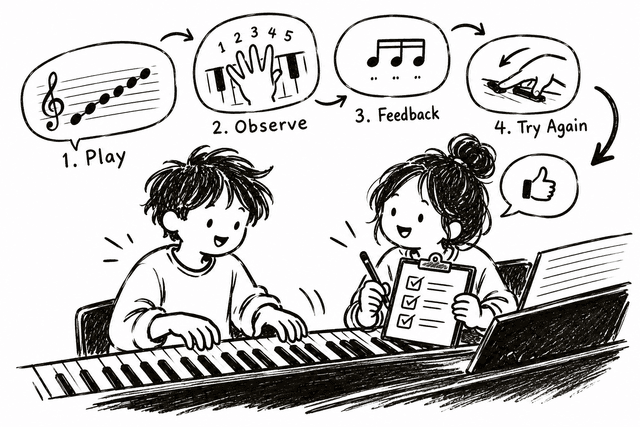
Students work in pairs, taking turns as the performer and observer. The performer plays an assigned scale while the observer focuses on a specific element identified by the teacher, such as note accuracy, fingering, rhythmic evenness, or thumb crossings, and provides brief, focused feedback. Through a repeated cycle of play–observe–feedback–retry, students develop scale fluency while strengthening listening, self-correction, and peer-feedback skills.
Procedures
- 1
Divide students into pairs and assign a scale for the first round.
- 2
Set one specific observation focus for the round, such as note accuracy, fingering, rhythmic evenness, or thumb crossings.
- 3
Student A plays the entire assigned scale while Student B listens and observes without playing, focusing on the designated element.
- 4
After the performance, Student B gives Student A one specific piece of feedback, identifying something to maintain or adjust.
- 5
Student A plays the same scale again and immediately applies the feedback.
- 6
Students switch roles: Student B performs while Student A observes and provides feedback.
- 7
Change the key or observation focus and repeat the play–observe–feedback–retry cycle.
- 8
At the end of the activity, each student plays one of the scales practiced during the session and uses the earlier feedback to monitor their own performance.
Variations
1. Feedback Cards: Prepare cards labeled with observation focuses such as notes, fingering, rhythmic evenness, and hand movement. Each pair draws one card to determine the focus for the round.
2. Synchronized Scales: After taking turns, both students play the same scale simultaneously and aim to maintain the same tempo and rhythmic evenness.
3. Different-Octave Synchronization: Students play the same scale simultaneously in different octaves, maintaining coordination without relying heavily on visual cues from one another.
4. Self-Diagnosis: Before receiving peer feedback, the performer identifies one aspect of the performance that could be improved, then compares that assessment with the observer’s feedback.
Activity Sources
- Source Type:
- Website / Online resource
- Source:
- Adapted from the paired scale-practice concept referenced in the MTNA Group Piano and Piano Pedagogy Forum research project, “The Effect of a Paired Warm-Up Activity on Students’ Interaction During the Paired Practice of Scales in Class Piano.” https://www.mtna.org/November_2020.html
- Adaptation Notes:
- The available source supports the general concept of using a paired warm-up for scale practice in Class Piano, but the publicly available project description does not provide enough detail to reconstruct the original activity procedures. Therefore, the play–observe–feedback–retry sequence, single-focus observation structure, role rotation, and variations in this entry were developed as a classroom adaptation of the paired scale-practice concept rather than as a direct reproduction of the original research activity.
MAPS teaching activities may come from a variety of sources, including original contributions by the MAPS team, online resources, published materials, activities learned from teachers, activities shared by colleagues, traditional teaching practices, and other sources. When a source can be reasonably identified, we make every effort to acknowledge it on the relevant activity page or in the accompanying reference information.
Some content may be organized, translated, structured, or adapted by the MAPS team for specific teaching contexts. Such editorial or instructional adaptation does not mean that MAPS claims ownership of the underlying third-party material. Rights to third-party content remain with the original authors, publishers, or other lawful rights holders.
If you are an author, copyright holder, or authorized representative and have questions or concerns regarding the source, attribution, or use of any content, please contact us:
Email: musicactivityps@gmail.com
Paired Scale Warm-Up
Summary
Students work in pairs, taking turns as the performer and observer. The performer plays an assigned scale while the observer focuses on a specific element identified by the teacher, such as note accuracy, fingering, rhythmic evenness, or thumb crossings, and provides brief, focused feedback. Through a repeated cycle of play–observe–feedback–retry, students develop scale fluency while strengthening listening, self-correction, and peer-feedback skills.
Procedures
- 1
Divide students into pairs and assign a scale for the first round.
- 2
Set one specific observation focus for the round, such as note accuracy, fingering, rhythmic evenness, or thumb crossings.
- 3
Student A plays the entire assigned scale while Student B listens and observes without playing, focusing on the designated element.
- 4
After the performance, Student B gives Student A one specific piece of feedback, identifying something to maintain or adjust.
- 5
Student A plays the same scale again and immediately applies the feedback.
- 6
Students switch roles: Student B performs while Student A observes and provides feedback.
- 7
Change the key or observation focus and repeat the play–observe–feedback–retry cycle.
- 8
At the end of the activity, each student plays one of the scales practiced during the session and uses the earlier feedback to monitor their own performance.
Variations
1. Feedback Cards: Prepare cards labeled with observation focuses such as notes, fingering, rhythmic evenness, and hand movement. Each pair draws one card to determine the focus for the round.
2. Synchronized Scales: After taking turns, both students play the same scale simultaneously and aim to maintain the same tempo and rhythmic evenness.
3. Different-Octave Synchronization: Students play the same scale simultaneously in different octaves, maintaining coordination without relying heavily on visual cues from one another.
4. Self-Diagnosis: Before receiving peer feedback, the performer identifies one aspect of the performance that could be improved, then compares that assessment with the observer’s feedback.
Activity Sources
- Source Type:
- Website / Online resource
- Source:
- Adapted from the paired scale-practice concept referenced in the MTNA Group Piano and Piano Pedagogy Forum research project, “The Effect of a Paired Warm-Up Activity on Students’ Interaction During the Paired Practice of Scales in Class Piano.” https://www.mtna.org/November_2020.html
- Adaptation Notes:
- The available source supports the general concept of using a paired warm-up for scale practice in Class Piano, but the publicly available project description does not provide enough detail to reconstruct the original activity procedures. Therefore, the play–observe–feedback–retry sequence, single-focus observation structure, role rotation, and variations in this entry were developed as a classroom adaptation of the paired scale-practice concept rather than as a direct reproduction of the original research activity.
MAPS teaching activities may come from a variety of sources, including original contributions by the MAPS team, online resources, published materials, activities learned from teachers, activities shared by colleagues, traditional teaching practices, and other sources. When a source can be reasonably identified, we make every effort to acknowledge it on the relevant activity page or in the accompanying reference information.
Some content may be organized, translated, structured, or adapted by the MAPS team for specific teaching contexts. Such editorial or instructional adaptation does not mean that MAPS claims ownership of the underlying third-party material. Rights to third-party content remain with the original authors, publishers, or other lawful rights holders.
If you are an author, copyright holder, or authorized representative and have questions or concerns regarding the source, attribution, or use of any content, please contact us:
Email: musicactivityps@gmail.com