MAPS
Play Your Blues

Summary
This activity introduces the C Blues Scale through fingering exploration and immediate improvisation. Students explore comfortable fingering using the principle “Long Fingers Find the Black Keys,” practice and memorize the scale, and apply it directly to improvisation over a blues accompaniment. By comparing straight and swung eighth notes and experimenting with rhythmic variations, students discover how a simple collection of notes can become their own musical ideas.
Procedures
- 1
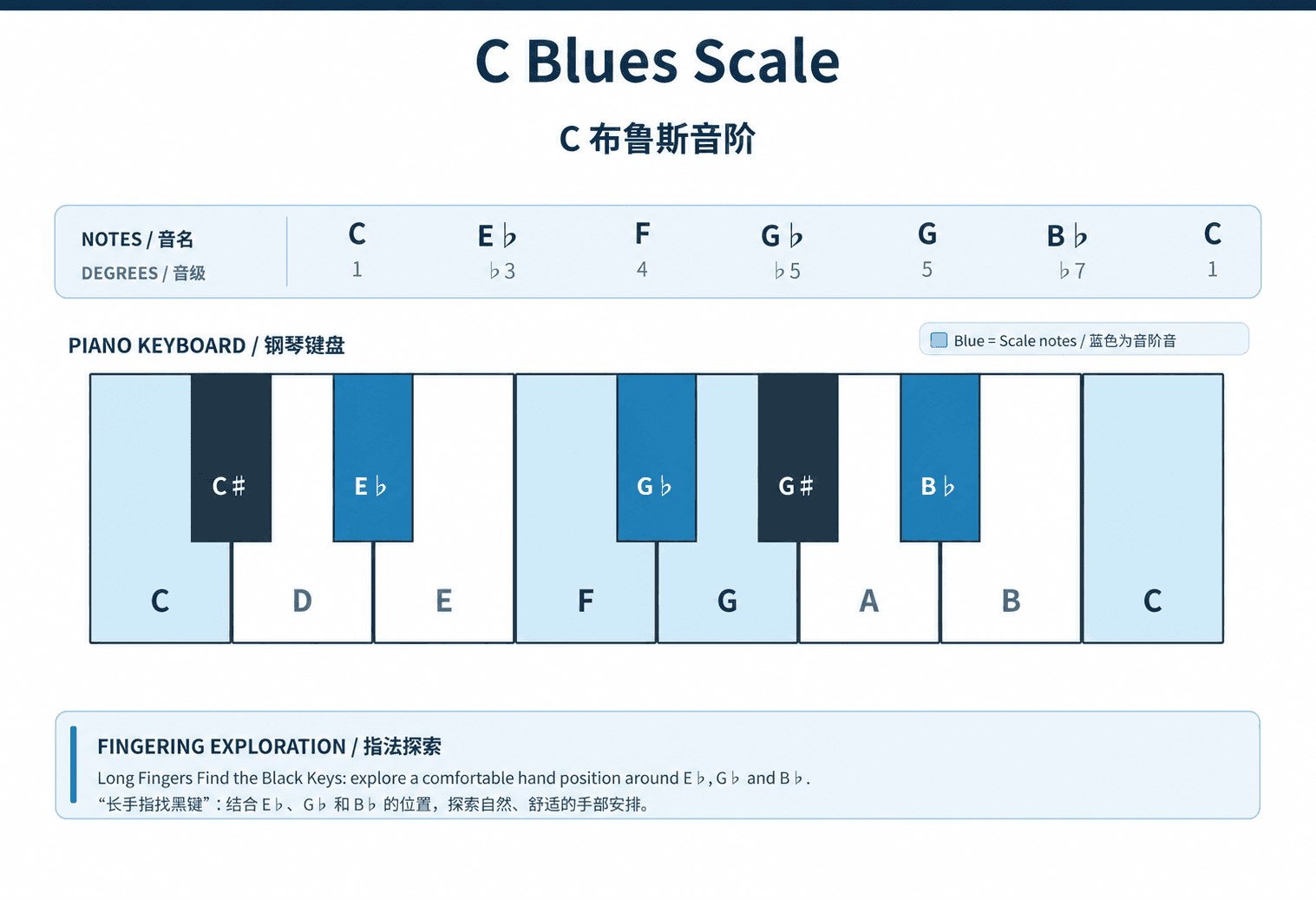
Learn the C Blues Scale. Introduce the C Blues Scale (C–E♭–F–G♭–G–B♭–C). Guide students to explore comfortable fingering using the principle “Long Fingers Find the Black Keys.” Encourage them to consider finger length, black-key placement, and natural hand alignment before practicing the scale ascending and descending.
- 2
Remember the Notes. Have students identify and memorize the six notes of the C Blues Scale. Ask them to locate and play these notes on the keyboard without looking at the written scale.
- 3
Explore and Improvise. Play a C blues backing track or provide a live accompaniment. Invite students to improvise freely using any notes from the C Blues Scale. Encourage them to explore different note combinations, repetitions, and short musical ideas.
- 4
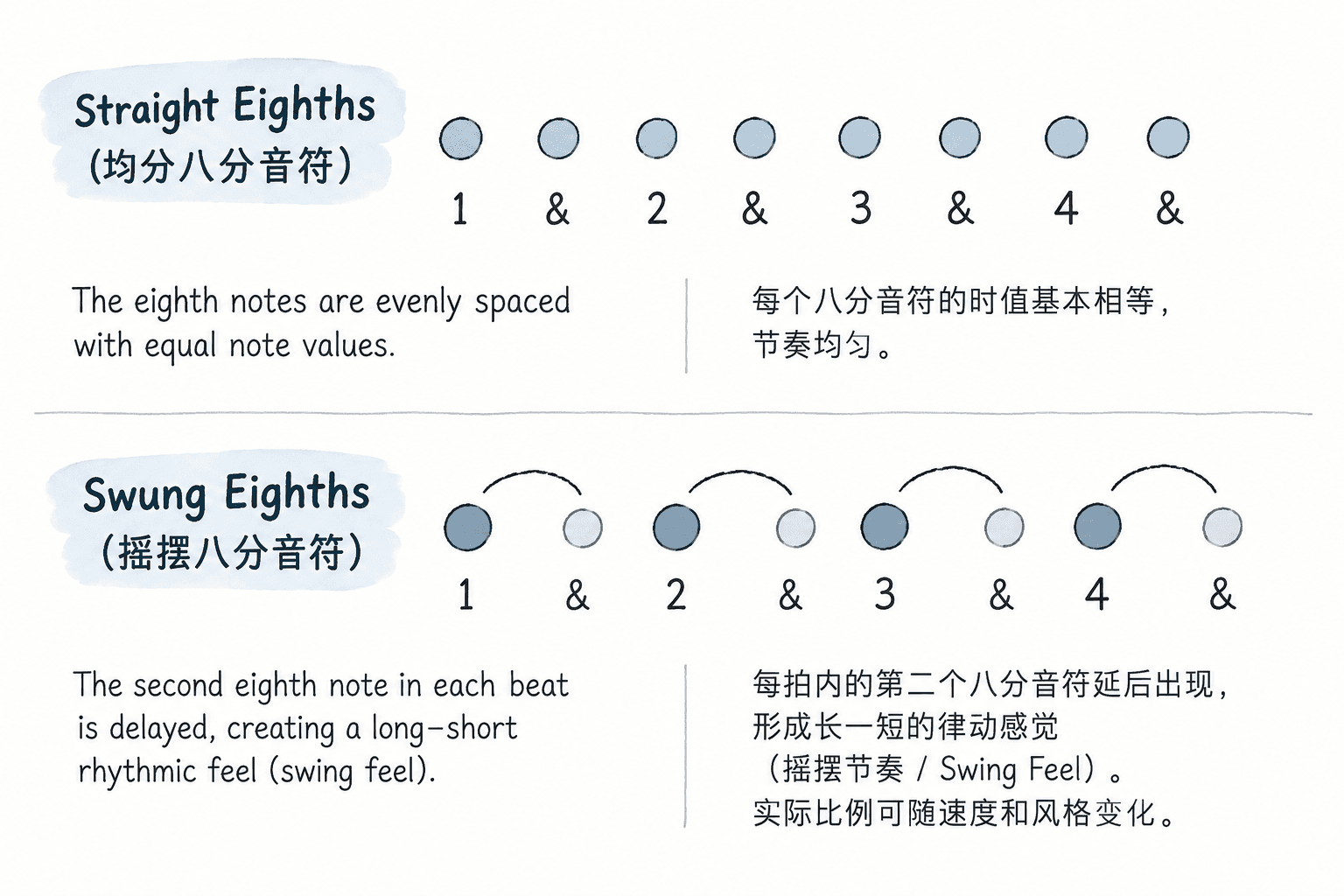
Explore the Blues Feel. Demonstrate the difference between straight and swung eighth notes, highlighting the uneven rhythmic feel commonly heard in blues. While maintaining a steady beat, encourage students to experiment with off-beat notes and apply a swing feel to their improvisation using the C Blues Scale.
Variations
1. Call and Response: The teacher improvises a short phrase using the C Blues Scale, and students respond by imitating or modifying it.
2. Partner Improvisation: Students work in pairs. One provides a simple blues accompaniment while the other improvises using the C Blues Scale. Switch roles afterward.
3. 12-Bar Blues Challenge: Introduce the 12-bar blues progression and encourage students to organize their improvisation using an AAB structure: statement, repetition, and response.
Reference Video Link
- C布鲁斯音阶伴奏/C Blues Scale Backing Track: https://youtu.be/7OEcvWw7d4M?si=UH-V43o2F7HwcZrh
- 圣路易斯布鲁斯/St. Louis Blues: https://youtu.be/cSuTTSOctGw?si=TaOVLFifbz_ZwbmB
Activity Preparation
1. Piano or electronic keyboards.
2. A C Blues Scale chart (C–E♭–F–G♭–G–B♭–C).
3. A C blues backing track or a teacher-prepared accompaniment.
Optional: A selected recording of W. C. Handy’s St. Louis Blues for listening.
Activity Sources
- Source Type:
- MAPS Original
MAPS teaching activities may come from a variety of sources, including original contributions by the MAPS team, online resources, published materials, activities learned from teachers, activities shared by colleagues, traditional teaching practices, and other sources. When a source can be reasonably identified, we make every effort to acknowledge it on the relevant activity page or in the accompanying reference information.
Some content may be organized, translated, structured, or adapted by the MAPS team for specific teaching contexts. Such editorial or instructional adaptation does not mean that MAPS claims ownership of the underlying third-party material. Rights to third-party content remain with the original authors, publishers, or other lawful rights holders.
If you are an author, copyright holder, or authorized representative and have questions or concerns regarding the source, attribution, or use of any content, please contact us:
Email: musicactivityps@gmail.com
Play Your Blues
Summary
This activity introduces the C Blues Scale through fingering exploration and immediate improvisation. Students explore comfortable fingering using the principle “Long Fingers Find the Black Keys,” practice and memorize the scale, and apply it directly to improvisation over a blues accompaniment. By comparing straight and swung eighth notes and experimenting with rhythmic variations, students discover how a simple collection of notes can become their own musical ideas.
Procedures
- 1
Learn the C Blues Scale. Introduce the C Blues Scale (C–E♭–F–G♭–G–B♭–C). Guide students to explore comfortable fingering using the principle “Long Fingers Find the Black Keys.” Encourage them to consider finger length, black-key placement, and natural hand alignment before practicing the scale ascending and descending.
- 2
Remember the Notes. Have students identify and memorize the six notes of the C Blues Scale. Ask them to locate and play these notes on the keyboard without looking at the written scale.
- 3
Explore and Improvise. Play a C blues backing track or provide a live accompaniment. Invite students to improvise freely using any notes from the C Blues Scale. Encourage them to explore different note combinations, repetitions, and short musical ideas.
- 4
Explore the Blues Feel. Demonstrate the difference between straight and swung eighth notes, highlighting the uneven rhythmic feel commonly heard in blues. While maintaining a steady beat, encourage students to experiment with off-beat notes and apply a swing feel to their improvisation using the C Blues Scale.
Variations
1. Call and Response: The teacher improvises a short phrase using the C Blues Scale, and students respond by imitating or modifying it.
2. Partner Improvisation: Students work in pairs. One provides a simple blues accompaniment while the other improvises using the C Blues Scale. Switch roles afterward.
3. 12-Bar Blues Challenge: Introduce the 12-bar blues progression and encourage students to organize their improvisation using an AAB structure: statement, repetition, and response.
Reference Video Link
- C布鲁斯音阶伴奏/C Blues Scale Backing Track: https://youtu.be/7OEcvWw7d4M?si=UH-V43o2F7HwcZrh
- 圣路易斯布鲁斯/St. Louis Blues: https://youtu.be/cSuTTSOctGw?si=TaOVLFifbz_ZwbmB
Activity Preparation
1. Piano or electronic keyboards.
2. A C Blues Scale chart (C–E♭–F–G♭–G–B♭–C).
3. A C blues backing track or a teacher-prepared accompaniment.
Optional: A selected recording of W. C. Handy’s St. Louis Blues for listening.
Activity Sources
- Source Type:
- MAPS Original
MAPS teaching activities may come from a variety of sources, including original contributions by the MAPS team, online resources, published materials, activities learned from teachers, activities shared by colleagues, traditional teaching practices, and other sources. When a source can be reasonably identified, we make every effort to acknowledge it on the relevant activity page or in the accompanying reference information.
Some content may be organized, translated, structured, or adapted by the MAPS team for specific teaching contexts. Such editorial or instructional adaptation does not mean that MAPS claims ownership of the underlying third-party material. Rights to third-party content remain with the original authors, publishers, or other lawful rights holders.
If you are an author, copyright holder, or authorized representative and have questions or concerns regarding the source, attribution, or use of any content, please contact us:
Email: musicactivityps@gmail.com