MAPS
Register Relay
Summary
A group piano relay activity that develops register awareness, keyboard geography, listening, and quick musical response. Students first learn a short, familiar pattern, then pass it from player to player while responding to relative register cues—higher, lower, or same—and additional musical cues such as louder, softer, faster, slower, legato, or staccato. The pattern stays the same while students listen, compare, and modify selected musical features.
Procedures
- 1
Learn the Pattern: Teach the class a short, easy keyboard pattern of about three to five notes, preferably within a five-finger position. Practice it together until students can play it comfortably and consistently.
- 2
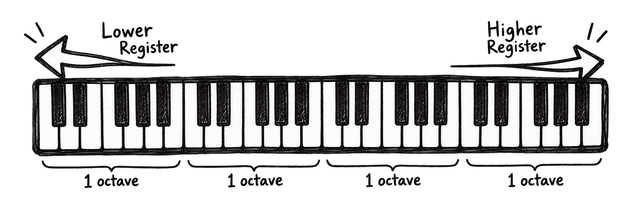
Explore Register Direction: Demonstrate the same pattern in different locations on the keyboard. Establish three relative directions: Higher—move to the right; Lower—move to the left; Same—remain in approximately the same register. Emphasize that these directions are always judged in relation to the previous player.
- 3
Start the Relay: Divide students into groups of three to five. The first student plays the pattern in any comfortable register. Before each following student plays, give one register cue: Higher, Lower, or Same. The student keeps the pattern unchanged and moves it according to the cue, using the previous player’s register as the reference point.
- 4
Add One Musical Instruction: Once the register relay is secure, add one additional musical cue, such as Louder, Softer, Faster, Slower, Legato, or Staccato. For example: Higher + Softer, Lower + Staccato, or Same + Faster. Students keep the original pattern while changing both the register relationship and the requested musical feature.
- 5
Two-Cue Relay: Continue the relay with two cues for each player: one register cue—Higher, Lower, or Same—and one musical cue involving dynamics, tempo, or articulation. Students respond immediately, then pass the pattern to the next player.
Variations
1. Single-Cue Version: Use only Higher, Lower, or Same until students can move confidently around the keyboard.
2. Student Caller: Let one student give the register and musical cues while classmates continue the relay.
3. New Pattern Round: Keep the relay rules the same but introduce a different short pattern once the class is comfortable with the activity.
Activity Preparation
1.Each student needs access to a piano or keyboard.
2.Teacher should prepare one short pattern that students can learn quickly, preferably within a five-finger position.
3. Before the relay, make sure students understand that higher means moving to the right on the keyboard and lower means moving to the left, and review the musical cues that will be used.
Activity Sources
- Source Type:
- MAPS Original
MAPS teaching activities may come from a variety of sources, including original contributions by the MAPS team, online resources, published materials, activities learned from teachers, activities shared by colleagues, traditional teaching practices, and other sources. When a source can be reasonably identified, we make every effort to acknowledge it on the relevant activity page or in the accompanying reference information.
Some content may be organized, translated, structured, or adapted by the MAPS team for specific teaching contexts. Such editorial or instructional adaptation does not mean that MAPS claims ownership of the underlying third-party material. Rights to third-party content remain with the original authors, publishers, or other lawful rights holders.
If you are an author, copyright holder, or authorized representative and have questions or concerns regarding the source, attribution, or use of any content, please contact us:
Email: musicactivityps@gmail.com
Register Relay
Summary
A group piano relay activity that develops register awareness, keyboard geography, listening, and quick musical response. Students first learn a short, familiar pattern, then pass it from player to player while responding to relative register cues—higher, lower, or same—and additional musical cues such as louder, softer, faster, slower, legato, or staccato. The pattern stays the same while students listen, compare, and modify selected musical features.
Procedures
- 1
Learn the Pattern: Teach the class a short, easy keyboard pattern of about three to five notes, preferably within a five-finger position. Practice it together until students can play it comfortably and consistently.
- 2
Explore Register Direction: Demonstrate the same pattern in different locations on the keyboard. Establish three relative directions: Higher—move to the right; Lower—move to the left; Same—remain in approximately the same register. Emphasize that these directions are always judged in relation to the previous player.
- 3
Start the Relay: Divide students into groups of three to five. The first student plays the pattern in any comfortable register. Before each following student plays, give one register cue: Higher, Lower, or Same. The student keeps the pattern unchanged and moves it according to the cue, using the previous player’s register as the reference point.
- 4
Add One Musical Instruction: Once the register relay is secure, add one additional musical cue, such as Louder, Softer, Faster, Slower, Legato, or Staccato. For example: Higher + Softer, Lower + Staccato, or Same + Faster. Students keep the original pattern while changing both the register relationship and the requested musical feature.
- 5
Two-Cue Relay: Continue the relay with two cues for each player: one register cue—Higher, Lower, or Same—and one musical cue involving dynamics, tempo, or articulation. Students respond immediately, then pass the pattern to the next player.
Variations
1. Single-Cue Version: Use only Higher, Lower, or Same until students can move confidently around the keyboard.
2. Student Caller: Let one student give the register and musical cues while classmates continue the relay.
3. New Pattern Round: Keep the relay rules the same but introduce a different short pattern once the class is comfortable with the activity.
Activity Preparation
1.Each student needs access to a piano or keyboard.
2.Teacher should prepare one short pattern that students can learn quickly, preferably within a five-finger position.
3. Before the relay, make sure students understand that higher means moving to the right on the keyboard and lower means moving to the left, and review the musical cues that will be used.
Activity Sources
- Source Type:
- MAPS Original
MAPS teaching activities may come from a variety of sources, including original contributions by the MAPS team, online resources, published materials, activities learned from teachers, activities shared by colleagues, traditional teaching practices, and other sources. When a source can be reasonably identified, we make every effort to acknowledge it on the relevant activity page or in the accompanying reference information.
Some content may be organized, translated, structured, or adapted by the MAPS team for specific teaching contexts. Such editorial or instructional adaptation does not mean that MAPS claims ownership of the underlying third-party material. Rights to third-party content remain with the original authors, publishers, or other lawful rights holders.
If you are an author, copyright holder, or authorized representative and have questions or concerns regarding the source, attribution, or use of any content, please contact us:
Email: musicactivityps@gmail.com