 MAPS
Rhythm Grid
Summary
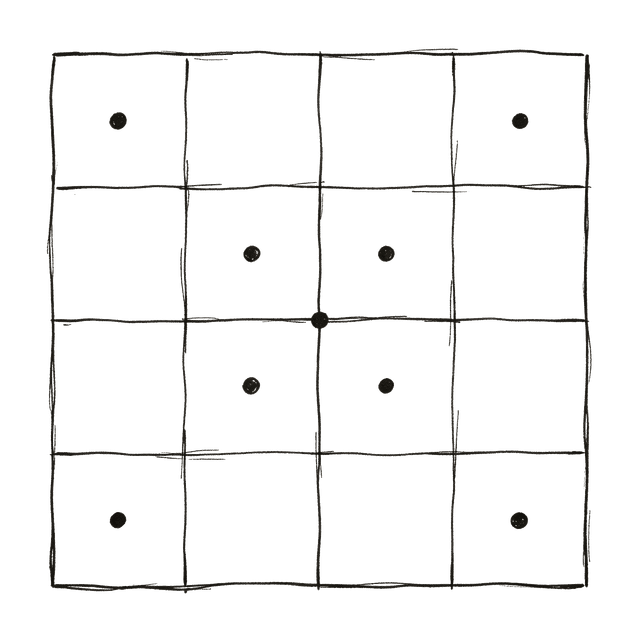
An Orff-style rhythm training activity in which a 4x4 grid of filled dots and blanks is shown to the class. The teacher points to each box and students clap one beat per box, leaving blank boxes as rests. It can be extended to two to four voice layers starting from opposite corners, and students take turns being the conductor. The dots can also be replaced with various one-beat rhythmic figures. The activity trains four-beat meter, reaction, multi-directional thinking, and creative exploration.
Procedures
- 1
The teacher displays the 16-box grid (4x4), with some boxes filled with a dot and others blank.
- 2
The teacher tells the class the clapping order and points to boxes one by one; students clap one beat per box, leaving blank boxes as rests.
- 3
Start simply with the whole class clapping together while the teacher conducts the grid.
- 4
Extend to two to four voice layers, starting from opposite corners (two corners or four corners).
- 5
Invite a student to come up and be the conductor, pointing to the boxes to lead the class.
- 6
Replace the dots inside the boxes with various one-beat rhythmic figures (e.g. eighth-note pairs, sixteenth-note groups).
Variations
1. This exercise trains four-beat meter and beat rate, but its real value lies in students' reaction and multi-directional thinking.
2. Exploring different clapping routes through the grid is itself a creative thinking exercise.
3. Let students design their own clapping order and routes.
Activity Preparation
A printed or drawn 16-box (4x4) grid on the board or a projector.
Activity Sources
- Source Type:
- Textbook / Book
- Source:
- Orff Music Education: Thought and Practice
MAPS teaching activities may come from a variety of sources, including original contributions by the MAPS team, online resources, published materials, activities learned from teachers, activities shared by colleagues, traditional teaching practices, and other sources. When a source can be reasonably identified, we make every effort to acknowledge it on the relevant activity page or in the accompanying reference information.
Some content may be organized, translated, structured, or adapted by the MAPS team for specific teaching contexts. Such editorial or instructional adaptation does not mean that MAPS claims ownership of the underlying third-party material. Rights to third-party content remain with the original authors, publishers, or other lawful rights holders.
If you are an author, copyright holder, or authorized representative and have questions or concerns regarding the source, attribution, or use of any content, please contact us:
Email: musicactivityps@gmail.com
Rhythm Grid
Summary
An Orff-style rhythm training activity in which a 4x4 grid of filled dots and blanks is shown to the class. The teacher points to each box and students clap one beat per box, leaving blank boxes as rests. It can be extended to two to four voice layers starting from opposite corners, and students take turns being the conductor. The dots can also be replaced with various one-beat rhythmic figures. The activity trains four-beat meter, reaction, multi-directional thinking, and creative exploration.
Procedures
- 1
The teacher displays the 16-box grid (4x4), with some boxes filled with a dot and others blank.
- 2
The teacher tells the class the clapping order and points to boxes one by one; students clap one beat per box, leaving blank boxes as rests.
- 3
Start simply with the whole class clapping together while the teacher conducts the grid.
- 4
Extend to two to four voice layers, starting from opposite corners (two corners or four corners).
- 5
Invite a student to come up and be the conductor, pointing to the boxes to lead the class.
- 6
Replace the dots inside the boxes with various one-beat rhythmic figures (e.g. eighth-note pairs, sixteenth-note groups).
Variations
1. This exercise trains four-beat meter and beat rate, but its real value lies in students' reaction and multi-directional thinking.
2. Exploring different clapping routes through the grid is itself a creative thinking exercise.
3. Let students design their own clapping order and routes.
Activity Preparation
A printed or drawn 16-box (4x4) grid on the board or a projector.
Activity Sources
- Source Type:
- Textbook / Book
- Source:
- Orff Music Education: Thought and Practice
MAPS teaching activities may come from a variety of sources, including original contributions by the MAPS team, online resources, published materials, activities learned from teachers, activities shared by colleagues, traditional teaching practices, and other sources. When a source can be reasonably identified, we make every effort to acknowledge it on the relevant activity page or in the accompanying reference information.
Some content may be organized, translated, structured, or adapted by the MAPS team for specific teaching contexts. Such editorial or instructional adaptation does not mean that MAPS claims ownership of the underlying third-party material. Rights to third-party content remain with the original authors, publishers, or other lawful rights holders.
If you are an author, copyright holder, or authorized representative and have questions or concerns regarding the source, attribution, or use of any content, please contact us:
Email: musicactivityps@gmail.com