MAPS
Same Key, Different Name
Summary
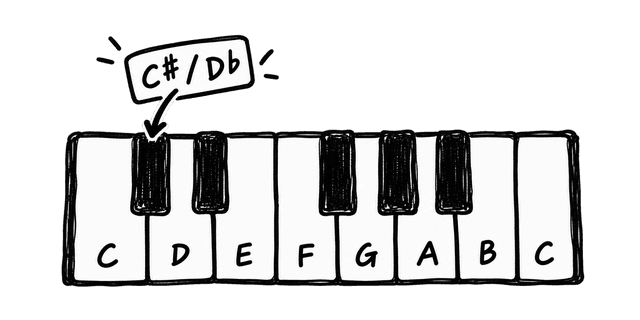
Students discover enharmonic equivalents by approaching the same piano key from different note names. They first build familiar sharp-flat pairs such as C-sharp/D-flat, then extend the idea to white-key enharmonics and, for advanced students, double accidentals. The activity emphasizes that enharmonic notes share the same sounding pitch on the piano while keeping different spellings and theoretical functions.
Procedures
- 1
Two Roads, One Key. Start from C and ask students to raise it by one half step: C-sharp. Then start from D and lower it by one half step: D-flat. Compare the results and notice that both names land on the same piano key. Introduce the term enharmonic equivalents: notes that sound the same and are played on the same key, but are written or named differently.
- 2
Build More Pairs. Repeat the process with D-sharp/E-flat, F-sharp/G-flat, G-sharp/A-flat, and A-sharp/B-flat. For each pair, students begin from the two neighboring natural notes, apply the correct half-step movement, and verify that both spellings reach the same key.
- 3
Same Key, Different Name Match. Give students note-name cards or display a mixed list of sharp and flat spellings. Students match enharmonic partners, then verify each pair on a keyboard. Require a short explanation such as “F-sharp and G-flat are played on the same key.”
- 4
White-Key Enharmonics. Add E-sharp/F, B-sharp/C, C-flat/B, and F-flat/E. Ask students to derive each answer from the half-step rule learned earlier rather than memorizing the pair. Emphasize that enharmonic equivalents are not limited to black keys.
- 5
Enharmonic Detective. Give one note name and ask students to find an enharmonic equivalent, or show several names and ask which ones belong to the same key. Students may point, move, write, or play the answer depending on the class setting. Include both black-key and white-key examples.
- 6
Advanced Extension: Double Accidentals. For older or more advanced students, include examples such as C double sharp/D, F double sharp/G, D double flat/C, and B double flat/A.
Variations
1. Human Keyboard — Younger Learners: Two students begin on neighboring natural notes and move toward the same destination key, for example C to C-sharp and D to D-flat. When they meet on the same key, say together: “Two names, one key.”
2. Visual Keyboard — Older Students or Theory Classes: Use a projected or printed keyboard. Students identify enharmonic pairs, write both spellings, and explain how each spelling reaches the same key.
3. Play the Answer — Class Piano: Ask students to play C-sharp, then D-flat. They should notice that the hand does not move. Repeat with other pairs and ask, “What changed: the key, the sound, or the name?”
4. Find Your Partner: Give each student one note-name card. Students circulate to find the classmate holding an enharmonic equivalent, then verify the pair on a keyboard.
5. Same Key or Different Key?: Present pairs such as C-sharp/D-flat, F/E-sharp, G-sharp/A, and B/C-flat. Students classify each pair and explain their decision.
Activity Preparation
Materials
a.Keyboard diagram, projected keyboard, floor keyboard, or student keyboards.
b.Optional note-name cards for matching activities.
Prior Knowledge
a.Students know A-G white-key names and half-step movement.
Students understand sharp, flat, natural, and, for the advanced extension, double sharp and double flat.
Activity Sources
- Source Type:
- MAPS Original
- Adaptation Notes:
- Adapted into a keyboard-based discovery activity that uses half-step movement, matching, and performance to teach enharmonic equivalents across different age groups and class settings.
MAPS teaching activities may come from a variety of sources, including original contributions by the MAPS team, online resources, published materials, activities learned from teachers, activities shared by colleagues, traditional teaching practices, and other sources. When a source can be reasonably identified, we make every effort to acknowledge it on the relevant activity page or in the accompanying reference information.
Some content may be organized, translated, structured, or adapted by the MAPS team for specific teaching contexts. Such editorial or instructional adaptation does not mean that MAPS claims ownership of the underlying third-party material. Rights to third-party content remain with the original authors, publishers, or other lawful rights holders.
If you are an author, copyright holder, or authorized representative and have questions or concerns regarding the source, attribution, or use of any content, please contact us:
Email: musicactivityps@gmail.com
Same Key, Different Name
Summary
Students discover enharmonic equivalents by approaching the same piano key from different note names. They first build familiar sharp-flat pairs such as C-sharp/D-flat, then extend the idea to white-key enharmonics and, for advanced students, double accidentals. The activity emphasizes that enharmonic notes share the same sounding pitch on the piano while keeping different spellings and theoretical functions.
Procedures
- 1
Two Roads, One Key. Start from C and ask students to raise it by one half step: C-sharp. Then start from D and lower it by one half step: D-flat. Compare the results and notice that both names land on the same piano key. Introduce the term enharmonic equivalents: notes that sound the same and are played on the same key, but are written or named differently.
- 2
Build More Pairs. Repeat the process with D-sharp/E-flat, F-sharp/G-flat, G-sharp/A-flat, and A-sharp/B-flat. For each pair, students begin from the two neighboring natural notes, apply the correct half-step movement, and verify that both spellings reach the same key.
- 3
Same Key, Different Name Match. Give students note-name cards or display a mixed list of sharp and flat spellings. Students match enharmonic partners, then verify each pair on a keyboard. Require a short explanation such as “F-sharp and G-flat are played on the same key.”
- 4
White-Key Enharmonics. Add E-sharp/F, B-sharp/C, C-flat/B, and F-flat/E. Ask students to derive each answer from the half-step rule learned earlier rather than memorizing the pair. Emphasize that enharmonic equivalents are not limited to black keys.
- 5
Enharmonic Detective. Give one note name and ask students to find an enharmonic equivalent, or show several names and ask which ones belong to the same key. Students may point, move, write, or play the answer depending on the class setting. Include both black-key and white-key examples.
- 6
Advanced Extension: Double Accidentals. For older or more advanced students, include examples such as C double sharp/D, F double sharp/G, D double flat/C, and B double flat/A.
Variations
1. Human Keyboard — Younger Learners: Two students begin on neighboring natural notes and move toward the same destination key, for example C to C-sharp and D to D-flat. When they meet on the same key, say together: “Two names, one key.”
2. Visual Keyboard — Older Students or Theory Classes: Use a projected or printed keyboard. Students identify enharmonic pairs, write both spellings, and explain how each spelling reaches the same key.
3. Play the Answer — Class Piano: Ask students to play C-sharp, then D-flat. They should notice that the hand does not move. Repeat with other pairs and ask, “What changed: the key, the sound, or the name?”
4. Find Your Partner: Give each student one note-name card. Students circulate to find the classmate holding an enharmonic equivalent, then verify the pair on a keyboard.
5. Same Key or Different Key?: Present pairs such as C-sharp/D-flat, F/E-sharp, G-sharp/A, and B/C-flat. Students classify each pair and explain their decision.
Activity Preparation
Materials
a.Keyboard diagram, projected keyboard, floor keyboard, or student keyboards.
b.Optional note-name cards for matching activities.
Prior Knowledge
a.Students know A-G white-key names and half-step movement.
Students understand sharp, flat, natural, and, for the advanced extension, double sharp and double flat.
Activity Sources
- Source Type:
- MAPS Original
- Adaptation Notes:
- Adapted into a keyboard-based discovery activity that uses half-step movement, matching, and performance to teach enharmonic equivalents across different age groups and class settings.
MAPS teaching activities may come from a variety of sources, including original contributions by the MAPS team, online resources, published materials, activities learned from teachers, activities shared by colleagues, traditional teaching practices, and other sources. When a source can be reasonably identified, we make every effort to acknowledge it on the relevant activity page or in the accompanying reference information.
Some content may be organized, translated, structured, or adapted by the MAPS team for specific teaching contexts. Such editorial or instructional adaptation does not mean that MAPS claims ownership of the underlying third-party material. Rights to third-party content remain with the original authors, publishers, or other lawful rights holders.
If you are an author, copyright holder, or authorized representative and have questions or concerns regarding the source, attribution, or use of any content, please contact us:
Email: musicactivityps@gmail.com