MAPS
Same Melody, Different Accompaniment
Summary
A class piano arranging activity in which students review I–IV–V chord progressions and basic harmonization rules, then draw roles to prepare either the melody through sight-reading, a block-chord accompaniment, or an Alberti bass accompaniment. The class then performs together and compares how different accompaniment textures affect the character of the melody.
Procedures
- 1
Review I-IV-V chords. Students briefly review the I, IV, and V chords in the assigned key, first with both hands if needed and then with the left hand alone, including the chord positions used in the progression.
- 2
Review harmonization rules. The teacher reviews: tonic for scale tones 1, 3, and 5; dominant for 2, 4, 5, and 7; subdominant when most melody notes are 1, 4, and 6; begin and end on tonic; dominant commonly precedes tonic at the end. Students apply the rules to a few short examples.
- 3
Review accompaniment patterns. The teacher demonstrates and students briefly practice block chords and Alberti bass with the same I-IV-V progression.
- 4
Draw roles. Students randomly draw one of three roles: Melody, Block Chord Accompaniment, or Alberti Bass Accompaniment.
- 5
Prepare by role. The Melody group sight-reads only the melody. The Block Chord group prepares the left-hand block-chord accompaniment. The Alberti Bass group prepares the same harmony using the Alberti-bass pattern.
- 6
Rehearse in role groups. Students with the same role check notes, rhythm, chord changes, and pattern consistency together.
- 7
Combine and perform. Students form mixed groups and perform the melody first with block-chord accompaniment and then with Alberti bass.
Variations
1. Rotate roles so students experience melody, block chords, and Alberti bass.
2. Extension: add another accompaniment pattern or transpose the final arrangement to a new key.
Activity Preparation
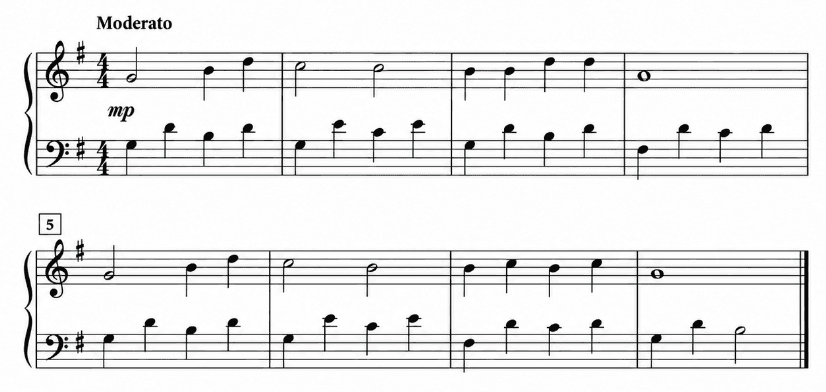
Materials: one short melody score for each student, role-draw slips/cards, and pianos/keyboards.
Prior knowledge: students can play I, IV, and V chords in the assigned key, know the chord positions/voicings used in the progression, can play the progression with the left hand alone, and have basic sight-reading experience.
Activity Sources
- Source Type:
- Textbook / Book
- Source:
- Adapted from textbook content: Alfred’s Group Piano for Adults Student Book 1 (2nd edition).
MAPS teaching activities may come from a variety of sources, including original contributions by the MAPS team, online resources, published materials, activities learned from teachers, activities shared by colleagues, traditional teaching practices, and other sources. When a source can be reasonably identified, we make every effort to acknowledge it on the relevant activity page or in the accompanying reference information.
Some content may be organized, translated, structured, or adapted by the MAPS team for specific teaching contexts. Such editorial or instructional adaptation does not mean that MAPS claims ownership of the underlying third-party material. Rights to third-party content remain with the original authors, publishers, or other lawful rights holders.
If you are an author, copyright holder, or authorized representative and have questions or concerns regarding the source, attribution, or use of any content, please contact us:
Email: musicactivityps@gmail.com
Same Melody, Different Accompaniment
Summary
A class piano arranging activity in which students review I–IV–V chord progressions and basic harmonization rules, then draw roles to prepare either the melody through sight-reading, a block-chord accompaniment, or an Alberti bass accompaniment. The class then performs together and compares how different accompaniment textures affect the character of the melody.
Procedures
- 1
Review I-IV-V chords. Students briefly review the I, IV, and V chords in the assigned key, first with both hands if needed and then with the left hand alone, including the chord positions used in the progression.
- 2
Review harmonization rules. The teacher reviews: tonic for scale tones 1, 3, and 5; dominant for 2, 4, 5, and 7; subdominant when most melody notes are 1, 4, and 6; begin and end on tonic; dominant commonly precedes tonic at the end. Students apply the rules to a few short examples.
- 3
Review accompaniment patterns. The teacher demonstrates and students briefly practice block chords and Alberti bass with the same I-IV-V progression.
- 4
Draw roles. Students randomly draw one of three roles: Melody, Block Chord Accompaniment, or Alberti Bass Accompaniment.
- 5
Prepare by role. The Melody group sight-reads only the melody. The Block Chord group prepares the left-hand block-chord accompaniment. The Alberti Bass group prepares the same harmony using the Alberti-bass pattern.
- 6
Rehearse in role groups. Students with the same role check notes, rhythm, chord changes, and pattern consistency together.
- 7
Combine and perform. Students form mixed groups and perform the melody first with block-chord accompaniment and then with Alberti bass.
Variations
1. Rotate roles so students experience melody, block chords, and Alberti bass.
2. Extension: add another accompaniment pattern or transpose the final arrangement to a new key.
Activity Preparation
Materials: one short melody score for each student, role-draw slips/cards, and pianos/keyboards.
Prior knowledge: students can play I, IV, and V chords in the assigned key, know the chord positions/voicings used in the progression, can play the progression with the left hand alone, and have basic sight-reading experience.
Activity Sources
- Source Type:
- Textbook / Book
- Source:
- Adapted from textbook content: Alfred’s Group Piano for Adults Student Book 1 (2nd edition).
MAPS teaching activities may come from a variety of sources, including original contributions by the MAPS team, online resources, published materials, activities learned from teachers, activities shared by colleagues, traditional teaching practices, and other sources. When a source can be reasonably identified, we make every effort to acknowledge it on the relevant activity page or in the accompanying reference information.
Some content may be organized, translated, structured, or adapted by the MAPS team for specific teaching contexts. Such editorial or instructional adaptation does not mean that MAPS claims ownership of the underlying third-party material. Rights to third-party content remain with the original authors, publishers, or other lawful rights holders.
If you are an author, copyright holder, or authorized representative and have questions or concerns regarding the source, attribution, or use of any content, please contact us:
Email: musicactivityps@gmail.com