 MAPS
Scale Canon
Summary
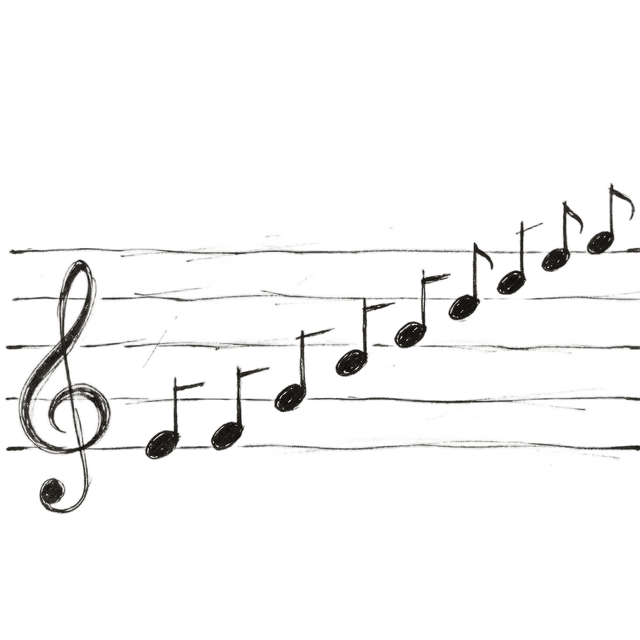
Building upon their prior proficiency in playing scales, students work in groups to perform the same scale using with staggered entries, thereby understanding and experiencing the polyphonic technique of the canon. The lesson content can also be adapted for vocal scale practice or used as a warm-up exercise for an ensemble to develop harmonic listening skills.
Procedures
- 1
The teacher leads the entire class in playing the C major scale in unison, ensuring that students maintain a steady tempo and beat.
- 2
The teacher explains the definition of a canon: A canon is a polyphonic form/technique in which one voice introduces a melody and one or more other voices enter later, imitating it.
- 3
The teacher divides the students into two groups. The first group begins playing the C major scale; after a two-beat interval, the second group enters on the same scale, starting on the first note.
- 4
The teacher uses a preparatory beat and hand gestures to cue each part' s staggered entrance, and leads the students in performing the complete canon. The teacher should explain in advance how each group should conclude after reaching the highest note—for example, by sustaining the final note and waiting for the other group to finish before ending together.
- 5
Once the students can consistently perform a two-part canon, the teacher can divide the class into three groups, having each group enter sequentially at two-beat intervals.
- 6
The teacher may invite a student to serve as the conductor, responsible for giving the preparatory beat, cueing the entry of each group, and coordinating the unified conclusion.
Variations
1. Vary the time intervals between the entry of each voice (e.g., one, two, or four beats).
2. Increase the number of voices to three or four.
3. Play the scales using different rhythmic patterns.
4. Expand the ascending scale to include both ascending and descending movements, Extend the scale to include descending motion, thereby prolonging the period of voice overlap.
5. Encourage students to practice playing one voice while singing another after class.
Activity Preparation
Piano or keyboard
Activity Sources
- Source Type:
- Shared by colleague
- Source:
- Canon activity inspired by Dr. Stephanie Archer.
MAPS teaching activities may come from a variety of sources, including original contributions by the MAPS team, online resources, published materials, activities learned from teachers, activities shared by colleagues, traditional teaching practices, and other sources. When a source can be reasonably identified, we make every effort to acknowledge it on the relevant activity page or in the accompanying reference information.
Some content may be organized, translated, structured, or adapted by the MAPS team for specific teaching contexts. Such editorial or instructional adaptation does not mean that MAPS claims ownership of the underlying third-party material. Rights to third-party content remain with the original authors, publishers, or other lawful rights holders.
If you are an author, copyright holder, or authorized representative and have questions or concerns regarding the source, attribution, or use of any content, please contact us:
Email: musicactivityps@gmail.com
Scale Canon
Summary
Building upon their prior proficiency in playing scales, students work in groups to perform the same scale using with staggered entries, thereby understanding and experiencing the polyphonic technique of the canon. The lesson content can also be adapted for vocal scale practice or used as a warm-up exercise for an ensemble to develop harmonic listening skills.
Procedures
- 1
The teacher leads the entire class in playing the C major scale in unison, ensuring that students maintain a steady tempo and beat.
- 2
The teacher explains the definition of a canon: A canon is a polyphonic form/technique in which one voice introduces a melody and one or more other voices enter later, imitating it.
- 3
The teacher divides the students into two groups. The first group begins playing the C major scale; after a two-beat interval, the second group enters on the same scale, starting on the first note.
- 4
The teacher uses a preparatory beat and hand gestures to cue each part' s staggered entrance, and leads the students in performing the complete canon. The teacher should explain in advance how each group should conclude after reaching the highest note—for example, by sustaining the final note and waiting for the other group to finish before ending together.
- 5
Once the students can consistently perform a two-part canon, the teacher can divide the class into three groups, having each group enter sequentially at two-beat intervals.
- 6
The teacher may invite a student to serve as the conductor, responsible for giving the preparatory beat, cueing the entry of each group, and coordinating the unified conclusion.
Variations
1. Vary the time intervals between the entry of each voice (e.g., one, two, or four beats).
2. Increase the number of voices to three or four.
3. Play the scales using different rhythmic patterns.
4. Expand the ascending scale to include both ascending and descending movements, Extend the scale to include descending motion, thereby prolonging the period of voice overlap.
5. Encourage students to practice playing one voice while singing another after class.
Activity Preparation
Piano or keyboard
Activity Sources
- Source Type:
- Shared by colleague
- Source:
- Canon activity inspired by Dr. Stephanie Archer.
MAPS teaching activities may come from a variety of sources, including original contributions by the MAPS team, online resources, published materials, activities learned from teachers, activities shared by colleagues, traditional teaching practices, and other sources. When a source can be reasonably identified, we make every effort to acknowledge it on the relevant activity page or in the accompanying reference information.
Some content may be organized, translated, structured, or adapted by the MAPS team for specific teaching contexts. Such editorial or instructional adaptation does not mean that MAPS claims ownership of the underlying third-party material. Rights to third-party content remain with the original authors, publishers, or other lawful rights holders.
If you are an author, copyright holder, or authorized representative and have questions or concerns regarding the source, attribution, or use of any content, please contact us:
Email: musicactivityps@gmail.com