MAPS
Scale Relay
Summary
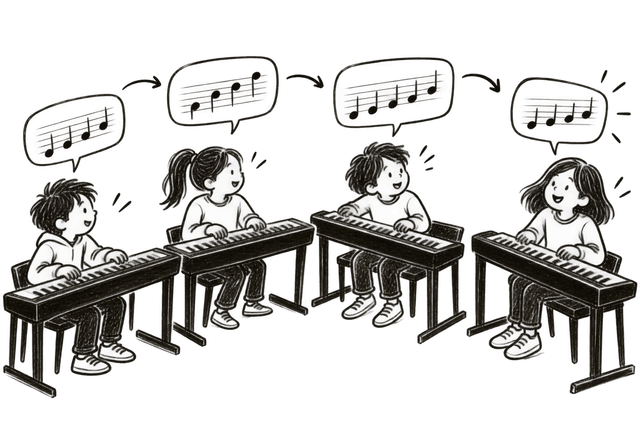
Students work in small groups to collaboratively complete a scale. Each student is responsible for one continuous segment of the scale and must listen to the previous player, entering accurately while maintaining a steady beat so that the individual segments connect into one uninterrupted scale. By rotating segments, changing keys, and increasing the tempo, students reinforce scale fingering, keyboard geography, and fluency through collaborative, game-based practice.
Procedures
- 1
Divide students into groups of three or four and select a scale they have already learned.
- 2
Divide the scale into continuous segments and assign each student a segment and a position in the relay order.
- 3
Give a steady preparatory beat, and have the first student play the assigned segment.
- 4
As soon as the first student finishes, the second student enters on the next beat and continues the scale. The remaining students follow in the same manner.
- 5
After completing the ascending scale, continue the relay through the descending scale, maintaining a steady pulse and avoiding noticeable breaks between players.
- 6
If the group makes a wrong note, uses incorrect fingering, or loses continuity between players, have the group restart the round.
- 7
After completing a round, rotate the assigned segments so that students practice starting from different points within the scale.
- 8
Change the key and begin another round. As students become more comfortable, gradually increase the tempo or reduce the preparation time before each new key.
Variations
1. Random Key Change: Use key cards to determine the scale for each round, reducing the amount of preparation time.
2. Tempo Challenge: Once the group can complete the relay accurately and continuously, gradually increase the tempo while maintaining accuracy and continuity.
3. Arpeggio Relay: Replace the scale with the tonic arpeggio in the same key.
4. Full-Scale Performance: After completing the relay, have the entire group play the same scale together from beginning to end, reconnecting the segmented practice into a complete performance.
Activity Preparation
1. Each student needs access to a piano or digital keyboard. Students should already have a basic command of the scales and fingerings used in the activity.
2. Determine the range of keys to be reviewed before the activity. Prepare key cards for random scale selection.
3. Groups of three or four are recommended, with students positioned so that they can hear one another clearly.
Activity Sources
- Source Type:
- Website / Online resource
- Source:
- Adapted from the Scale Relay activity concept used in Piano Camp / Piano Olympics activities shared by Music Matters Blog. https://musicmattersblog.com/2008/07/09/piano-camp-2008-qa/?utm
- Adaptation Notes:
- The original resource presents Scale Relay as an approach to group scale practice. This version adapts the concept specifically for Class Piano by assigning students continuous segments of a scale to perform in sequence. Additional elements—including steady-beat transitions, segment rotation, key changes, and an arpeggio variation—were added to reinforce scale performance, keyboard geography, listening, and group coordination.
MAPS teaching activities may come from a variety of sources, including original contributions by the MAPS team, online resources, published materials, activities learned from teachers, activities shared by colleagues, traditional teaching practices, and other sources. When a source can be reasonably identified, we make every effort to acknowledge it on the relevant activity page or in the accompanying reference information.
Some content may be organized, translated, structured, or adapted by the MAPS team for specific teaching contexts. Such editorial or instructional adaptation does not mean that MAPS claims ownership of the underlying third-party material. Rights to third-party content remain with the original authors, publishers, or other lawful rights holders.
If you are an author, copyright holder, or authorized representative and have questions or concerns regarding the source, attribution, or use of any content, please contact us:
Email: musicactivityps@gmail.com
Scale Relay
Summary
Students work in small groups to collaboratively complete a scale. Each student is responsible for one continuous segment of the scale and must listen to the previous player, entering accurately while maintaining a steady beat so that the individual segments connect into one uninterrupted scale. By rotating segments, changing keys, and increasing the tempo, students reinforce scale fingering, keyboard geography, and fluency through collaborative, game-based practice.
Procedures
- 1
Divide students into groups of three or four and select a scale they have already learned.
- 2
Divide the scale into continuous segments and assign each student a segment and a position in the relay order.
- 3
Give a steady preparatory beat, and have the first student play the assigned segment.
- 4
As soon as the first student finishes, the second student enters on the next beat and continues the scale. The remaining students follow in the same manner.
- 5
After completing the ascending scale, continue the relay through the descending scale, maintaining a steady pulse and avoiding noticeable breaks between players.
- 6
If the group makes a wrong note, uses incorrect fingering, or loses continuity between players, have the group restart the round.
- 7
After completing a round, rotate the assigned segments so that students practice starting from different points within the scale.
- 8
Change the key and begin another round. As students become more comfortable, gradually increase the tempo or reduce the preparation time before each new key.
Variations
1. Random Key Change: Use key cards to determine the scale for each round, reducing the amount of preparation time.
2. Tempo Challenge: Once the group can complete the relay accurately and continuously, gradually increase the tempo while maintaining accuracy and continuity.
3. Arpeggio Relay: Replace the scale with the tonic arpeggio in the same key.
4. Full-Scale Performance: After completing the relay, have the entire group play the same scale together from beginning to end, reconnecting the segmented practice into a complete performance.
Activity Preparation
1. Each student needs access to a piano or digital keyboard. Students should already have a basic command of the scales and fingerings used in the activity.
2. Determine the range of keys to be reviewed before the activity. Prepare key cards for random scale selection.
3. Groups of three or four are recommended, with students positioned so that they can hear one another clearly.
Activity Sources
- Source Type:
- Website / Online resource
- Source:
- Adapted from the Scale Relay activity concept used in Piano Camp / Piano Olympics activities shared by Music Matters Blog. https://musicmattersblog.com/2008/07/09/piano-camp-2008-qa/?utm
- Adaptation Notes:
- The original resource presents Scale Relay as an approach to group scale practice. This version adapts the concept specifically for Class Piano by assigning students continuous segments of a scale to perform in sequence. Additional elements—including steady-beat transitions, segment rotation, key changes, and an arpeggio variation—were added to reinforce scale performance, keyboard geography, listening, and group coordination.
MAPS teaching activities may come from a variety of sources, including original contributions by the MAPS team, online resources, published materials, activities learned from teachers, activities shared by colleagues, traditional teaching practices, and other sources. When a source can be reasonably identified, we make every effort to acknowledge it on the relevant activity page or in the accompanying reference information.
Some content may be organized, translated, structured, or adapted by the MAPS team for specific teaching contexts. Such editorial or instructional adaptation does not mean that MAPS claims ownership of the underlying third-party material. Rights to third-party content remain with the original authors, publishers, or other lawful rights holders.
If you are an author, copyright holder, or authorized representative and have questions or concerns regarding the source, attribution, or use of any content, please contact us:
Email: musicactivityps@gmail.com