MAPS
Scale-to-Improvisation Relay
Summary
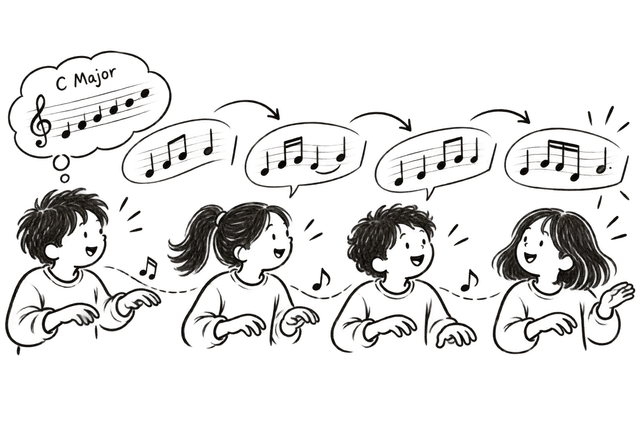
Students begin by playing a scale in a designated key to become familiar with its pitch collection and keyboard geography, then use notes from the same scale to improvise short musical phrases. Students take turns improvising, with each player continuing after the previous performer so that individual phrases connect into a continuous group improvisation. The activity transforms scale practice into musical application, helping students connect scales with tonality, aural awareness, and improvisation.
Procedures
- 1
Select a key that students have already learned, and have the class play the corresponding major or minor scale.
- 2
Review that students may use any notes from the selected scale for their improvisation, and demonstrate a short improvised phrase.
- 3
The teacher or a student plays a simple, repeating accompaniment to establish a clear tonal and rhythmic foundation.
- 4
Keep the accompaniement going, then the first student improvises a four-measure phrase using notes from the selected scale.
- 5
When the first student finishes, the second student enters immediately and improvises another four-measure phrase in the same key and steady pulse.
- 6
Students continue taking turns until everyone has improvised once, connecting the individual phrases into one continuous group performance.
- 7
After completing the round, have the class play the scale again and briefly discuss which notes or patterns were especially effective or comfortable to use during the improvisation.
- 8
Change the key and begin another round, asking students to transfer the same improvisational process to a different scale and keyboard position.
Variations
1. Last-Note Relay: Each student must begin their phrase on the final note played by the previous student, creating a stronger connection between phrases.
2. Rhythmic Constraint: Provide a short rhythmic pattern that each student must incorporate at least once during their improvisation.
3. Question-and-Answer Improvisation: Students work in pairs. The first student improvises a four-measure “call,” and the second improvises a four-measure “response” using notes from the same key.
4. Harmonic Extension: Once students are comfortable with the activity, use a simple progression such as I–IV–V–I as the accompaniment while students improvise with notes from the target scale.
Activity Preparation
1. Select the key or keys to be used and prepare a simple, repeatable accompaniment pattern.
2. For the first round, use a familiar key and maintain a steady, moderate-to-slow tempo.
3. Students should be able to maintain a basic four-measure phrase within a steady pulse. If this is not yet comfortable, begin with two-measure improvisations.
Activity Sources
- Source Type:
- Website / Online resource
- Source:
- Adapted from a Music Matters Blog Piano Camp activity concept that connects major/minor pentascale practice with improvisation duets. https://musicmattersblog.com/2009/07/14/piano-camp-improvising/
- Adaptation Notes:
- The original activity concept extends students’ practice of major and minor pentascales into improvisation duets, allowing technical material to be applied in a creative musical context. This version expands that idea into a group improvisation relay for Class Piano: students first review a complete scale and then take turns improvising short phrases using notes from the selected key. The specific relay structure and additional elements—including fixed phrase lengths, continuous entrances, last-note connections, and harmonic accompaniment—are classroom adaptations developed from the broader scale/pentascale-to-improvisation concept.
MAPS teaching activities may come from a variety of sources, including original contributions by the MAPS team, online resources, published materials, activities learned from teachers, activities shared by colleagues, traditional teaching practices, and other sources. When a source can be reasonably identified, we make every effort to acknowledge it on the relevant activity page or in the accompanying reference information.
Some content may be organized, translated, structured, or adapted by the MAPS team for specific teaching contexts. Such editorial or instructional adaptation does not mean that MAPS claims ownership of the underlying third-party material. Rights to third-party content remain with the original authors, publishers, or other lawful rights holders.
If you are an author, copyright holder, or authorized representative and have questions or concerns regarding the source, attribution, or use of any content, please contact us:
Email: musicactivityps@gmail.com
Scale-to-Improvisation Relay
Summary
Students begin by playing a scale in a designated key to become familiar with its pitch collection and keyboard geography, then use notes from the same scale to improvise short musical phrases. Students take turns improvising, with each player continuing after the previous performer so that individual phrases connect into a continuous group improvisation. The activity transforms scale practice into musical application, helping students connect scales with tonality, aural awareness, and improvisation.
Procedures
- 1
Select a key that students have already learned, and have the class play the corresponding major or minor scale.
- 2
Review that students may use any notes from the selected scale for their improvisation, and demonstrate a short improvised phrase.
- 3
The teacher or a student plays a simple, repeating accompaniment to establish a clear tonal and rhythmic foundation.
- 4
Keep the accompaniement going, then the first student improvises a four-measure phrase using notes from the selected scale.
- 5
When the first student finishes, the second student enters immediately and improvises another four-measure phrase in the same key and steady pulse.
- 6
Students continue taking turns until everyone has improvised once, connecting the individual phrases into one continuous group performance.
- 7
After completing the round, have the class play the scale again and briefly discuss which notes or patterns were especially effective or comfortable to use during the improvisation.
- 8
Change the key and begin another round, asking students to transfer the same improvisational process to a different scale and keyboard position.
Variations
1. Last-Note Relay: Each student must begin their phrase on the final note played by the previous student, creating a stronger connection between phrases.
2. Rhythmic Constraint: Provide a short rhythmic pattern that each student must incorporate at least once during their improvisation.
3. Question-and-Answer Improvisation: Students work in pairs. The first student improvises a four-measure “call,” and the second improvises a four-measure “response” using notes from the same key.
4. Harmonic Extension: Once students are comfortable with the activity, use a simple progression such as I–IV–V–I as the accompaniment while students improvise with notes from the target scale.
Activity Preparation
1. Select the key or keys to be used and prepare a simple, repeatable accompaniment pattern.
2. For the first round, use a familiar key and maintain a steady, moderate-to-slow tempo.
3. Students should be able to maintain a basic four-measure phrase within a steady pulse. If this is not yet comfortable, begin with two-measure improvisations.
Activity Sources
- Source Type:
- Website / Online resource
- Source:
- Adapted from a Music Matters Blog Piano Camp activity concept that connects major/minor pentascale practice with improvisation duets. https://musicmattersblog.com/2009/07/14/piano-camp-improvising/
- Adaptation Notes:
- The original activity concept extends students’ practice of major and minor pentascales into improvisation duets, allowing technical material to be applied in a creative musical context. This version expands that idea into a group improvisation relay for Class Piano: students first review a complete scale and then take turns improvising short phrases using notes from the selected key. The specific relay structure and additional elements—including fixed phrase lengths, continuous entrances, last-note connections, and harmonic accompaniment—are classroom adaptations developed from the broader scale/pentascale-to-improvisation concept.
MAPS teaching activities may come from a variety of sources, including original contributions by the MAPS team, online resources, published materials, activities learned from teachers, activities shared by colleagues, traditional teaching practices, and other sources. When a source can be reasonably identified, we make every effort to acknowledge it on the relevant activity page or in the accompanying reference information.
Some content may be organized, translated, structured, or adapted by the MAPS team for specific teaching contexts. Such editorial or instructional adaptation does not mean that MAPS claims ownership of the underlying third-party material. Rights to third-party content remain with the original authors, publishers, or other lawful rights holders.
If you are an author, copyright holder, or authorized representative and have questions or concerns regarding the source, attribution, or use of any content, please contact us:
Email: musicactivityps@gmail.com