 MAPS
Sight-Reading Preparation Routine
Summary
Students prepare to sight-read an unfamiliar excerpt by analyzing the score, identifying key musical cues, using audiation, and ghost playing before performing with a steady pulse. They then reflect on the strategies that supported continuous reading.
Procedures
- 1
Analyze the Score:
The teacher provides a short, unfamiliar excerpt and gives students limited preparation time. Students observe: a. Clef signs b. Key signature c. Time signature d. Starting position and hand placement e. Potentially challenging rhythms or intervals f. Overall melodic direction, dynamics, and possible fingering
- 2
Share an Observation:
Students state one musical clue they noticed in a complete sentence. For example: “This piece is in 3/4 time, and the right hand moves mostly stepwise upward.” Or: “The left hand has a repeating chord pattern.”
- 3
Audiate:
Students silently sing the melody internally while maintaining a sense of rhythm and steady beat. The teacher may provide a starting tempo and ask students to internally hear the first measure or phrase before playing.
- 4
Ghost Play:
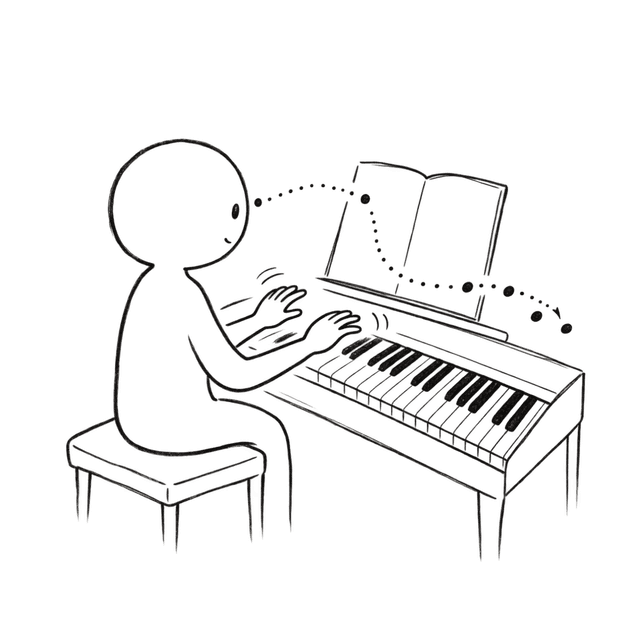
Students hold their hands above the keyboard and silently simulate the performance. Guided by the music they hear internally, they preview the starting position, hand shifts, interval distances, and directions of movement.
- 5
Establish a Steady Pulse and Sight-Read Continuously:
The teacher sets a comfortable, sustainable tempo. Students sight-read from beginning to end, keeping their eyes on the score as much as possible. While their hands play the current beat or measure, students look ahead to the next beat or measure, gradually developing an eye–hand span. If an error occurs, students continue forward with the steady pulse rather than stopping to correct it.
- 6
Reflect:
After playing, students briefly respond to the following questions: a. What did I notice before I began playing? b. Which passage was the most difficult to keep moving through? c. What will I look for first next time?
Activity Preparation
1. A short, unfamiliar sight-reading excerpt appropriate to the student’s level
2. Piano or keyboard
Activity Sources
- Source Type:
- MAPS Original
- Source:
- Reference James Bastien, sight-reading material: “To the Student” reading tips. Pike, P. D. (2012). Sight-reading strategies for the beginning and intermediate piano student: A fresh look at a familiar topic. American Music Teacher, 61(4), 23–28.
- Adaptation Notes:
- This activity draws on general sight-reading principles from Bastien’s material and on strategies discussed by Pike (2012), including eye–hand span.
MAPS teaching activities may come from a variety of sources, including original contributions by the MAPS team, online resources, published materials, activities learned from teachers, activities shared by colleagues, traditional teaching practices, and other sources. When a source can be reasonably identified, we make every effort to acknowledge it on the relevant activity page or in the accompanying reference information.
Some content may be organized, translated, structured, or adapted by the MAPS team for specific teaching contexts. Such editorial or instructional adaptation does not mean that MAPS claims ownership of the underlying third-party material. Rights to third-party content remain with the original authors, publishers, or other lawful rights holders.
If you are an author, copyright holder, or authorized representative and have questions or concerns regarding the source, attribution, or use of any content, please contact us:
Email: musicactivityps@gmail.com
Sight-Reading Preparation Routine
Summary
Students prepare to sight-read an unfamiliar excerpt by analyzing the score, identifying key musical cues, using audiation, and ghost playing before performing with a steady pulse. They then reflect on the strategies that supported continuous reading.
Procedures
- 1
Analyze the Score:
The teacher provides a short, unfamiliar excerpt and gives students limited preparation time. Students observe: a. Clef signs b. Key signature c. Time signature d. Starting position and hand placement e. Potentially challenging rhythms or intervals f. Overall melodic direction, dynamics, and possible fingering
- 2
Share an Observation:
Students state one musical clue they noticed in a complete sentence. For example: “This piece is in 3/4 time, and the right hand moves mostly stepwise upward.” Or: “The left hand has a repeating chord pattern.”
- 3
Audiate:
Students silently sing the melody internally while maintaining a sense of rhythm and steady beat. The teacher may provide a starting tempo and ask students to internally hear the first measure or phrase before playing.
- 4
Ghost Play:
Students hold their hands above the keyboard and silently simulate the performance. Guided by the music they hear internally, they preview the starting position, hand shifts, interval distances, and directions of movement.
- 5
Establish a Steady Pulse and Sight-Read Continuously:
The teacher sets a comfortable, sustainable tempo. Students sight-read from beginning to end, keeping their eyes on the score as much as possible. While their hands play the current beat or measure, students look ahead to the next beat or measure, gradually developing an eye–hand span. If an error occurs, students continue forward with the steady pulse rather than stopping to correct it.
- 6
Reflect:
After playing, students briefly respond to the following questions: a. What did I notice before I began playing? b. Which passage was the most difficult to keep moving through? c. What will I look for first next time?
Activity Preparation
1. A short, unfamiliar sight-reading excerpt appropriate to the student’s level
2. Piano or keyboard
Activity Sources
- Source Type:
- MAPS Original
- Source:
- Reference James Bastien, sight-reading material: “To the Student” reading tips. Pike, P. D. (2012). Sight-reading strategies for the beginning and intermediate piano student: A fresh look at a familiar topic. American Music Teacher, 61(4), 23–28.
- Adaptation Notes:
- This activity draws on general sight-reading principles from Bastien’s material and on strategies discussed by Pike (2012), including eye–hand span.
MAPS teaching activities may come from a variety of sources, including original contributions by the MAPS team, online resources, published materials, activities learned from teachers, activities shared by colleagues, traditional teaching practices, and other sources. When a source can be reasonably identified, we make every effort to acknowledge it on the relevant activity page or in the accompanying reference information.
Some content may be organized, translated, structured, or adapted by the MAPS team for specific teaching contexts. Such editorial or instructional adaptation does not mean that MAPS claims ownership of the underlying third-party material. Rights to third-party content remain with the original authors, publishers, or other lawful rights holders.
If you are an author, copyright holder, or authorized representative and have questions or concerns regarding the source, attribution, or use of any content, please contact us:
Email: musicactivityps@gmail.com