MAPS
Staff Hopscotch
Summary
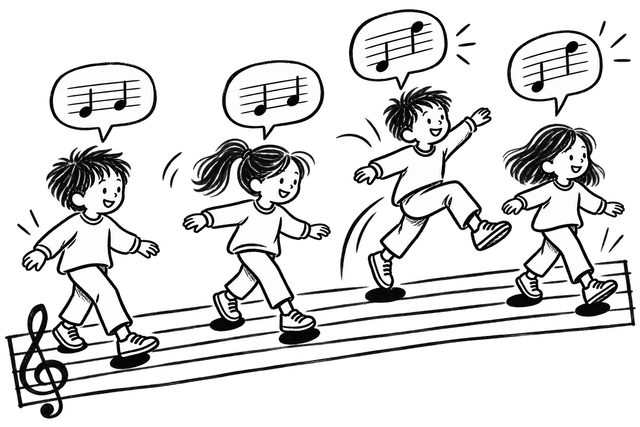
Students move along a large floor staff to physically experience the difference between melodic steps and leaps. They first explore how steps and leaps are represented spatially on the staff, then listen to examples played on pitched instruments and reproduce what they hear through movement. The activity connects aural recognition, physical movement, and staff notation.
Procedures
- 1
Use painter’s tape to create a large five-line staff on the floor, leaving enough space for students to stand and move safely between the lines.
- 2
Invite students to explore the staff by placing their feet on its lines and spaces and identifying the difference between the two.
- 3
Demonstrate a step by moving from a line to the neighboring space, or from a space to the neighboring line. Students follow by walking successive steps across the staff.
- 4
Demonstrate a leap by moving from line to line, space to space, or across a larger distance. Students reproduce the motion by hopping or skipping.
- 5
Ask students to compare the two movements and describe what makes a step different from a leap.
- 6
Play examples of steps and leaps on a piano, glockenspiel, Orff instrument, or another pitched instrument while showing how each sound corresponds to movement on the floor staff.
- 7
Play a step or leap without showing the answer. Students listen, decide which they hear, and demonstrate their answer by moving appropriately on the floor staff.
- 8
Repeat with different pitch combinations, allowing students to take turns responding.
Variations
1. Simplify: Begin with visual demonstrations only. Have students copy steps and leaps before adding aural identification.
2. Increase difficulty: Play several consecutive intervals and ask students to create a movement sequence that represents the melodic contour.
3. Notation extension: Transfer the same step-and-leap patterns from the floor staff to written notation.
Reference Video Link
Activity Preparation
1. Painter’s tape
2. Open floor space
3. Piano, glockenspiel, Orff instruments, or other pitched instruments
4. Prepare a large five-line staff on the floor before the activity
5. Students should have enough space to walk and hop safely
Activity Sources
- Source Type:
- Website / Online resource
- Source:
- Carnegie Hall, Music Educators Toolbox — Grade 2: Staff Hopscotch.
MAPS teaching activities may come from a variety of sources, including original contributions by the MAPS team, online resources, published materials, activities learned from teachers, activities shared by colleagues, traditional teaching practices, and other sources. When a source can be reasonably identified, we make every effort to acknowledge it on the relevant activity page or in the accompanying reference information.
Some content may be organized, translated, structured, or adapted by the MAPS team for specific teaching contexts. Such editorial or instructional adaptation does not mean that MAPS claims ownership of the underlying third-party material. Rights to third-party content remain with the original authors, publishers, or other lawful rights holders.
If you are an author, copyright holder, or authorized representative and have questions or concerns regarding the source, attribution, or use of any content, please contact us:
Email: musicactivityps@gmail.com
Staff Hopscotch
Summary
Students move along a large floor staff to physically experience the difference between melodic steps and leaps. They first explore how steps and leaps are represented spatially on the staff, then listen to examples played on pitched instruments and reproduce what they hear through movement. The activity connects aural recognition, physical movement, and staff notation.
Procedures
- 1
Use painter’s tape to create a large five-line staff on the floor, leaving enough space for students to stand and move safely between the lines.
- 2
Invite students to explore the staff by placing their feet on its lines and spaces and identifying the difference between the two.
- 3
Demonstrate a step by moving from a line to the neighboring space, or from a space to the neighboring line. Students follow by walking successive steps across the staff.
- 4
Demonstrate a leap by moving from line to line, space to space, or across a larger distance. Students reproduce the motion by hopping or skipping.
- 5
Ask students to compare the two movements and describe what makes a step different from a leap.
- 6
Play examples of steps and leaps on a piano, glockenspiel, Orff instrument, or another pitched instrument while showing how each sound corresponds to movement on the floor staff.
- 7
Play a step or leap without showing the answer. Students listen, decide which they hear, and demonstrate their answer by moving appropriately on the floor staff.
- 8
Repeat with different pitch combinations, allowing students to take turns responding.
Variations
1. Simplify: Begin with visual demonstrations only. Have students copy steps and leaps before adding aural identification.
2. Increase difficulty: Play several consecutive intervals and ask students to create a movement sequence that represents the melodic contour.
3. Notation extension: Transfer the same step-and-leap patterns from the floor staff to written notation.
Reference Video Link
Activity Preparation
1. Painter’s tape
2. Open floor space
3. Piano, glockenspiel, Orff instruments, or other pitched instruments
4. Prepare a large five-line staff on the floor before the activity
5. Students should have enough space to walk and hop safely
Activity Sources
- Source Type:
- Website / Online resource
- Source:
- Carnegie Hall, Music Educators Toolbox — Grade 2: Staff Hopscotch.
MAPS teaching activities may come from a variety of sources, including original contributions by the MAPS team, online resources, published materials, activities learned from teachers, activities shared by colleagues, traditional teaching practices, and other sources. When a source can be reasonably identified, we make every effort to acknowledge it on the relevant activity page or in the accompanying reference information.
Some content may be organized, translated, structured, or adapted by the MAPS team for specific teaching contexts. Such editorial or instructional adaptation does not mean that MAPS claims ownership of the underlying third-party material. Rights to third-party content remain with the original authors, publishers, or other lawful rights holders.
If you are an author, copyright holder, or authorized representative and have questions or concerns regarding the source, attribution, or use of any content, please contact us:
Email: musicactivityps@gmail.com