 MAPS
Step, Skip, Repeat
Summary
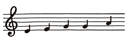
Students learn to read short melodic patterns by noticing relationships between consecutive notes—repeat, step up or down, and skip up or down—rather than identifying every note separately. After recognizing the pattern, students use a given starting note to determine the remaining pitches and then sing or play the pattern, building more fluent, pattern-based music reading.
Procedures
- 1
Introduce the three basic relationships on the staff. Show pairs of notes and establish that the same staff position is a repeat, an adjacent line-to-space or space-to-line movement is a step, and a line-to-line or space-to-space movement is a skip. At first, focus on the visual relationship rather than note names.
- 2
Display a short pattern of about 4–6 notes using one clef and simple note values. Point to the first note, then move through the pattern one note at a time. Ask students to describe each change as repeat, step up, step down, skip up, or skip down.
- 3
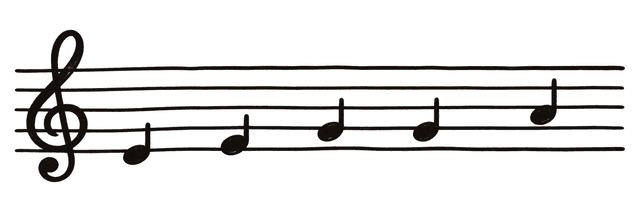
Give the name of the starting note only. Ask students to use the relationships they identified to determine the remaining note names. For example, if the pattern starts on C and moves step up, step up, skip up, repeat, students derive C–D–E–G–G.
- 4
Have students sing or play the complete pattern. Encourage them to keep their eyes moving through the melodic shape and to use the relationships between notes instead of stopping to identify every pitch independently.
- 5
Practice with several new patterns that mix upward and downward motion, repeats, steps, and skips. At first, students may say the relationships aloud before performing; gradually ask them to recognize the relationships silently.
- 6
Reduce support as students become more fluent. Remove written note names, provide only the starting note, and ask students to read and perform the pattern directly.
Variations
1. Use the movement shape the melody: Assign a physical response to each relationship—for example, stay in place for repeat, take one small step for step, and one larger step for skip. Students follow a displayed melodic pattern with body movement before singing or playing it. This is especially useful for younger learners who benefit from experiencing pitch distance physically.
2. Add Rhythm: Once students can follow pitch relationships comfortably, add simple rhythmic patterns. Students first scan the melodic contour for repeats, steps, and skips, then perform the phrase while maintaining the written rhythm and steady beat.
3. Sight-Reading Transfer: Use a short excerpt from actual repertoire. Before playing, ask students to quickly locate groups of repeats, steps, and skips and identify where the melodic direction changes. As the strategy becomes automatic, remove the verbal analysis and ask students to use the same process silently during sight-reading.
Activity Preparation
1. Materials
a. A staff on a whiteboard, paper, felt board, or magnetic board.
b. A piano, keyboard, or another pitched instrument is recommended for transferring the reading pattern into performance.
2.Prior Knowledge
a. Students should understand that notes are placed on lines and spaces and know the musical alphabet A–G.
b. Students should know at least one or two familiar landmark notes in the clef being used. Fluent note naming is not required; developing that fluency is part of the activity.
3.Pattern Preparation
a. Prepare approximately 6–10 short patterns of 4–6 notes each.
b. Begin with one clef, one hand/register, and equal or very simple note values so that students can focus on pitch relationships.
c. In early examples, avoid accidentals, ledger lines, and large intervals. Use only repeats, steps, and skips, then gradually mix upward and downward motion.
d. Clearly identify the starting note in the first rounds. Later, remove that support or replace it with a nearby landmark note.
e. If the activity is used at the keyboard, keep the notated register within a comfortable playing range and confirm that students can locate the starting pitch.
Activity Sources
- Source Type:
- Textbook / Book
- Source:
- Open Music Theory, Version 2. Online open textbook, Pressbooks.
- Adaptation Notes:
- Emphasizes relational and pattern-based reading, with progressive transfer from visual recognition to naming, singing, and performance.
MAPS teaching activities may come from a variety of sources, including original contributions by the MAPS team, online resources, published materials, activities learned from teachers, activities shared by colleagues, traditional teaching practices, and other sources. When a source can be reasonably identified, we make every effort to acknowledge it on the relevant activity page or in the accompanying reference information.
Some content may be organized, translated, structured, or adapted by the MAPS team for specific teaching contexts. Such editorial or instructional adaptation does not mean that MAPS claims ownership of the underlying third-party material. Rights to third-party content remain with the original authors, publishers, or other lawful rights holders.
If you are an author, copyright holder, or authorized representative and have questions or concerns regarding the source, attribution, or use of any content, please contact us:
Email: musicactivityps@gmail.com
Step, Skip, Repeat
Summary
Students learn to read short melodic patterns by noticing relationships between consecutive notes—repeat, step up or down, and skip up or down—rather than identifying every note separately. After recognizing the pattern, students use a given starting note to determine the remaining pitches and then sing or play the pattern, building more fluent, pattern-based music reading.
Procedures
- 1
Introduce the three basic relationships on the staff. Show pairs of notes and establish that the same staff position is a repeat, an adjacent line-to-space or space-to-line movement is a step, and a line-to-line or space-to-space movement is a skip. At first, focus on the visual relationship rather than note names.
- 2
Display a short pattern of about 4–6 notes using one clef and simple note values. Point to the first note, then move through the pattern one note at a time. Ask students to describe each change as repeat, step up, step down, skip up, or skip down.
- 3
Give the name of the starting note only. Ask students to use the relationships they identified to determine the remaining note names. For example, if the pattern starts on C and moves step up, step up, skip up, repeat, students derive C–D–E–G–G.
- 4
Have students sing or play the complete pattern. Encourage them to keep their eyes moving through the melodic shape and to use the relationships between notes instead of stopping to identify every pitch independently.
- 5
Practice with several new patterns that mix upward and downward motion, repeats, steps, and skips. At first, students may say the relationships aloud before performing; gradually ask them to recognize the relationships silently.
- 6
Reduce support as students become more fluent. Remove written note names, provide only the starting note, and ask students to read and perform the pattern directly.
Variations
1. Use the movement shape the melody: Assign a physical response to each relationship—for example, stay in place for repeat, take one small step for step, and one larger step for skip. Students follow a displayed melodic pattern with body movement before singing or playing it. This is especially useful for younger learners who benefit from experiencing pitch distance physically.
2. Add Rhythm: Once students can follow pitch relationships comfortably, add simple rhythmic patterns. Students first scan the melodic contour for repeats, steps, and skips, then perform the phrase while maintaining the written rhythm and steady beat.
3. Sight-Reading Transfer: Use a short excerpt from actual repertoire. Before playing, ask students to quickly locate groups of repeats, steps, and skips and identify where the melodic direction changes. As the strategy becomes automatic, remove the verbal analysis and ask students to use the same process silently during sight-reading.
Activity Preparation
1. Materials
a. A staff on a whiteboard, paper, felt board, or magnetic board.
b. A piano, keyboard, or another pitched instrument is recommended for transferring the reading pattern into performance.
2.Prior Knowledge
a. Students should understand that notes are placed on lines and spaces and know the musical alphabet A–G.
b. Students should know at least one or two familiar landmark notes in the clef being used. Fluent note naming is not required; developing that fluency is part of the activity.
3.Pattern Preparation
a. Prepare approximately 6–10 short patterns of 4–6 notes each.
b. Begin with one clef, one hand/register, and equal or very simple note values so that students can focus on pitch relationships.
c. In early examples, avoid accidentals, ledger lines, and large intervals. Use only repeats, steps, and skips, then gradually mix upward and downward motion.
d. Clearly identify the starting note in the first rounds. Later, remove that support or replace it with a nearby landmark note.
e. If the activity is used at the keyboard, keep the notated register within a comfortable playing range and confirm that students can locate the starting pitch.
Activity Sources
- Source Type:
- Textbook / Book
- Source:
- Open Music Theory, Version 2. Online open textbook, Pressbooks.
- Adaptation Notes:
- Emphasizes relational and pattern-based reading, with progressive transfer from visual recognition to naming, singing, and performance.
MAPS teaching activities may come from a variety of sources, including original contributions by the MAPS team, online resources, published materials, activities learned from teachers, activities shared by colleagues, traditional teaching practices, and other sources. When a source can be reasonably identified, we make every effort to acknowledge it on the relevant activity page or in the accompanying reference information.
Some content may be organized, translated, structured, or adapted by the MAPS team for specific teaching contexts. Such editorial or instructional adaptation does not mean that MAPS claims ownership of the underlying third-party material. Rights to third-party content remain with the original authors, publishers, or other lawful rights holders.
If you are an author, copyright holder, or authorized representative and have questions or concerns regarding the source, attribution, or use of any content, please contact us:
Email: musicactivityps@gmail.com