MAPS
Theme and Variation
Summary
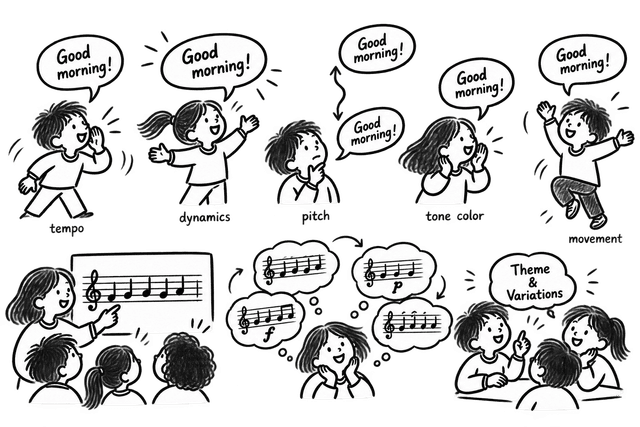
Students explore the concept of theme and variation by changing the delivery of a simple sentence through vocal and physical expression. They then listen to Mozart’s variations on “Twinkle, Twinkle Little Star,” identify the familiar theme, and discuss how subsequent variations differ from it.
Procedures
- 1
Arrange students in a circle and invite one student to create and recite a simple sentence as the theme.
- 2
Moving around the circle, each student repeats the same sentence in a new way without copying any earlier version. Encourage changes in vocal register, timbre, dynamics, and tempo, as well as body movement or body percussion.
- 3
Lead a class discussion about what changed and what remained recognizable. Introduce the term “variation,” and ask how composers might vary a musical theme, such as by changing tempo, dynamics, instrumentation, rhythm, or melody.
- 4
Play Mozart’s variations on “Twinkle, Twinkle Little Star.” Ask students to raise their hands when they recognize the familiar theme.
- 5
Continue the recording. In small groups, students listen and discuss how the variations differ from the theme, using observable musical features to support their comparisons.
Variations
1. Ask students to write variations on a familiar poem or story.
2. Study the score of Mozart’s variations and mark the theme and variations. Compare details visible in the notation with those noticed by ear.
3. Invite students to compose variations on “Twinkle, Twinkle Little Star” or another familiar song.
Activity Preparation
1. Prepare a recording of Mozart’s variations on “Twinkle, Twinkle Little Star” and suitable playback equipment.
2. Prepare chart paper and markers to record students’ observations and suggested ways to vary a theme.
3. Arrange an open space where students can stand or sit in a circle and participate in turn.
Activity Sources
- Source Type:
- Website / Online resource
MAPS teaching activities may come from a variety of sources, including original contributions by the MAPS team, online resources, published materials, activities learned from teachers, activities shared by colleagues, traditional teaching practices, and other sources. When a source can be reasonably identified, we make every effort to acknowledge it on the relevant activity page or in the accompanying reference information.
Some content may be organized, translated, structured, or adapted by the MAPS team for specific teaching contexts. Such editorial or instructional adaptation does not mean that MAPS claims ownership of the underlying third-party material. Rights to third-party content remain with the original authors, publishers, or other lawful rights holders.
If you are an author, copyright holder, or authorized representative and have questions or concerns regarding the source, attribution, or use of any content, please contact us:
Email: musicactivityps@gmail.com
Theme and Variation
Summary
Students explore the concept of theme and variation by changing the delivery of a simple sentence through vocal and physical expression. They then listen to Mozart’s variations on “Twinkle, Twinkle Little Star,” identify the familiar theme, and discuss how subsequent variations differ from it.
Procedures
- 1
Arrange students in a circle and invite one student to create and recite a simple sentence as the theme.
- 2
Moving around the circle, each student repeats the same sentence in a new way without copying any earlier version. Encourage changes in vocal register, timbre, dynamics, and tempo, as well as body movement or body percussion.
- 3
Lead a class discussion about what changed and what remained recognizable. Introduce the term “variation,” and ask how composers might vary a musical theme, such as by changing tempo, dynamics, instrumentation, rhythm, or melody.
- 4
Play Mozart’s variations on “Twinkle, Twinkle Little Star.” Ask students to raise their hands when they recognize the familiar theme.
- 5
Continue the recording. In small groups, students listen and discuss how the variations differ from the theme, using observable musical features to support their comparisons.
Variations
1. Ask students to write variations on a familiar poem or story.
2. Study the score of Mozart’s variations and mark the theme and variations. Compare details visible in the notation with those noticed by ear.
3. Invite students to compose variations on “Twinkle, Twinkle Little Star” or another familiar song.
Activity Preparation
1. Prepare a recording of Mozart’s variations on “Twinkle, Twinkle Little Star” and suitable playback equipment.
2. Prepare chart paper and markers to record students’ observations and suggested ways to vary a theme.
3. Arrange an open space where students can stand or sit in a circle and participate in turn.
Activity Sources
- Source Type:
- Website / Online resource
MAPS teaching activities may come from a variety of sources, including original contributions by the MAPS team, online resources, published materials, activities learned from teachers, activities shared by colleagues, traditional teaching practices, and other sources. When a source can be reasonably identified, we make every effort to acknowledge it on the relevant activity page or in the accompanying reference information.
Some content may be organized, translated, structured, or adapted by the MAPS team for specific teaching contexts. Such editorial or instructional adaptation does not mean that MAPS claims ownership of the underlying third-party material. Rights to third-party content remain with the original authors, publishers, or other lawful rights holders.
If you are an author, copyright holder, or authorized representative and have questions or concerns regarding the source, attribution, or use of any content, please contact us:
Email: musicactivityps@gmail.com