MAPS
Tie It Together
Summary
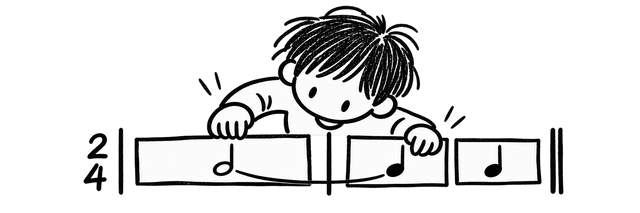
Students learn how a tie connects two notes of the same pitch and combines their written durations into one continuous sound without a second attack. Using proportional duration strips, note cards, tie connectors, and barlines, students build tied durations, check whether pitches can be tied, and apply the concept across a barline.
Procedures
- 1
Introduce the tie and establish the core rule.
Show students that a tie is a curved line connecting two notes. State the key rule clearly: a tie can only connect notes of the same pitch. Explain that the written note values are added together, but the second note is not played or sung again. Instead, the first sound continues through the second note. Use two quarter notes on the same pitch as a simple example. The teacher may demonstrate both versions on the piano: first play the two notes separately, then play the first note once and sustain it for the combined duration so students can hear the difference between two attacks and one continuous sound.
- 2
Build different tied durations.
Give students same-pitch note cards, proportional duration strips, and tie connectors. Provide a target duration, such as two beats or three beats, and ask students to build it using two written notes—for example, quarter + quarter or half + quarter. Students add the written values, place the tie between the matching pitches, and represent the full duration by pressing a hand down at the first attack and holding until the total value is complete. Reinforce throughout that a tie represents one continuous sound on the same pitch; the second note is not re-articulated.
- 3
Decide whether a curved line creates a tie.
Show several note pairs with curved lines, such as C–C, C–D, F–F, and G–A. Ask questions such as: “Does this curved line make the first sound continue?” and “Is this a tie? Why or why not?” Students decide based on whether the pitches are the same. With C–C or F–F, they should explain that the notes can be tied, the durations are combined, and the second note is not re-attacked. With C–D or G–A, they should explain that the line does not create a tie, so the two written values are not combined into one sustained sound. Briefly remind students that curved lines can also appear between different pitches, but those are not ties.
- 4
Experience a tie across the barline in context.
Show two measures in 4/4, each containing four quarter notes, for example: C – D – F – G | G – G – E – C Place a tie between the G on beat 4 of the first measure and the G on beat 1 of the second measure. Have students speak the note names in rhythm. First, they may read all eight note names normally. Then repeat using the tie correctly: begin the G on beat 4, sustain it through beat 1 of the next measure, and do not repeat the second G. Continue with the next G on beat 2. The teacher may also demonstrate the passage on the piano so students can hear the difference between sustaining across the barline and re-attacking the note on beat 1.
- 5
Review and close the activity.
Ask students to summarize the rule in their own words: “What kinds of notes can a tie connect?” “Do you play or sing the second note again?” “What happens to the two written durations?” and “Can a tie cross a barline?” Conclude with the full rule: a tie connects notes of the same pitch and combines their written durations into one continuous sound. The second note is not re-articulated, and a tie may cross a barline.
Activity Preparation
1. Materials
a. Proportionally sized duration strips for whole, half, quarter, and eighth notes. The physical lengths must accurately reflect the relative note values.
b. Sets of same-pitch note cards in several note values (for example, two C quarter notes, a G half note and G quarter note, etc.).
c. Curved tie connector cards that can be placed between note cards.
d. Barline cards and simple 4/4 measure templates for cross-barline practice.
e. One piano or keyboard for teacher demonstration only; students do not need individual instruments.
2. Prior Knowledge
a. Students should know the basic values of whole, half, quarter, and eighth notes.
b. Students should be able to add simple note values and maintain a steady count in 4/4.
c. Students should understand what a barline and measure are. Prior knowledge of ties is not required.
3. Teacher Setup
a. Prepare enough note cards, duration strips, and tie connectors for students to work individually, in pairs, or in small groups.
b. Keep pitch labels or staff notation clear enough that students can immediately tell whether two notes represent the same pitch.
c. Prepare at least one simple cross-barline example in 4/4, such as a note beginning on beat 4 and continuing through beat 1 of the next measure.
d. Use the piano only for short listening demonstrations; the central student work should remain card-based, visual, and physical so the activity functions well in a general classroom.
Activity Sources
- Source Type:
- MAPS Original
- Adaptation Notes:
- Developed as a hands-on classroom activity that combines proportional duration strips, same-pitch note cards, physical holding, and teacher-led listening demonstrations to make tied duration visible and audible.
MAPS teaching activities may come from a variety of sources, including original contributions by the MAPS team, online resources, published materials, activities learned from teachers, activities shared by colleagues, traditional teaching practices, and other sources. When a source can be reasonably identified, we make every effort to acknowledge it on the relevant activity page or in the accompanying reference information.
Some content may be organized, translated, structured, or adapted by the MAPS team for specific teaching contexts. Such editorial or instructional adaptation does not mean that MAPS claims ownership of the underlying third-party material. Rights to third-party content remain with the original authors, publishers, or other lawful rights holders.
If you are an author, copyright holder, or authorized representative and have questions or concerns regarding the source, attribution, or use of any content, please contact us:
Email: musicactivityps@gmail.com
Tie It Together
Summary
Students learn how a tie connects two notes of the same pitch and combines their written durations into one continuous sound without a second attack. Using proportional duration strips, note cards, tie connectors, and barlines, students build tied durations, check whether pitches can be tied, and apply the concept across a barline.
Procedures
- 1
Introduce the tie and establish the core rule.
Show students that a tie is a curved line connecting two notes. State the key rule clearly: a tie can only connect notes of the same pitch. Explain that the written note values are added together, but the second note is not played or sung again. Instead, the first sound continues through the second note. Use two quarter notes on the same pitch as a simple example. The teacher may demonstrate both versions on the piano: first play the two notes separately, then play the first note once and sustain it for the combined duration so students can hear the difference between two attacks and one continuous sound.
- 2
Build different tied durations.
Give students same-pitch note cards, proportional duration strips, and tie connectors. Provide a target duration, such as two beats or three beats, and ask students to build it using two written notes—for example, quarter + quarter or half + quarter. Students add the written values, place the tie between the matching pitches, and represent the full duration by pressing a hand down at the first attack and holding until the total value is complete. Reinforce throughout that a tie represents one continuous sound on the same pitch; the second note is not re-articulated.
- 3
Decide whether a curved line creates a tie.
Show several note pairs with curved lines, such as C–C, C–D, F–F, and G–A. Ask questions such as: “Does this curved line make the first sound continue?” and “Is this a tie? Why or why not?” Students decide based on whether the pitches are the same. With C–C or F–F, they should explain that the notes can be tied, the durations are combined, and the second note is not re-attacked. With C–D or G–A, they should explain that the line does not create a tie, so the two written values are not combined into one sustained sound. Briefly remind students that curved lines can also appear between different pitches, but those are not ties.
- 4
Experience a tie across the barline in context.
Show two measures in 4/4, each containing four quarter notes, for example: C – D – F – G | G – G – E – C Place a tie between the G on beat 4 of the first measure and the G on beat 1 of the second measure. Have students speak the note names in rhythm. First, they may read all eight note names normally. Then repeat using the tie correctly: begin the G on beat 4, sustain it through beat 1 of the next measure, and do not repeat the second G. Continue with the next G on beat 2. The teacher may also demonstrate the passage on the piano so students can hear the difference between sustaining across the barline and re-attacking the note on beat 1.
- 5
Review and close the activity.
Ask students to summarize the rule in their own words: “What kinds of notes can a tie connect?” “Do you play or sing the second note again?” “What happens to the two written durations?” and “Can a tie cross a barline?” Conclude with the full rule: a tie connects notes of the same pitch and combines their written durations into one continuous sound. The second note is not re-articulated, and a tie may cross a barline.
Activity Preparation
1. Materials
a. Proportionally sized duration strips for whole, half, quarter, and eighth notes. The physical lengths must accurately reflect the relative note values.
b. Sets of same-pitch note cards in several note values (for example, two C quarter notes, a G half note and G quarter note, etc.).
c. Curved tie connector cards that can be placed between note cards.
d. Barline cards and simple 4/4 measure templates for cross-barline practice.
e. One piano or keyboard for teacher demonstration only; students do not need individual instruments.
2. Prior Knowledge
a. Students should know the basic values of whole, half, quarter, and eighth notes.
b. Students should be able to add simple note values and maintain a steady count in 4/4.
c. Students should understand what a barline and measure are. Prior knowledge of ties is not required.
3. Teacher Setup
a. Prepare enough note cards, duration strips, and tie connectors for students to work individually, in pairs, or in small groups.
b. Keep pitch labels or staff notation clear enough that students can immediately tell whether two notes represent the same pitch.
c. Prepare at least one simple cross-barline example in 4/4, such as a note beginning on beat 4 and continuing through beat 1 of the next measure.
d. Use the piano only for short listening demonstrations; the central student work should remain card-based, visual, and physical so the activity functions well in a general classroom.
Activity Sources
- Source Type:
- MAPS Original
- Adaptation Notes:
- Developed as a hands-on classroom activity that combines proportional duration strips, same-pitch note cards, physical holding, and teacher-led listening demonstrations to make tied duration visible and audible.
MAPS teaching activities may come from a variety of sources, including original contributions by the MAPS team, online resources, published materials, activities learned from teachers, activities shared by colleagues, traditional teaching practices, and other sources. When a source can be reasonably identified, we make every effort to acknowledge it on the relevant activity page or in the accompanying reference information.
Some content may be organized, translated, structured, or adapted by the MAPS team for specific teaching contexts. Such editorial or instructional adaptation does not mean that MAPS claims ownership of the underlying third-party material. Rights to third-party content remain with the original authors, publishers, or other lawful rights holders.
If you are an author, copyright holder, or authorized representative and have questions or concerns regarding the source, attribution, or use of any content, please contact us:
Email: musicactivityps@gmail.com