MAPS
Tie or Slur?
Summary
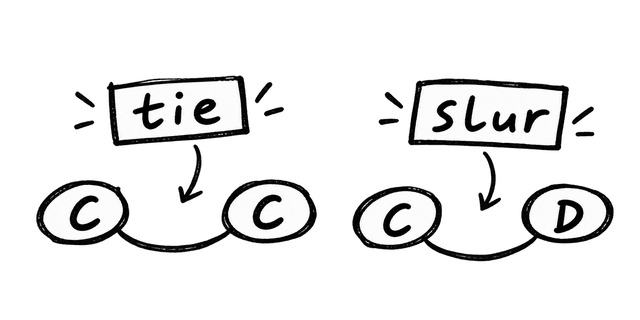
Students compare ties and slurs to learn why two similar curved markings serve different musical functions. Through visual sorting, teacher demonstrations, error detection, and simple gestures, students learn that a tie connects notes of the same pitch into one continuous duration, while a slur groups different pitches that should be performed smoothly.
Procedures
- 1
Compare the two markings. Show one example of two notes of the same pitch connected by a curved line and one example of two or more different pitches under a curved line. Ask what looks the same and what is different. Explain: a tie connects notes of the same pitch and combines their durations into one continuous sound without a second attack; a slur connects different pitches and indicates that they should be performed smoothly. Establish the quick check: same pitch - think tie; different pitches under one curved line - think slur.
- 2
Tie or Slur? Quick Sort. Show short notation cards one at a time. Students sort each example as Tie or Slur and give a reason, such as “It is a tie because the notes are the same pitch” or “It is a slur because the pitches are different and should be connected smoothly.” Use clear examples first, then vary the number and direction of notes under a slur.
- 3
Hear the Difference. The teacher demonstrates at the piano. For a tie, play the first note once and sustain it through the combined written duration; ask whether the pitch changed and whether a second attack was heard. For a slur, play a short group of different pitches smoothly; ask whether the pitch changed and whether the notes were connected. Summarize: tie = one sustained pitch; slur = different pitches smoothly connected.
- 4
Identify ties and slurs in short singing examples.
Prepare three short vocal examples, each containing both ties and slurs, and divide the class into three groups. Assign one example to each group. Before singing, students work together to identify which curved lines are ties and which are slurs. They discuss which note should not be re-articulated in a tie and which notes should be sung smoothly under a slur. Each group reaches an agreement before preparing its example for performance.
- 5
Sing and check the musical result.
Have the three groups perform their examples one at a time, demonstrating the difference between ties and slurs in actual singing. For a tie, the second written note is not re-articulated; the original sound continues through its value. Under a slur, the different pitches are still sung individually but connected smoothly. After each performance, briefly ask the class to listen and check: Was the tied note sustained correctly? Were the slurred notes sung smoothly? Conclude by reviewing the essential difference between the two markings.
Activity Preparation
1. Materials
a. A set of short notation cards showing clear examples of ties and slurs. Include same-pitch pairs for ties and two- or three-note groups of different pitches for slurs.
b. A whiteboard, document camera, projector, or magnetic surface for displaying examples to the whole class.
c. One piano or keyboard for teacher demonstrations; students do not need individual instruments.
2. Prior Knowledge
a. Students should already understand the basic concept of a tie: it connects notes of the same pitch, combines their written durations, and does not re-articulate the second note.
b. Students should be able to recognize whether written notes represent the same pitch or different pitches.
c. Familiarity with legato is helpful. If students have not formally learned the term, briefly explain that a slur indicates that different notes should be connected smoothly.
Activity Sources
- Source Type:
- MAPS Original
MAPS teaching activities may come from a variety of sources, including original contributions by the MAPS team, online resources, published materials, activities learned from teachers, activities shared by colleagues, traditional teaching practices, and other sources. When a source can be reasonably identified, we make every effort to acknowledge it on the relevant activity page or in the accompanying reference information.
Some content may be organized, translated, structured, or adapted by the MAPS team for specific teaching contexts. Such editorial or instructional adaptation does not mean that MAPS claims ownership of the underlying third-party material. Rights to third-party content remain with the original authors, publishers, or other lawful rights holders.
If you are an author, copyright holder, or authorized representative and have questions or concerns regarding the source, attribution, or use of any content, please contact us:
Email: musicactivityps@gmail.com
Tie or Slur?
Summary
Students compare ties and slurs to learn why two similar curved markings serve different musical functions. Through visual sorting, teacher demonstrations, error detection, and simple gestures, students learn that a tie connects notes of the same pitch into one continuous duration, while a slur groups different pitches that should be performed smoothly.
Procedures
- 1
Compare the two markings. Show one example of two notes of the same pitch connected by a curved line and one example of two or more different pitches under a curved line. Ask what looks the same and what is different. Explain: a tie connects notes of the same pitch and combines their durations into one continuous sound without a second attack; a slur connects different pitches and indicates that they should be performed smoothly. Establish the quick check: same pitch - think tie; different pitches under one curved line - think slur.
- 2
Tie or Slur? Quick Sort. Show short notation cards one at a time. Students sort each example as Tie or Slur and give a reason, such as “It is a tie because the notes are the same pitch” or “It is a slur because the pitches are different and should be connected smoothly.” Use clear examples first, then vary the number and direction of notes under a slur.
- 3
Hear the Difference. The teacher demonstrates at the piano. For a tie, play the first note once and sustain it through the combined written duration; ask whether the pitch changed and whether a second attack was heard. For a slur, play a short group of different pitches smoothly; ask whether the pitch changed and whether the notes were connected. Summarize: tie = one sustained pitch; slur = different pitches smoothly connected.
- 4
Identify ties and slurs in short singing examples.
Prepare three short vocal examples, each containing both ties and slurs, and divide the class into three groups. Assign one example to each group. Before singing, students work together to identify which curved lines are ties and which are slurs. They discuss which note should not be re-articulated in a tie and which notes should be sung smoothly under a slur. Each group reaches an agreement before preparing its example for performance.
- 5
Sing and check the musical result.
Have the three groups perform their examples one at a time, demonstrating the difference between ties and slurs in actual singing. For a tie, the second written note is not re-articulated; the original sound continues through its value. Under a slur, the different pitches are still sung individually but connected smoothly. After each performance, briefly ask the class to listen and check: Was the tied note sustained correctly? Were the slurred notes sung smoothly? Conclude by reviewing the essential difference between the two markings.
Activity Preparation
1. Materials
a. A set of short notation cards showing clear examples of ties and slurs. Include same-pitch pairs for ties and two- or three-note groups of different pitches for slurs.
b. A whiteboard, document camera, projector, or magnetic surface for displaying examples to the whole class.
c. One piano or keyboard for teacher demonstrations; students do not need individual instruments.
2. Prior Knowledge
a. Students should already understand the basic concept of a tie: it connects notes of the same pitch, combines their written durations, and does not re-articulate the second note.
b. Students should be able to recognize whether written notes represent the same pitch or different pitches.
c. Familiarity with legato is helpful. If students have not formally learned the term, briefly explain that a slur indicates that different notes should be connected smoothly.
Activity Sources
- Source Type:
- MAPS Original
MAPS teaching activities may come from a variety of sources, including original contributions by the MAPS team, online resources, published materials, activities learned from teachers, activities shared by colleagues, traditional teaching practices, and other sources. When a source can be reasonably identified, we make every effort to acknowledge it on the relevant activity page or in the accompanying reference information.
Some content may be organized, translated, structured, or adapted by the MAPS team for specific teaching contexts. Such editorial or instructional adaptation does not mean that MAPS claims ownership of the underlying third-party material. Rights to third-party content remain with the original authors, publishers, or other lawful rights holders.
If you are an author, copyright holder, or authorized representative and have questions or concerns regarding the source, attribution, or use of any content, please contact us:
Email: musicactivityps@gmail.com