MAPS
Triad Quality Cross
Summary
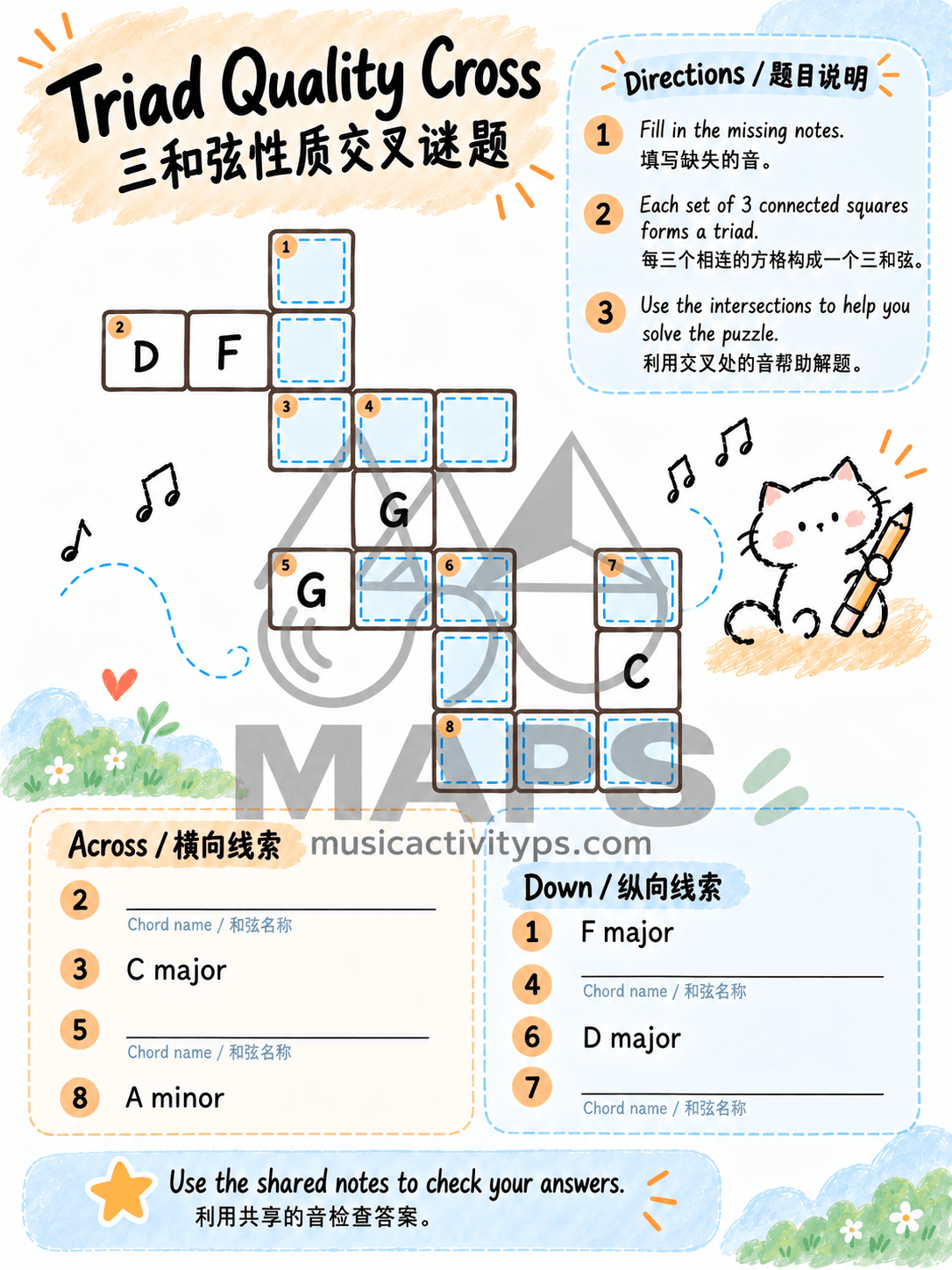
Triad Quality Cross is a printable activity that helps students build and identify major and minor triads through a crossword-style puzzle. Students fill in missing notes by using their knowledge of triad structure and the shared notes at each intersection. Some clues provide chord names, while others provide partial notes, encouraging students to apply their understanding flexibly. This activity can be used for individual practice, partner work, or a quick review in class piano and basic music theory.
Procedures
- 1
Review the Task. Explain that each set of three connected squares represents a major or minor triad.
- 2
Complete the Cross. Students use the given chord names or notes to fill in the missing notes. Encourage them to use shared notes at the intersections as clues.
- 3
Identify the Chords. For clues without chord names, students identify the root and determine whether each triad is major or minor.
- 4
Check the Answers. Review the completed puzzle and discuss how intersecting notes help verify the answers.
Variations
Advanced Challenge: Remove additional given notes or introduce triads with more sharps and flats.
Activity Preparation
1. Printable student worksheet.
2. Pencil or writing utensil.
3. Optional: piano or keyboard for checking selected interval answers.
Activity Sources
- Source Type:
- MAPS Original
- Source:
- Original activity and puzzle format developed by MAPS (Music Activity & Pedagogical Solutions).
MAPS teaching activities may come from a variety of sources, including original contributions by the MAPS team, online resources, published materials, activities learned from teachers, activities shared by colleagues, traditional teaching practices, and other sources. When a source can be reasonably identified, we make every effort to acknowledge it on the relevant activity page or in the accompanying reference information.
Some content may be organized, translated, structured, or adapted by the MAPS team for specific teaching contexts. Such editorial or instructional adaptation does not mean that MAPS claims ownership of the underlying third-party material. Rights to third-party content remain with the original authors, publishers, or other lawful rights holders.
If you are an author, copyright holder, or authorized representative and have questions or concerns regarding the source, attribution, or use of any content, please contact us:
Email: musicactivityps@gmail.com
Triad Quality Cross
Summary
Triad Quality Cross is a printable activity that helps students build and identify major and minor triads through a crossword-style puzzle. Students fill in missing notes by using their knowledge of triad structure and the shared notes at each intersection. Some clues provide chord names, while others provide partial notes, encouraging students to apply their understanding flexibly. This activity can be used for individual practice, partner work, or a quick review in class piano and basic music theory.
Procedures
- 1
Review the Task. Explain that each set of three connected squares represents a major or minor triad.
- 2
Complete the Cross. Students use the given chord names or notes to fill in the missing notes. Encourage them to use shared notes at the intersections as clues.
- 3
Identify the Chords. For clues without chord names, students identify the root and determine whether each triad is major or minor.
- 4
Check the Answers. Review the completed puzzle and discuss how intersecting notes help verify the answers.
Variations
Advanced Challenge: Remove additional given notes or introduce triads with more sharps and flats.
Activity Preparation
1. Printable student worksheet.
2. Pencil or writing utensil.
3. Optional: piano or keyboard for checking selected interval answers.
Activity Sources
- Source Type:
- MAPS Original
- Source:
- Original activity and puzzle format developed by MAPS (Music Activity & Pedagogical Solutions).
MAPS teaching activities may come from a variety of sources, including original contributions by the MAPS team, online resources, published materials, activities learned from teachers, activities shared by colleagues, traditional teaching practices, and other sources. When a source can be reasonably identified, we make every effort to acknowledge it on the relevant activity page or in the accompanying reference information.
Some content may be organized, translated, structured, or adapted by the MAPS team for specific teaching contexts. Such editorial or instructional adaptation does not mean that MAPS claims ownership of the underlying third-party material. Rights to third-party content remain with the original authors, publishers, or other lawful rights holders.
If you are an author, copyright holder, or authorized representative and have questions or concerns regarding the source, attribution, or use of any content, please contact us:
Email: musicactivityps@gmail.com