MAPS
Using Our Voices to Improvise
Summary
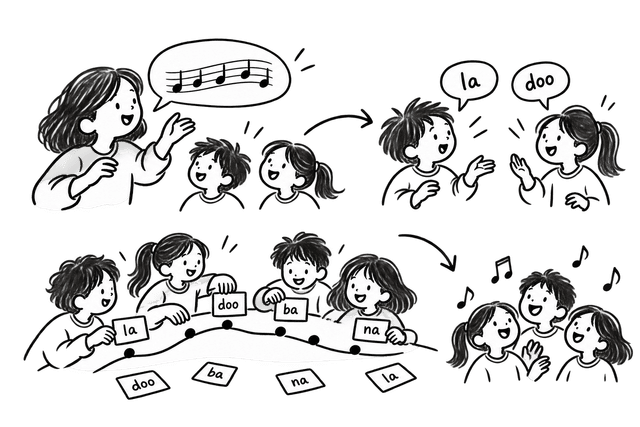
Students warm up with a familiar song, explore scat singing through call and response, create a class collection of nonsense syllables, and place those syllables along the melodic contour of the song. They then sing the melody with the selected syllables and rearrange them to hear how different choices change the result.
Procedures
- 1
Sing a familiar song as a class to warm up the voice, and have students trace the melodic contour in the air with their fingers.
- 2
Lead a brief call-and-response using scat syllables such as “shoo,” “bop,” “doo,” “woo,” “la,” and “fa.”
- 3
Invite students to take turns leading short scat patterns for the class to echo.
- 4
Explain that scat singing uses nonsense syllables in place of lyrics; in jazz, singers may use these syllables to imitate the flexibility and sound of instruments.
- 5
As a class, brainstorm nonsense words or scat syllables and write each one on a sticky note or index card.
- 6
On chart paper, draw a line showing the melodic contour of the warm-up song and add blank spaces along the line for the syllable cards. This chart may also be prepared before class.
- 7
Have students choose syllables from the class collection and place them in the blank spaces along the contour.
- 8
Sing the melody together using the selected scat syllables instead of the original lyrics.
- 9
Change the order of the syllables and sing the melody again, listening for how the new sequence changes the result.
Variations
1. Simplify: Provide three or four prepared scat syllables and let students choose and arrange them instead of inventing their own.
2. Extend: Draw staff lines across the melodic-contour chart and compare the locations of the syllable boxes to lines, spaces, and the distance between pitches.
3. Listening extension: Listen to a short example of scat singing and identify the kinds of nonsense syllables and vocal sounds used.
4. Creative extension: Once students are secure with the familiar melody, allow small rhythmic or melodic changes while keeping the overall contour recognizable.
Reference Video Link
Activity Preparation
1. Familiar song;
2. sticky notes or index cards;
3. chart paper;
4. markers
5. Prepare or be ready to draw the melodic contour of the chosen song.
Activity Sources
- Source Type:
- Website / Online resource
- Source:
- Carnegie Hall, Music Educators Toolbox — Grade 2: “Using Our Voices to Improvise.”
MAPS teaching activities may come from a variety of sources, including original contributions by the MAPS team, online resources, published materials, activities learned from teachers, activities shared by colleagues, traditional teaching practices, and other sources. When a source can be reasonably identified, we make every effort to acknowledge it on the relevant activity page or in the accompanying reference information.
Some content may be organized, translated, structured, or adapted by the MAPS team for specific teaching contexts. Such editorial or instructional adaptation does not mean that MAPS claims ownership of the underlying third-party material. Rights to third-party content remain with the original authors, publishers, or other lawful rights holders.
If you are an author, copyright holder, or authorized representative and have questions or concerns regarding the source, attribution, or use of any content, please contact us:
Email: musicactivityps@gmail.com
Using Our Voices to Improvise
Summary
Students warm up with a familiar song, explore scat singing through call and response, create a class collection of nonsense syllables, and place those syllables along the melodic contour of the song. They then sing the melody with the selected syllables and rearrange them to hear how different choices change the result.
Procedures
- 1
Sing a familiar song as a class to warm up the voice, and have students trace the melodic contour in the air with their fingers.
- 2
Lead a brief call-and-response using scat syllables such as “shoo,” “bop,” “doo,” “woo,” “la,” and “fa.”
- 3
Invite students to take turns leading short scat patterns for the class to echo.
- 4
Explain that scat singing uses nonsense syllables in place of lyrics; in jazz, singers may use these syllables to imitate the flexibility and sound of instruments.
- 5
As a class, brainstorm nonsense words or scat syllables and write each one on a sticky note or index card.
- 6
On chart paper, draw a line showing the melodic contour of the warm-up song and add blank spaces along the line for the syllable cards. This chart may also be prepared before class.
- 7
Have students choose syllables from the class collection and place them in the blank spaces along the contour.
- 8
Sing the melody together using the selected scat syllables instead of the original lyrics.
- 9
Change the order of the syllables and sing the melody again, listening for how the new sequence changes the result.
Variations
1. Simplify: Provide three or four prepared scat syllables and let students choose and arrange them instead of inventing their own.
2. Extend: Draw staff lines across the melodic-contour chart and compare the locations of the syllable boxes to lines, spaces, and the distance between pitches.
3. Listening extension: Listen to a short example of scat singing and identify the kinds of nonsense syllables and vocal sounds used.
4. Creative extension: Once students are secure with the familiar melody, allow small rhythmic or melodic changes while keeping the overall contour recognizable.
Reference Video Link
Activity Preparation
1. Familiar song;
2. sticky notes or index cards;
3. chart paper;
4. markers
5. Prepare or be ready to draw the melodic contour of the chosen song.
Activity Sources
- Source Type:
- Website / Online resource
- Source:
- Carnegie Hall, Music Educators Toolbox — Grade 2: “Using Our Voices to Improvise.”
MAPS teaching activities may come from a variety of sources, including original contributions by the MAPS team, online resources, published materials, activities learned from teachers, activities shared by colleagues, traditional teaching practices, and other sources. When a source can be reasonably identified, we make every effort to acknowledge it on the relevant activity page or in the accompanying reference information.
Some content may be organized, translated, structured, or adapted by the MAPS team for specific teaching contexts. Such editorial or instructional adaptation does not mean that MAPS claims ownership of the underlying third-party material. Rights to third-party content remain with the original authors, publishers, or other lawful rights holders.
If you are an author, copyright holder, or authorized representative and have questions or concerns regarding the source, attribution, or use of any content, please contact us:
Email: musicactivityps@gmail.com