 MAPS
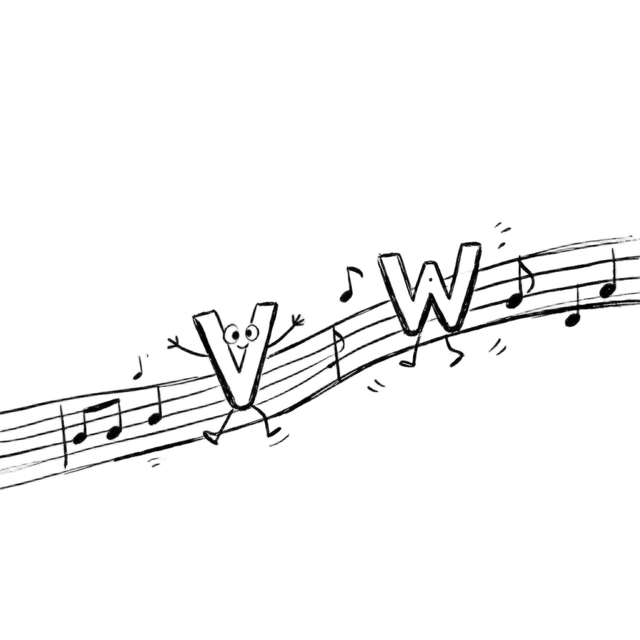
“V” and “W” in Scales
Summary
Students identify the groups of two and three black keys on the keyboard and associate them with the shapes “V” and “W.” Fingers 2–3 form the “V” on a group of two black keys, while fingers 2–3–4 form the “W” on a group of three black keys. Students first play these groups together using blocked playing, then add the corresponding white-key notes to discover and practice the fingering patterns of B major, D-flat major, and G-flat major scales.
Procedures
- 1
Identify the “V” and “W” shapes.
Ask students to locate groups of two and three black keys on the keyboard. Place fingers 2 and 3 on a group of two black keys to create a “V” shape, and fingers 2, 3, and 4 on a group of three black keys to create a “W” shape.
- 2
Introduce blocked playing.
Explain that in blocked playing, the notes within each “V” or “W” group are played simultaneously rather than one at a time. Have students play different “V” and “W” groups around the keyboard using this technique.
- 3
Explore the B major pattern.
Begin with B major. Ask students to locate the two white-key notes, B and E. These notes are played primarily with finger 1, except for the starting B in the left hand, which uses finger 4, and the top B in the right hand, which uses finger 5. Guide students to observe how the remaining notes fall naturally into the “V” and “W” black-key groups. Then ask students to use the same idea to discover the patterns for D-flat major and G-flat major.
- 4
Play the scale in blocked groups.
Have students first play B major as grouped shapes: B – “V” – E – “W” – B. Then apply the same grouped approach to D-flat major and G-flat major.
- 5
Move from blocked patterns to regular scale playing.
Students first practice the blocked patterns with one hand, then with both hands together. Once the fingering pattern feels secure, they release the blocked shapes and play the scale normally, one note at a time.
Variations
After students become comfortable with the “V” and “W” patterns in B major, D-flat major, and G-flat major, encourage them to explore other major or minor scales. Ask students to identify recurring black-key and white-key groups, fingering patterns, and hand shapes, and determine whether similar visual or kinesthetic patterns can help them organize and remember each scale.
Activity Preparation
Piano or keyboard
Activity Sources
- Source Type:
- Learned from a teacher
- Source:
- Group Piano Teaching Assistant Orientation at Florida State University
MAPS teaching activities may come from a variety of sources, including original contributions by the MAPS team, online resources, published materials, activities learned from teachers, activities shared by colleagues, traditional teaching practices, and other sources. When a source can be reasonably identified, we make every effort to acknowledge it on the relevant activity page or in the accompanying reference information.
Some content may be organized, translated, structured, or adapted by the MAPS team for specific teaching contexts. Such editorial or instructional adaptation does not mean that MAPS claims ownership of the underlying third-party material. Rights to third-party content remain with the original authors, publishers, or other lawful rights holders.
If you are an author, copyright holder, or authorized representative and have questions or concerns regarding the source, attribution, or use of any content, please contact us:
Email: musicactivityps@gmail.com
“V” and “W” in Scales
Summary
Students identify the groups of two and three black keys on the keyboard and associate them with the shapes “V” and “W.” Fingers 2–3 form the “V” on a group of two black keys, while fingers 2–3–4 form the “W” on a group of three black keys. Students first play these groups together using blocked playing, then add the corresponding white-key notes to discover and practice the fingering patterns of B major, D-flat major, and G-flat major scales.
Procedures
- 1
Identify the “V” and “W” shapes.
Ask students to locate groups of two and three black keys on the keyboard. Place fingers 2 and 3 on a group of two black keys to create a “V” shape, and fingers 2, 3, and 4 on a group of three black keys to create a “W” shape.
- 2
Introduce blocked playing.
Explain that in blocked playing, the notes within each “V” or “W” group are played simultaneously rather than one at a time. Have students play different “V” and “W” groups around the keyboard using this technique.
- 3
Explore the B major pattern.
Begin with B major. Ask students to locate the two white-key notes, B and E. These notes are played primarily with finger 1, except for the starting B in the left hand, which uses finger 4, and the top B in the right hand, which uses finger 5. Guide students to observe how the remaining notes fall naturally into the “V” and “W” black-key groups. Then ask students to use the same idea to discover the patterns for D-flat major and G-flat major.
- 4
Play the scale in blocked groups.
Have students first play B major as grouped shapes: B – “V” – E – “W” – B. Then apply the same grouped approach to D-flat major and G-flat major.
- 5
Move from blocked patterns to regular scale playing.
Students first practice the blocked patterns with one hand, then with both hands together. Once the fingering pattern feels secure, they release the blocked shapes and play the scale normally, one note at a time.
Variations
After students become comfortable with the “V” and “W” patterns in B major, D-flat major, and G-flat major, encourage them to explore other major or minor scales. Ask students to identify recurring black-key and white-key groups, fingering patterns, and hand shapes, and determine whether similar visual or kinesthetic patterns can help them organize and remember each scale.
Activity Preparation
Piano or keyboard
Activity Sources
- Source Type:
- Learned from a teacher
- Source:
- Group Piano Teaching Assistant Orientation at Florida State University
MAPS teaching activities may come from a variety of sources, including original contributions by the MAPS team, online resources, published materials, activities learned from teachers, activities shared by colleagues, traditional teaching practices, and other sources. When a source can be reasonably identified, we make every effort to acknowledge it on the relevant activity page or in the accompanying reference information.
Some content may be organized, translated, structured, or adapted by the MAPS team for specific teaching contexts. Such editorial or instructional adaptation does not mean that MAPS claims ownership of the underlying third-party material. Rights to third-party content remain with the original authors, publishers, or other lawful rights holders.
If you are an author, copyright holder, or authorized representative and have questions or concerns regarding the source, attribution, or use of any content, please contact us:
Email: musicactivityps@gmail.com