MAPS
Visualizing Chord Connections
Summary
Students visualize chord connections by mapping chord shapes, fingering, and voice movement within a progression. After identifying common tones and half- or whole-step motion between chords, students use the visual map to play the progression and transfer the same movement patterns to other keys.
Procedures
- 1
Play the chord progression: Have students first play the chord progression in C major from notation: I–IV⁶₄–I–V⁶₅–I.
- 2
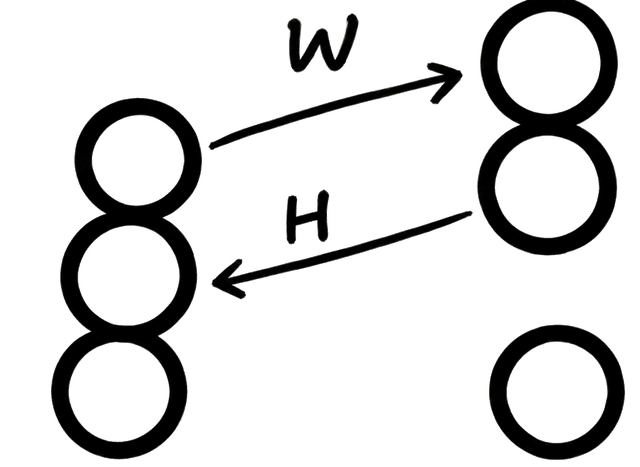
Draw the chord shapes: On the board, draw a simple visual shape for each chord, showing the relative position of the notes without using traditional notation.
- 3
Add the fingering: Guide students in identifying and writing the right-hand fingering for each chord, followed by the left-hand fingering.
- 4
Trace the note movement: Compare each chord with the one that follows. For each voice, identify whether the note stays the same, moves by a half step, or moves by a whole step. Mark these relationships directly on the visual diagram.
- 5
Play from the visual map: Remove or set aside the notation and ask students to play the C-major progression using only the chord-shape diagram, fingering, and interval-movement cues.
- 6
Transfer to new keys: Once students can play the progression securely in C major, ask them to reproduce the same chord shapes and movement patterns in G major, D major, A major, and other keys.
Activity Preparation
1. Piano or keyboard
2. A prepared visual map of I–IV6/4–I–V6/5–I in a familiar key (for example, C major), including both right- and left-hand fingering
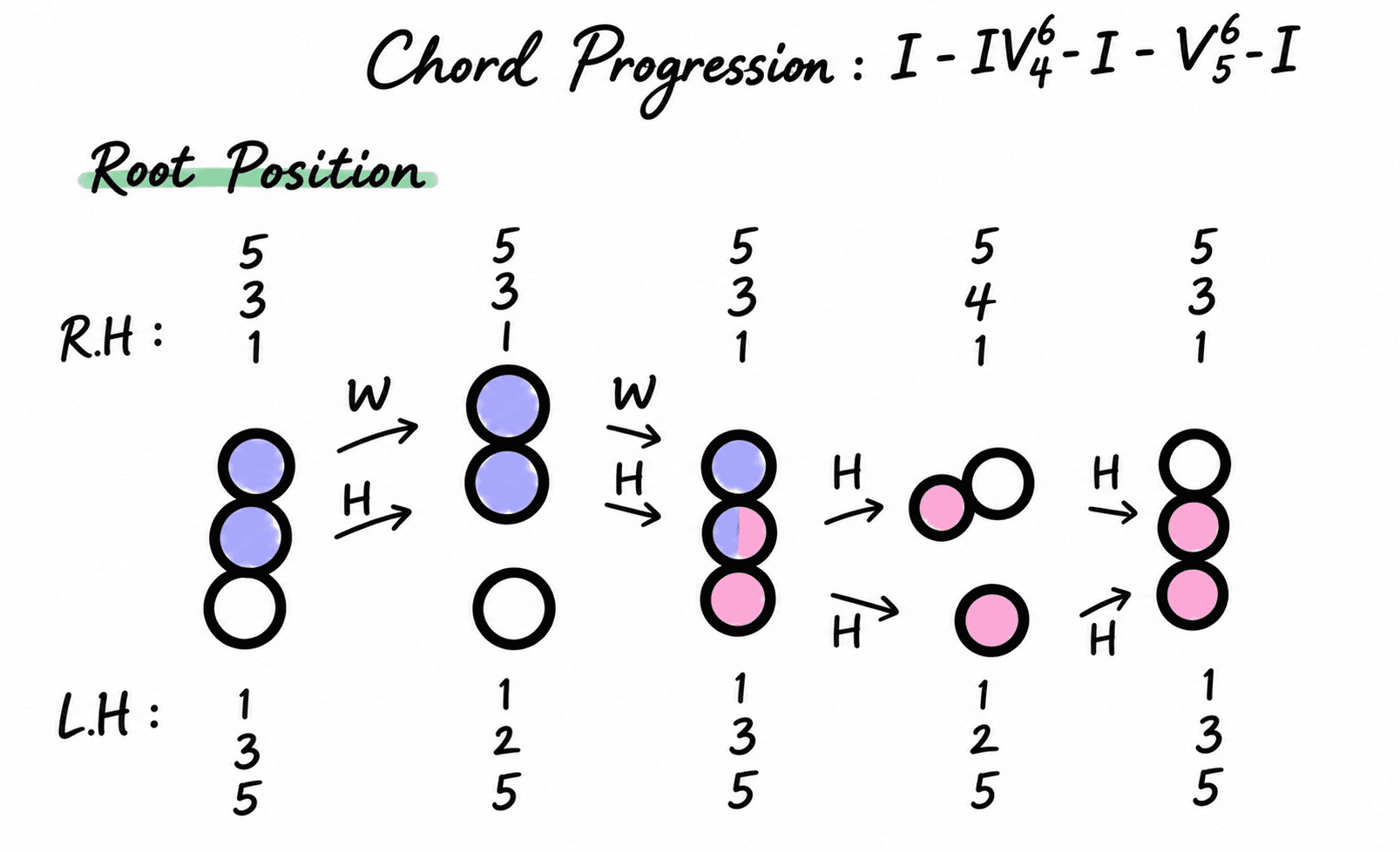
3. Whiteboard and colored markers, or a projected/printed copy of the visual map for students to see
4. Students should be able to play basic blocked triads and have introductory experience with inversions and V6/5
Activity Sources
- Source Type:
- Shared by colleague
MAPS teaching activities may come from a variety of sources, including original contributions by the MAPS team, online resources, published materials, activities learned from teachers, activities shared by colleagues, traditional teaching practices, and other sources. When a source can be reasonably identified, we make every effort to acknowledge it on the relevant activity page or in the accompanying reference information.
Some content may be organized, translated, structured, or adapted by the MAPS team for specific teaching contexts. Such editorial or instructional adaptation does not mean that MAPS claims ownership of the underlying third-party material. Rights to third-party content remain with the original authors, publishers, or other lawful rights holders.
If you are an author, copyright holder, or authorized representative and have questions or concerns regarding the source, attribution, or use of any content, please contact us:
Email: musicactivityps@gmail.com
Visualizing Chord Connections
Summary
Students visualize chord connections by mapping chord shapes, fingering, and voice movement within a progression. After identifying common tones and half- or whole-step motion between chords, students use the visual map to play the progression and transfer the same movement patterns to other keys.
Procedures
- 1
Play the chord progression: Have students first play the chord progression in C major from notation: I–IV⁶₄–I–V⁶₅–I.
- 2
Draw the chord shapes: On the board, draw a simple visual shape for each chord, showing the relative position of the notes without using traditional notation.
- 3
Add the fingering: Guide students in identifying and writing the right-hand fingering for each chord, followed by the left-hand fingering.
- 4
Trace the note movement: Compare each chord with the one that follows. For each voice, identify whether the note stays the same, moves by a half step, or moves by a whole step. Mark these relationships directly on the visual diagram.
- 5
Play from the visual map: Remove or set aside the notation and ask students to play the C-major progression using only the chord-shape diagram, fingering, and interval-movement cues.
- 6
Transfer to new keys: Once students can play the progression securely in C major, ask them to reproduce the same chord shapes and movement patterns in G major, D major, A major, and other keys.
Activity Preparation
1. Piano or keyboard
2. A prepared visual map of I–IV6/4–I–V6/5–I in a familiar key (for example, C major), including both right- and left-hand fingering
3. Whiteboard and colored markers, or a projected/printed copy of the visual map for students to see
4. Students should be able to play basic blocked triads and have introductory experience with inversions and V6/5
Activity Sources
- Source Type:
- Shared by colleague
MAPS teaching activities may come from a variety of sources, including original contributions by the MAPS team, online resources, published materials, activities learned from teachers, activities shared by colleagues, traditional teaching practices, and other sources. When a source can be reasonably identified, we make every effort to acknowledge it on the relevant activity page or in the accompanying reference information.
Some content may be organized, translated, structured, or adapted by the MAPS team for specific teaching contexts. Such editorial or instructional adaptation does not mean that MAPS claims ownership of the underlying third-party material. Rights to third-party content remain with the original authors, publishers, or other lawful rights holders.
If you are an author, copyright holder, or authorized representative and have questions or concerns regarding the source, attribution, or use of any content, please contact us:
Email: musicactivityps@gmail.com