 MAPS
What Makes Your Arm Move?
Summary
Students explore how the arm moves by gently touching and observing different areas of the body while making simple arm movements. Through this process, they notice how the clavicle, scapula, and upper arm work together and develop greater awareness of how the body supports coordinated movement.
Procedures
- 1
Find where the arm begins.
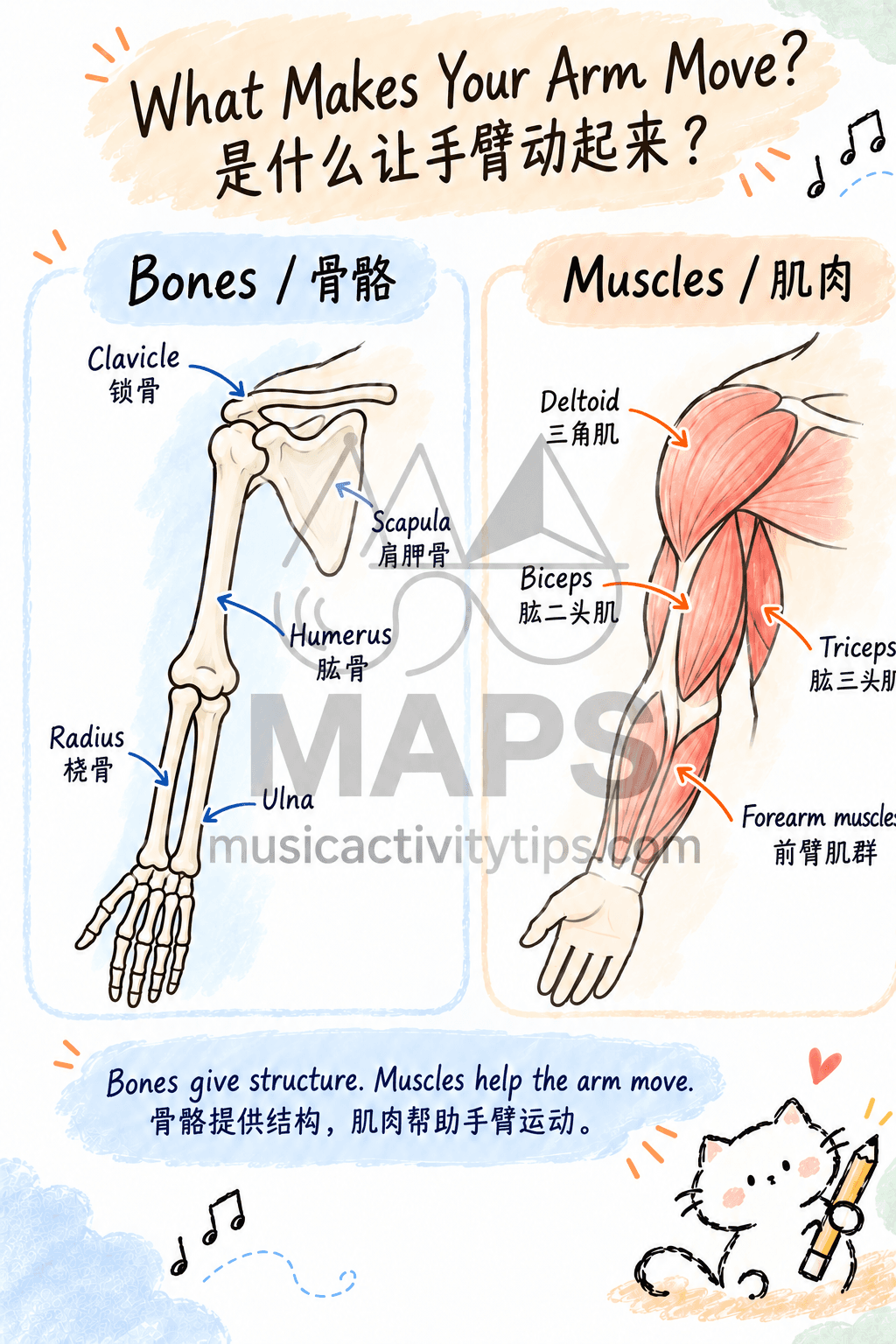
Ask students to point to where they think the arm begins and feel around the shoulder area. Use the poster to introduce the clavicle, scapula, and humerus, and help students notice that arm movement does not happen only below the shoulder joint; the clavicle and scapula are also part of the upper-limb movement system.
- 2
Feel how the clavicle and scapula participate in movement.
Ask students to place one hand lightly near the opposite scapula while slowly moving the other arm forward, out to the side, and back down. Remind them not to shrug or squeeze the shoulder blades together, but simply observe what happens naturally. Help students notice that as the arm changes direction and height, the scapula and clavicle also adjust their positions.
- 3
Observe how the shoulder and arm work together at the piano.
Ask students to move one hand slowly from the middle register to a distant higher or lower register. Have them notice whether they reach, twist the wrist, or lean noticeably to the side. Then repeat the movement without fixing the shoulder, allowing the scapula and shoulder girdle to move naturally with the arm. Compare the two attempts and notice how larger movements can feel smoother when the whole arm participates.
- 4
Feel how different muscles participate.
Use the poster to explore several simple movements: a. Touch the deltoid while raising the arm out to the side. b. Touch the biceps while bending the elbow. c. Touch the triceps while straightening the elbow. d. Touch the forearm muscles while moving the wrist and fingers. After each movement, relax the arm and compare the feeling of muscle engagement and release. Help students understand that different movements require different muscles and different amounts of effort.
- 5
Compare different piano movements.
Ask students to try repeating one note, playing several neighboring notes, moving to a distant register, and playing a familiar short phrase. After each task, ask: “Where did most of the movement come from?” and “Did any part use more effort than necessary?” Guide students to notice that different musical tasks require different amounts and combinations of body movement.
- 6
Summarize: use the effort you need.
Ask students to reflect on the bones and muscles they felt during the activity. Emphasize that efficient piano movement does not mean using no effort or holding one fixed posture. Instead, the body should coordinate according to the task and release effort that is no longer needed.
Activity Preparation
1. Piano or keyboard with enough space for comfortable arm movement.
2. “What Makes Your Arm Move?” bones-and-muscles poster.
Activity Sources
- Source Type:
- Traditional activity
- Adaptation Notes:
- This activity is informed by principles of Body Mapping and focuses on body awareness, coordinated movement, weight and support, and musical application.
MAPS teaching activities may come from a variety of sources, including original contributions by the MAPS team, online resources, published materials, activities learned from teachers, activities shared by colleagues, traditional teaching practices, and other sources. When a source can be reasonably identified, we make every effort to acknowledge it on the relevant activity page or in the accompanying reference information.
Some content may be organized, translated, structured, or adapted by the MAPS team for specific teaching contexts. Such editorial or instructional adaptation does not mean that MAPS claims ownership of the underlying third-party material. Rights to third-party content remain with the original authors, publishers, or other lawful rights holders.
If you are an author, copyright holder, or authorized representative and have questions or concerns regarding the source, attribution, or use of any content, please contact us:
Email: musicactivityps@gmail.com
What Makes Your Arm Move?
Summary
Students explore how the arm moves by gently touching and observing different areas of the body while making simple arm movements. Through this process, they notice how the clavicle, scapula, and upper arm work together and develop greater awareness of how the body supports coordinated movement.
Procedures
- 1
Find where the arm begins.
Ask students to point to where they think the arm begins and feel around the shoulder area. Use the poster to introduce the clavicle, scapula, and humerus, and help students notice that arm movement does not happen only below the shoulder joint; the clavicle and scapula are also part of the upper-limb movement system.
- 2
Feel how the clavicle and scapula participate in movement.
Ask students to place one hand lightly near the opposite scapula while slowly moving the other arm forward, out to the side, and back down. Remind them not to shrug or squeeze the shoulder blades together, but simply observe what happens naturally. Help students notice that as the arm changes direction and height, the scapula and clavicle also adjust their positions.
- 3
Observe how the shoulder and arm work together at the piano.
Ask students to move one hand slowly from the middle register to a distant higher or lower register. Have them notice whether they reach, twist the wrist, or lean noticeably to the side. Then repeat the movement without fixing the shoulder, allowing the scapula and shoulder girdle to move naturally with the arm. Compare the two attempts and notice how larger movements can feel smoother when the whole arm participates.
- 4
Feel how different muscles participate.
Use the poster to explore several simple movements: a. Touch the deltoid while raising the arm out to the side. b. Touch the biceps while bending the elbow. c. Touch the triceps while straightening the elbow. d. Touch the forearm muscles while moving the wrist and fingers. After each movement, relax the arm and compare the feeling of muscle engagement and release. Help students understand that different movements require different muscles and different amounts of effort.
- 5
Compare different piano movements.
Ask students to try repeating one note, playing several neighboring notes, moving to a distant register, and playing a familiar short phrase. After each task, ask: “Where did most of the movement come from?” and “Did any part use more effort than necessary?” Guide students to notice that different musical tasks require different amounts and combinations of body movement.
- 6
Summarize: use the effort you need.
Ask students to reflect on the bones and muscles they felt during the activity. Emphasize that efficient piano movement does not mean using no effort or holding one fixed posture. Instead, the body should coordinate according to the task and release effort that is no longer needed.
Activity Preparation
1. Piano or keyboard with enough space for comfortable arm movement.
2. “What Makes Your Arm Move?” bones-and-muscles poster.
Activity Sources
- Source Type:
- Traditional activity
- Adaptation Notes:
- This activity is informed by principles of Body Mapping and focuses on body awareness, coordinated movement, weight and support, and musical application.
MAPS teaching activities may come from a variety of sources, including original contributions by the MAPS team, online resources, published materials, activities learned from teachers, activities shared by colleagues, traditional teaching practices, and other sources. When a source can be reasonably identified, we make every effort to acknowledge it on the relevant activity page or in the accompanying reference information.
Some content may be organized, translated, structured, or adapted by the MAPS team for specific teaching contexts. Such editorial or instructional adaptation does not mean that MAPS claims ownership of the underlying third-party material. Rights to third-party content remain with the original authors, publishers, or other lawful rights holders.
If you are an author, copyright holder, or authorized representative and have questions or concerns regarding the source, attribution, or use of any content, please contact us:
Email: musicactivityps@gmail.com