MAPS
Where Did the Beat Go?
Summary
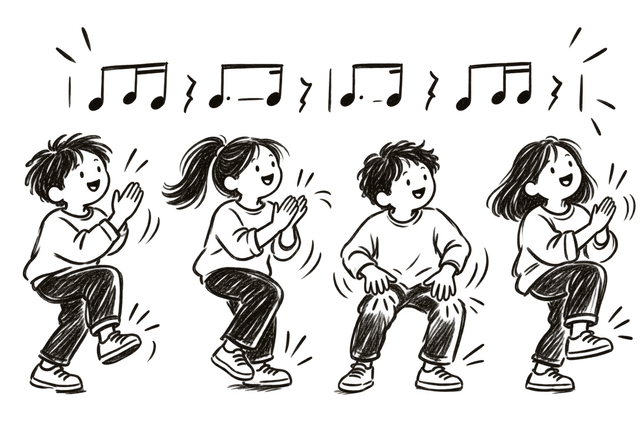
Students discover syncopation by maintaining a steady beat while listening to a rhythm that begins between beats and sustains across the next beat. They map sound onsets and durations onto a four-slot grid, translate the grid into eighth- and quarter-note notation, and read and perform the resulting rhythm.
Procedures
- 1
Establish a steady beat. Play or clap a moderate, even pulse. Students step once per beat and count aloud “1, 2” repeatedly; then keep stepping without the teacher’s counting.
- 2
Hear the contrast. While students continue stepping, perform two quarter notes (on beats 1 and 2); repeat with an eighth–quarter–eighth pattern (onsets on “1,” “&,” and “&” after beat 2). Sustain the middle quarter note across beat 2. Ask when the second sound begins in relation to the footsteps.
- 3
Map the rhythm. Display four equal slots labeled “1 & 2 &” (each slot = one eighth note). Perform both patterns again. Students place a dot where each note begins and draw an arrow into any following slot where that sound continues. Compare the two maps.
- 4
Discover the notation. For the syncopated pattern, guide students to identify durations of one, two, and one slots. Replace these with an eighth note, quarter note, and eighth note, respectively. Show the same notation as a two-beat rhythmic figure and locate the middle note crossing beat 2.
- 5
Read and perform. Without a model, students read either ♩ ♩ or ♪ ♩ ♪, step the beat, and clap each note onset. Ask them to explain which note starts between beats and continues across beat 2. Repeat with the examples in a different order.
Variations
1. Adjust the challenge: Begin with slower pulses and teacher-guided counting; gradually remove counting or increase the tempo without changing the pattern.
2. Change the response: Replace clapping with a drum, woodblock, or keyboard note while the feet continue marking the beat.
3. Extend the notation: Place ♪ ♩ ♪ within a full 4/4 measure by adding two quarter notes; ask students to maintain the four-beat meter while sight-reading.
4. Student-created patterns: In pairs, one student maintains the beat while the other makes a two-beat rhythm with eighth and quarter notes; both map, notate, perform, and discuss whether it produces syncopation.
Activity Preparation
Materials: Piano/keyboard, hand drum or clapping; board or projected four-slot grid labeled “1 & 2 &”; markers and optional rhythm cards.
Setup: Open space for stepping in place; students must be able to see the grid. Prepare two examples: ♩ ♩ and ♪ ♩ ♪.
Prior knowledge: Students can keep a steady beat, subdivide beats into eighth notes, and recognize quarter and eighth notes.
Activity Sources
- Source Type:
- MAPS Original
MAPS teaching activities may come from a variety of sources, including original contributions by the MAPS team, online resources, published materials, activities learned from teachers, activities shared by colleagues, traditional teaching practices, and other sources. When a source can be reasonably identified, we make every effort to acknowledge it on the relevant activity page or in the accompanying reference information.
Some content may be organized, translated, structured, or adapted by the MAPS team for specific teaching contexts. Such editorial or instructional adaptation does not mean that MAPS claims ownership of the underlying third-party material. Rights to third-party content remain with the original authors, publishers, or other lawful rights holders.
If you are an author, copyright holder, or authorized representative and have questions or concerns regarding the source, attribution, or use of any content, please contact us:
Email: musicactivityps@gmail.com
Where Did the Beat Go?
Summary
Students discover syncopation by maintaining a steady beat while listening to a rhythm that begins between beats and sustains across the next beat. They map sound onsets and durations onto a four-slot grid, translate the grid into eighth- and quarter-note notation, and read and perform the resulting rhythm.
Procedures
- 1
Establish a steady beat. Play or clap a moderate, even pulse. Students step once per beat and count aloud “1, 2” repeatedly; then keep stepping without the teacher’s counting.
- 2
Hear the contrast. While students continue stepping, perform two quarter notes (on beats 1 and 2); repeat with an eighth–quarter–eighth pattern (onsets on “1,” “&,” and “&” after beat 2). Sustain the middle quarter note across beat 2. Ask when the second sound begins in relation to the footsteps.
- 3
Map the rhythm. Display four equal slots labeled “1 & 2 &” (each slot = one eighth note). Perform both patterns again. Students place a dot where each note begins and draw an arrow into any following slot where that sound continues. Compare the two maps.
- 4
Discover the notation. For the syncopated pattern, guide students to identify durations of one, two, and one slots. Replace these with an eighth note, quarter note, and eighth note, respectively. Show the same notation as a two-beat rhythmic figure and locate the middle note crossing beat 2.
- 5
Read and perform. Without a model, students read either ♩ ♩ or ♪ ♩ ♪, step the beat, and clap each note onset. Ask them to explain which note starts between beats and continues across beat 2. Repeat with the examples in a different order.
Variations
1. Adjust the challenge: Begin with slower pulses and teacher-guided counting; gradually remove counting or increase the tempo without changing the pattern.
2. Change the response: Replace clapping with a drum, woodblock, or keyboard note while the feet continue marking the beat.
3. Extend the notation: Place ♪ ♩ ♪ within a full 4/4 measure by adding two quarter notes; ask students to maintain the four-beat meter while sight-reading.
4. Student-created patterns: In pairs, one student maintains the beat while the other makes a two-beat rhythm with eighth and quarter notes; both map, notate, perform, and discuss whether it produces syncopation.
Activity Preparation
Materials: Piano/keyboard, hand drum or clapping; board or projected four-slot grid labeled “1 & 2 &”; markers and optional rhythm cards.
Setup: Open space for stepping in place; students must be able to see the grid. Prepare two examples: ♩ ♩ and ♪ ♩ ♪.
Prior knowledge: Students can keep a steady beat, subdivide beats into eighth notes, and recognize quarter and eighth notes.
Activity Sources
- Source Type:
- MAPS Original
MAPS teaching activities may come from a variety of sources, including original contributions by the MAPS team, online resources, published materials, activities learned from teachers, activities shared by colleagues, traditional teaching practices, and other sources. When a source can be reasonably identified, we make every effort to acknowledge it on the relevant activity page or in the accompanying reference information.
Some content may be organized, translated, structured, or adapted by the MAPS team for specific teaching contexts. Such editorial or instructional adaptation does not mean that MAPS claims ownership of the underlying third-party material. Rights to third-party content remain with the original authors, publishers, or other lawful rights holders.
If you are an author, copyright holder, or authorized representative and have questions or concerns regarding the source, attribution, or use of any content, please contact us:
Email: musicactivityps@gmail.com